The short answer: Under 29 CFR 1910.178(l), an employer must ensure that every powered industrial truck operator is competent before that person drives, demonstrated through formal instruction, practical training, and an evaluation of the operator's performance in the workplace. The employer then certifies each operator by name, recording the dates of training and evaluation and who performed them, and re-evaluates that operator's performance at least once every three years. Prior experience does not remove the duty to train and evaluate: it only lets the employer skip repeating topics the operator has already been evaluated on and found competent to perform.
Does OSHA require forklift operators to be trained and certified?
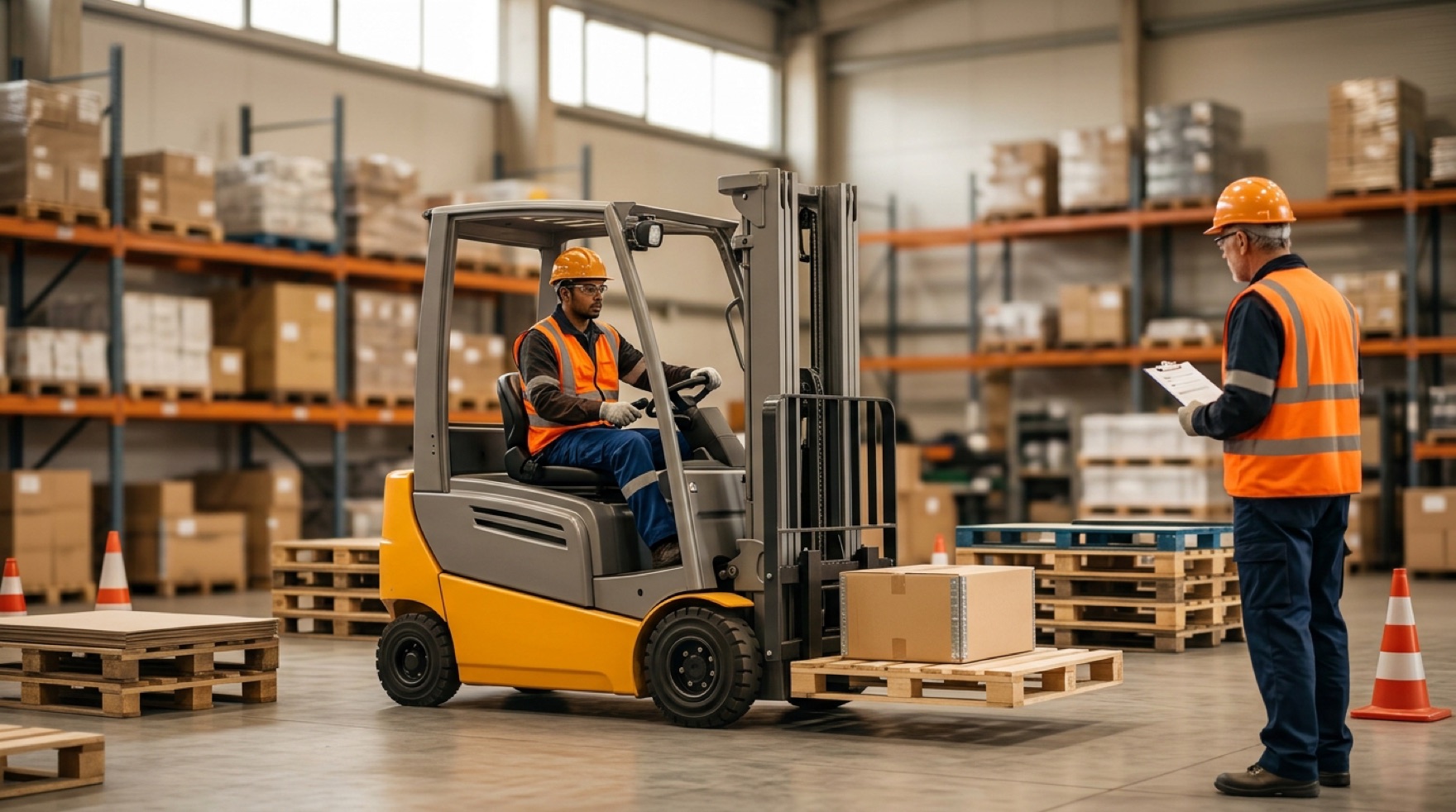
Yes. 29 CFR 1910.178(l)(1)(i) requires the employer to ensure that each powered industrial truck operator is "competent to operate a powered industrial truck safely, as demonstrated by the successful completion of the training and evaluation" the standard specifies, and 1910.178(l)(6) requires the employer to certify that each operator has been trained and evaluated. Training alone does not satisfy the rule. The standard pairs instruction with a hands-on evaluation on the actual truck, in the actual workplace, because the thing being verified is not attendance but the ability to drive safely on that floor.
That distinction matters operationally. A counterbalance operator who tests well in a classroom can still misjudge a turret truck in a narrow aisle, a reach truck at height, or a dock plate under a trailer. The evaluation is where the employer confirms the operator can handle the equipment and the conditions they will actually meet, which is why 1910.178(l) treats the workplace performance check as a required part of qualifying an operator rather than an optional add-on.
What has to be in the training, and who can deliver it?
Training must combine three elements: formal instruction, practical training, and an evaluation of performance in the workplace. 1910.178(l)(2)(ii) defines that combination, describing formal instruction such as lecture, discussion, video, or written material, plus practical training through trainer demonstrations and trainee exercises, plus the workplace evaluation. A slideshow and a quiz do not meet the standard on their own.
The people delivering it have to be qualified. 1910.178(l)(2)(iii) requires that all operator training and evaluation be conducted by persons who have the knowledge, training, and experience to train operators and to evaluate their competence. The content itself is scoped by 1910.178(l)(3), which lists the initial training topics an operator must receive, covering both truck-related subjects (controls, stability, capacity, refueling or recharging, inspection) and workplace-related subjects (surface conditions, pedestrian traffic, narrow aisles, ramps and grades, and hazardous locations), except topics the employer can demonstrate are not applicable to safe operation in that workplace. Building the program around 1910.178(l)(3) is what keeps a training file defensible: each listed topic is either covered or documented as not applicable.
Is prior experience enough to skip training?
No. Experience does not exempt an operator from being trained and evaluated: 1910.178(l)(5) lets the employer avoid repeating a topic only when the operator has already received appropriate training in it and has been evaluated and found competent to operate the truck safely. The evaluation is the gate. Certifying someone as an operator because a previous employer trained them, without confirming competence on this equipment and this floor, is the exact shortcut the standard is written to close.
A New Jersey FACE investigation shows where that shortcut leads. In NJ FACE report 02-NJ-081, a 39-year-old worker at a pallet manufacturer had been promoted to forklift operator about four weeks before the incident. Because he had roughly three years of forklift experience with a previous employer, the company certified him but, in the investigators' words, did not fully train him. On the day of the incident he backed an 8,600-pound counterbalance truck off the unguarded edge of an outdoor loading dock, was partly thrown from the seat because he was not wearing the operator restraint, and was crushed under the rollover cage; he died nine days later. NJ FACE recommended that all new operators be fully trained or retrained before certification. The transferable point is that "experienced" is a reason to evaluate, not a reason to skip evaluation, which is what 1910.178(l)(5) requires.
How often must operators be re-evaluated or retrained?
Every operator's performance must be re-evaluated at least once every three years, and refresher training is required sooner whenever specific triggers occur. 1910.178(l)(4)(iii) sets the three-year evaluation cycle explicitly. That is a floor, not a target: it is the longest an employer can go without formally re-checking an operator, and many programs re-evaluate more often on higher-risk equipment.
Refresher training does not wait for the three-year clock. 1910.178(l)(4)(ii) requires refresher instruction, with an evaluation of its effectiveness, when an operator is observed operating unsafely, is involved in an accident or a near-miss, is found during an evaluation to be operating unsafely, is assigned to a different type of truck, or when conditions in the workplace change in a way that could affect safe operation. Treat each of those triggers as a scheduled retraining event, not a disciplinary one: a near-miss on a reach truck or the arrival of a new order picker resets the operator's need for a competence check.
What does the certification record have to contain?
The certification is a named record with dates, not a wall certificate. 1910.178(l)(6) requires the certification to include the name of the operator, the date of the training, the date of the evaluation, and the identity of the person or persons who performed the training and the evaluation. If any of those four items is missing, the record does not meet the standard, and it is the first thing a compliance officer asks to see after an incident. The table below condenses what 1910.178(l) requires end to end.
| Requirement | What 1910.178 requires | Clause |
|---|---|---|
| Competence before operating | Employer ensures the operator is competent, demonstrated by completed training and evaluation | 1910.178(l)(1)(i) |
| Training format | Formal instruction, plus practical training, plus a workplace performance evaluation | 1910.178(l)(2)(ii) |
| Who trains and evaluates | A person with the knowledge, training, and experience to train operators and judge competence | 1910.178(l)(2)(iii) |
| Topics covered | Listed truck-related and workplace-related topics, unless shown not applicable | 1910.178(l)(3) |
| Refresher triggers | After unsafe operation, an accident or near-miss, a failed evaluation, a new truck type, or changed conditions | 1910.178(l)(4)(ii) |
| Periodic re-evaluation | Evaluate each operator's performance at least once every three years | 1910.178(l)(4)(iii) |
| Certification record | Operator name, date of training, date of evaluation, identity of trainer and evaluator | 1910.178(l)(6) |
Turning the certificate into competence
A forklift certificate is evidence of a process, and the process is what protects people. 1910.178(l) is built so that a signature at the bottom of a form stands for real instruction, a genuine hands-on evaluation on the equipment in use, and a commitment to re-check that competence on a schedule and after every warning sign. Programs that treat the certificate as the goal drift toward exactly the gap that the NJ FACE case describes, where a worker is certified but not actually trained for the conditions that kill him. Programs that treat the certificate as the record of an ongoing evaluation, refreshed after near-misses and new equipment and re-run at least every three years, are the ones that keep operators competent and keep the paperwork defensible when an inspector asks to see it.