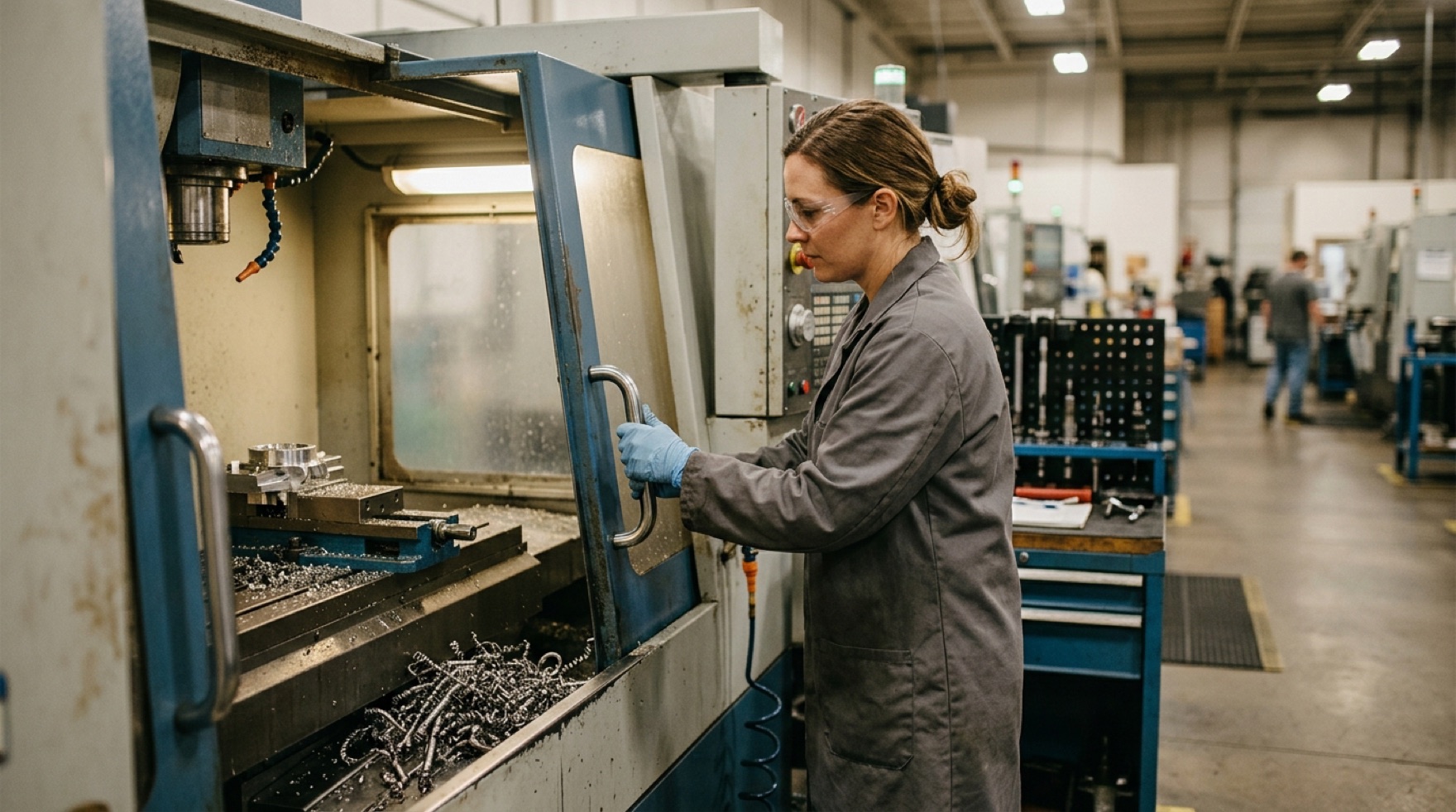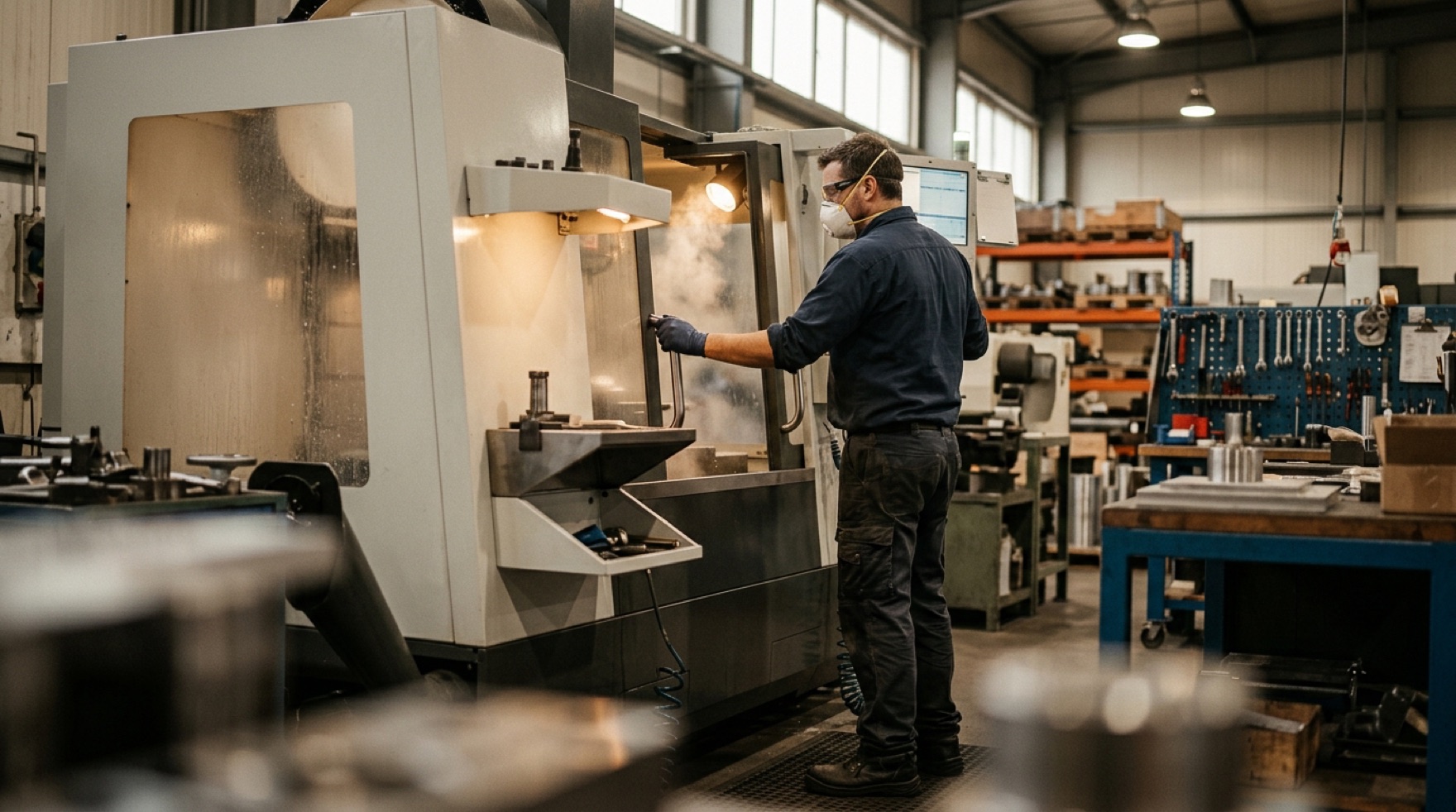
The short answer: There is no OSHA permissible exposure limit written specifically for metalworking fluids. Coolant mist is instead measured against the enforceable PELs for the material it most resembles, 5 mg/m³ as an 8-hour TWA for mineral oil mist and 15 mg/m³ for Particulates Not Otherwise Regulated, both under 29 CFR 1910.1000 (Table Z-1). NIOSH recommends a much lower level: 0.4 mg/m³ of thoracic particulate mass as a time-weighted average, which corresponds to roughly 0.5 mg/m³ of total particulate. That NIOSH REL is advisory, not enforceable, so the practical target on a CNC is set by the health evidence rather than by the PEL, and it is reached through enclosure and mist collection before respiratory protection.
Do metalworking fluids have an OSHA exposure limit?
No. OSHA has never set a permissible exposure limit specific to metalworking fluids, so the aerosol from flood coolant, through-spindle coolant, or a straight cutting oil is enforced against the general air-contaminant PELs it falls under. OSHA's Metalworking Fluids best practices manual states the applicable limits as 5 mg/m³ for an 8-hour time-weighted average for mineral oil mist, and 15 mg/m³ (8-hour TWA) for Particulates Not Otherwise Classified, both codified in 29 CFR 1910.1000 Table Z-1.
NIOSH concluded those PELs are too high to protect against the respiratory effects of MWF aerosol. It recommends a REL of 0.4 mg/m³ for thoracic particulate mass as a TWA for up to 10 hours per day, noting that because thoracic samplers are not widely available, total particulate mass is an acceptable substitute, with 0.4 mg/m³ thoracic corresponding to approximately 0.5 mg/m³ total, as OSHA's manual records. A recommended exposure limit is a NIOSH recommendation, not a regulation. That distinction matters operationally: an employer complying with the 5 mg/m³ oil-mist PEL can still run a shop where mist sits an order of magnitude above the level the health data supports, which is why the REL, not the PEL, is the number a serious mist-control program aims at.
| Limit | Value | Averaging | Set by / status | Document |
|---|---|---|---|---|
| NIOSH REL, MWF aerosol | 0.4 mg/m³ thoracic (≈0.5 mg/m³ total) | 10-hour TWA | NIOSH, advisory (recommended) | NIOSH criteria, cited in OSHA MWF manual |
| PEL, oil mist (mineral) | 5 mg/m³ | 8-hour TWA | OSHA, enforceable | 29 CFR 1910.1000 Table Z-1 |
| PEL, Particulates Not Otherwise Regulated (total) | 15 mg/m³ | 8-hour TWA | OSHA, enforceable | 29 CFR 1910.1000 Table Z-1 |
| PEL, PNOR (respirable fraction) | 5 mg/m³ | 8-hour TWA | OSHA, enforceable | 29 CFR 1910.1000 Table Z-1 |
What does coolant mist do to the lungs and skin?
Metalworking fluid aerosol is a respiratory sensitizer and an irritant, and the documented effects run from reversible airway inflammation to permanent lung scarring. OSHA's MWF manual describes hypersensitivity pneumonitis, occupational asthma, and chronic bronchitis as the principal respiratory outcomes, alongside dermatitis on the skin side. These are not theoretical: the manual attributes recent outbreaks of hypersensitivity pneumonitis to aerosols of synthetic, semi-synthetic, and soluble-oil fluids, particularly where microbial contaminants and additives are present.
Each condition has a different operational signature. Hypersensitivity pneumonitis presents first as cough, shortness of breath, and flu-like symptoms, and in its chronic phase produces lung scarring and permanent disease, which means an operator can read early symptoms as a passing bug while irreversible damage accumulates. Occupational asthma reflects airway inflammation that reduces airflow, and it can be induced fresh in a worker with no prior asthma by MWF components and additives. Chronic bronchitis develops over longer exposure as a persistent cough with phlegm. On the skin, OSHA's manual reports that 14 to 67 percent of workers exposed to MWFs are at risk of developing dermatitis, which is why fluid contact through the arms and hands belongs in the same exposure assessment as the mist. The through-line is that the mist reaching an operator's breathing zone at the machine is the exposure, so controlling the disease means controlling the aerosol at its source. It also means the exposure is cumulative and often silent: an operator who runs the same job for years absorbs a dose the enforceable 5 mg/m³ oil-mist PEL was never calibrated to prevent, which is why the health outcomes, not the citation risk, are the reason to drive mist down toward the NIOSH REL.
How do you control coolant mist on a CNC?
Control the mist in the order the hierarchy of controls sets out: contain and capture the aerosol at the machine first, manage the fluid so it generates less mist, and use respirators only to cover what engineering cannot. OSHA's MWF manual is explicit that before requiring respiratory protection, the employer must institute effective engineering controls such as machine enclosures and local exhaust ventilation, along with work-practice and administrative controls. That sequence is the whole strategy, because a respirator protects one worker for one shift while an enclosure and a mist collector lower the concentration for everyone in the cell.
- Enclose the machine and capture at the source (most reliable). A full or partial enclosure around the work zone, tied to a dedicated mist collector drawing the aerosol away from the spindle, is the primary control. Most modern CNCs are supplied with an enclosure; the control value comes from keeping the doors closed during the cycle and ducting the captured mist to a coalescing or electrostatic collector rather than letting it drift back into the shop.
- Manage the fluid to generate less mist. Aerosol generation rises with coolant pressure and spindle speed, so through-spindle and high-pressure delivery need matched extraction. Controlling fluid concentration, temperature, and cleanliness reduces both mist and the microbial load that drives hypersensitivity pneumonitis. This is where fluid management and mist control meet: a contaminated, over-concentrated sump is both a mist source and a sensitizer reservoir.
- Add general dilution ventilation where source capture leaves a gap. Shop-wide air handling dilutes what escapes the enclosures, but it is a backstop, not a substitute for capture at the machine. Diluting a mist after it has already reached the breathing zone is far less effective than never letting it get there.
- Use respiratory protection to cover the remainder (least reliable alone). Where sampling shows exposures still above the target after engineering controls, respirators fill the gap under a full program. A program that leads with respirators while the enclosure doors stay open and the collector is undersized is leaning on the weakest layer.
The practical test of a mist-control program is a personal air sample in the operator's breathing zone measured against the target level, not a visual check of the shop. Mist thin enough to be invisible can still sit above the NIOSH REL, so the program has to be verified by measurement and adjusted when spindle speeds, coolant pressures, or part mix change.
When is respiratory protection required, and which standard governs it?
Respiratory protection on a CNC is governed by 29 CFR 1910.134, and it is required when engineering and work-practice controls cannot bring exposures down to an acceptable level. OSHA's respiratory protection standard makes engineering controls the first line of defense and positions respirators as the control used while those measures are being installed or where they are not sufficient, which is exactly how OSHA's MWF manual frames their use for coolant mist.
That order is not a paperwork nicety. Once respirators are in play, 1910.134 pulls in a written program, a medical evaluation before an operator wears a respirator, fit testing for tight-fitting facepieces, and training, so reaching for respirators as the primary control converts a machine-level problem into an ongoing program obligation for every affected operator. The efficient path is to spend the effort on the enclosure and the mist collector, verify the result by sampling, and use respirators to close a measured remainder rather than to substitute for controls that were never installed.
Why does the coolant sump itself become a hazard?
A neglected coolant sump turns the fluid into a biological hazard that no amount of mist capture fully offsets. Water-based metalworking fluids support microbial growth, and the bacterial and fungal contamination that builds in a poorly maintained sump is directly linked to the hypersensitivity pneumonitis and respiratory symptoms documented with MWF exposure. The mist carries whatever is growing in the tank into the operator's lungs.
That makes fluid management a respiratory control, not just a quality or tool-life measure. Monitoring concentration and pH, keeping tramp oil and swarf out of the sump, maintaining fluid within the supplier's specification, and cleaning and recharging tanks on a schedule all reduce the microbial load that drives sensitization. Treating the sump as a living system that has to be maintained, rather than a reservoir that gets topped up until it smells, is what keeps the fluid from becoming the exposure the mist collector is trying to remove.