The short answer: Flour dust is a respiratory sensitizer. Breathing it day after day can cause baker's asthma and allergic rhinitis, which are among the most common forms of occupational asthma. OSHA has no substance-specific exposure limit for flour dust, so it defaults to the Particulates Not Otherwise Regulated limits in 29 CFR 1910.1000 (15 mg/m³ total dust), while the ACGIH threshold limit value is 0.5 mg/m³ inhalable, 30 times lower, with a respiratory-sensitizer notation. Because flour is a hazardous chemical, 29 CFR 1910.1200 (Hazard Communication) requires safety data sheets, labels, and training. The control that works is keeping the dust airborne in the first place: enclosed ingredient transfer and local exhaust ventilation, not a dust mask.
Is flour dust really a serious respiratory hazard?
Yes. Flour dust is a respiratory sensitizer, and baker's allergy and asthma remain one of the most common forms of occupational asthma worldwide, according to a peer-reviewed review of baker's asthma prevention published in the National Library of Medicine's PMC archive. Sensitization is not the same as ordinary irritation. It is a specific immune response: after repeated exposure, the worker's body produces IgE antibodies to wheat proteins and to the fungal enzymes, such as alpha-amylase, that bakeries add to improve dough. Once a baker is sensitized, even small amounts of flour dust can trigger wheezing, a blocked or running nose, and asthma attacks.
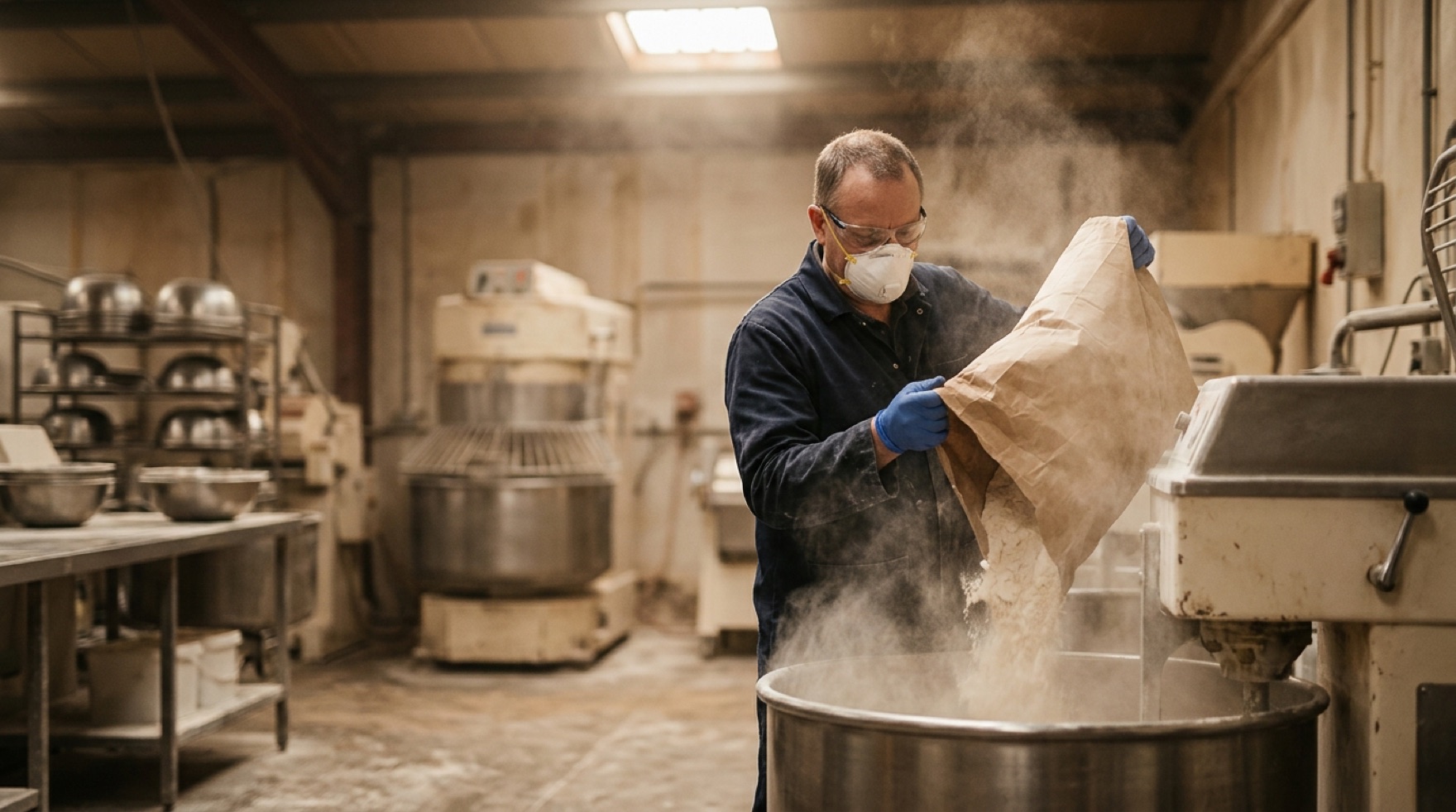
That sequence is why the hazard is easy to underrate. A new hire feels nothing for months or years, so the dusting flour at the make-up table, the puff from a bulk bag dump, and the haze around the mixer all read as normal bakery conditions. The exposure is doing its work silently. By the time symptoms appear, the sensitization is often established and, for some bakers, permanent, which is what turns a nuisance into a reason to leave the trade. The operational point for a bakery is that the people most at risk are the ones you have already invested in training, so protecting them protects your production capacity as much as their health.
A NIOSH investigation shows the dose-response at work. In a study of a large commercial bakery published by NIOSH researchers in the American Journal of Industrial Medicine (2010), investigators measured personal breathing-zone inhalable flour dust and drew blood from 96 employees. The geometric mean exposure was about 0.235 mg/m³ in the lower-exposure group and 3.01 mg/m³ in the higher-exposure group. Workers in the higher-exposure group had significantly more work-related wheezing, runny nose, and sneezing, and were markedly more likely to carry IgE specific to flour dust and wheat. The investigators recommended enclosing the transfer of powdered ingredients to the dispensing hoppers and adding local exhaust ventilation. The transferable point is that the health difference tracked the dust level, which is exactly what engineering controls exist to change.
What are the exposure limits for flour dust, and which are enforceable?
The enforceable federal limit is far weaker than the health-based guidance, and the gap matters. OSHA has no substance-specific permissible exposure limit for flour dust, so it falls under the Particulates Not Otherwise Regulated (PNOR) entry in 29 CFR 1910.1000 Table Z-1: 15 mg/m³ for total dust and 5 mg/m³ for the respirable fraction, both as 8-hour time-weighted averages. The ACGIH threshold limit value for flour dust is 0.5 mg/m³ inhalable, adopted in 1999, with a respiratory-sensitizer (senR) notation added in 2014. That is a difference of 30 times between the enforceable ceiling and the health-based recommendation.
The distinction between the two numbers is the whole point. A PEL is an OSHA limit and is enforceable. A TLV is an ACGIH recommendation and is advisory. Meeting the PNOR PEL keeps you compliant on paper while leaving bakers at exposures well above the level where sensitization occurs. Research summarized in an occupational-exposure assessment in PMC reports that sensitization to flour dust has been seen at exposures below 0.5 mg/m³, and that respiratory and asthmatic symptoms rise at exposures of 1.5 to 4.0 mg/m³. In other words, the dust levels measured in the higher-exposure group of the NIOSH bakery study, around 3 mg/m³, sit squarely in the symptom range and are still a fraction of the 15 mg/m³ PNOR limit.
| Limit | Value | Fraction | Status | Set by |
|---|---|---|---|---|
| ACGIH TLV-TWA (flour dust) | 0.5 mg/m³ | Inhalable | Advisory, senR notation | ACGIH |
| OSHA PEL, PNOR total dust | 15 mg/m³ | Total dust | Enforceable | OSHA 1910.1000 Z-1 |
| OSHA PEL, PNOR respirable | 5 mg/m³ | Respirable | Enforceable | OSHA 1910.1000 Z-1 |
For a safety leader, the takeaway is to design the dust-control program to the ACGIH TLV, not the PNOR PEL. Compliance with 15 mg/m³ is a floor that does little to prevent baker's asthma, and treating it as the target is how a bakery ends up compliant and still sensitizing its workforce.
What does OSHA's Hazard Communication Standard require for flour dust?
Flour is a hazardous chemical under the Hazard Communication Standard, so 29 CFR 1910.1200 applies to a bakery the same way it applies to a chemical plant. The standard classifies respiratory and skin sensitization as health hazards in its Appendix A criteria, which means a flour supplier's hazard evaluation and the resulting label and safety data sheet should communicate the sensitization hazard. The bakery's duty is to build a written hazard communication program around those documents.
In practice that means three things on the floor. First, keep a safety data sheet for each flour and each dough-conditioning enzyme readily accessible during every shift, as required by 1910.1200(g). Second, make sure incoming and workplace containers are labeled with the product identifier and hazard information under 1910.1200(f). Third, and most important for this hazard, provide effective employee training under 1910.1200(h) at initial assignment and whenever a new hazard is introduced, covering what the sensitization hazard is, how to recognize early symptoms, and the specific controls in use. Details of the HazCom text are on the OSHA 1910.1200 standard page. Training earns its place here because sensitization is invisible until it is advanced: a baker who knows that a runny nose and work-related wheeze are early warnings, not just a cold, is a baker who can be moved and evaluated before the asthma becomes fixed.
How do you control flour dust exposure on the bakery floor?
Control the dust the way you would control any airborne hazard: remove it at the source first, ventilate what remains, and treat respirators as the last layer. A respirator protects one worker for one shift and depends on fit and discipline; engineering controls protect everyone in the space every shift, which is why investigators keep recommending them over PPE.
- Eliminate or substitute the release. Handle flour in enclosed systems: pneumatic transfer from bulk storage, enclosed dispensing hoppers, and low-dust or granulated ingredient forms where the recipe allows. Enclosing the transfer of powdered ingredients was the first control the NIOSH bakery investigators recommended, because a dump station that is open to the room is a dust generator that no downstream control fully catches.
- Engineer the exposure down. Add local exhaust ventilation (source capture) at dump stations, sifters, mixers, and dividers, so dust is drawn away before it reaches the breathing zone. Use HEPA-filtered vacuums for cleanup, never compressed air or dry sweeping, both of which re-suspend settled flour into the air the whole crew breathes.
- Use administrative controls. Written low-dust handling procedures, gentle bag-emptying technique, prompt cleanup of spills, and a medical-surveillance or symptom-reporting route that lets a sensitizing worker be identified and moved early. Rotating a symptomatic baker away from the dustiest tasks buys time that a fixed asthma diagnosis does not give back.
- Provide respiratory protection last. Where exposures still exceed the target after engineering and administrative controls, provide respirators under a program that meets 29 CFR 1910.134, including fit testing and medical evaluation. A voluntary dust mask handed out without a program is not a substitute for capturing the dust.
The hierarchy matters because flour dust sensitization is driven by cumulative exposure. Every layer that keeps the dust out of the air lowers the dose that a new baker accumulates over their first years, which is the window when sensitization is most preventable.
One more hazard from the same dust: it is combustible
Flour dust is not only a respiratory hazard, it is a combustible dust. Ground finely enough and suspended in air at the right concentration in a confined space, flour can deflagrate from a single ignition source, a point OSHA's combustible dust guidance makes for agricultural and food dusts generally. Fire and explosion prevention in bakeries, flour mills, and other food-processing facilities is governed by NFPA 61, the Standard for the Prevention of Fires and Dust Explosions in Agricultural and Food Processing Facilities (its requirements now also carried in the consolidated NFPA 660). The connection to the respiratory program is direct: the same accumulated dust layers on beams, ductwork, and equipment that feed a secondary explosion are the settled flour that dry sweeping and compressed air throw back into the breathing zone. Housekeeping that captures dust with HEPA vacuums instead of re-suspending it serves both the asthma risk and the explosion risk at once.
Protecting bakers means designing to the health limit
Flour dust is the defining occupational-health exposure of commercial baking, and the reason it gets missed is that it does its damage slowly and silently. The enforceable OSHA limit is a nuisance-dust ceiling that a bakery can meet while still sensitizing its people, so the program that actually protects bakers is built to the ACGIH TLV of 0.5 mg/m³ and to the controls the NIOSH investigation recommended: enclose the transfer, capture the dust at the source, clean with HEPA rather than a broom, train workers to recognize the early signs, and hold the HazCom documentation and respiratory program that 1910.1200 and 1910.134 require. Do that, and the bakery keeps both its people and the skilled capacity they represent, which is the outcome every one of these controls is finally about.