The short answer: Isocyanates (mainly HDI, MDI, and TDI) are the curing agent in two-component polyurethane paints and coatings, and they are respiratory sensitizers: repeated exposure can cause occupational asthma that then flares at concentrations far below any legal limit. OSHA's Table Z-1 sets an enforceable ceiling of 0.02 ppm for TDI and for MDI, but there is no federal OSHA limit for HDI, the isocyanate most common in modern spray coatings, so shops rely on the ACGIH TLV and NIOSH REL of 0.005 ppm for it. Because spraying atomizes the coating into a breathable aerosol, an air-supplied respirator and a properly ventilated booth are the controls that matter, not an organic-vapor cartridge alone.
What are isocyanates, and why are they dangerous in spray coating?
Isocyanates are compounds carrying the reactive isocyanate group, and they are the part of a two-component (2K) polyurethane system that cross-links the coating into a hard, durable film. OSHA identifies the main health effects of hazardous exposure as occupational asthma and other lung problems, plus irritation of the eyes, nose, throat, and skin, and lists painting among the jobs that expose workers. The three that a finishing shop meets most often are hexamethylene diisocyanate (HDI), methylene bisphenyl isocyanate (MDI), and toluene diisocyanate (TDI).
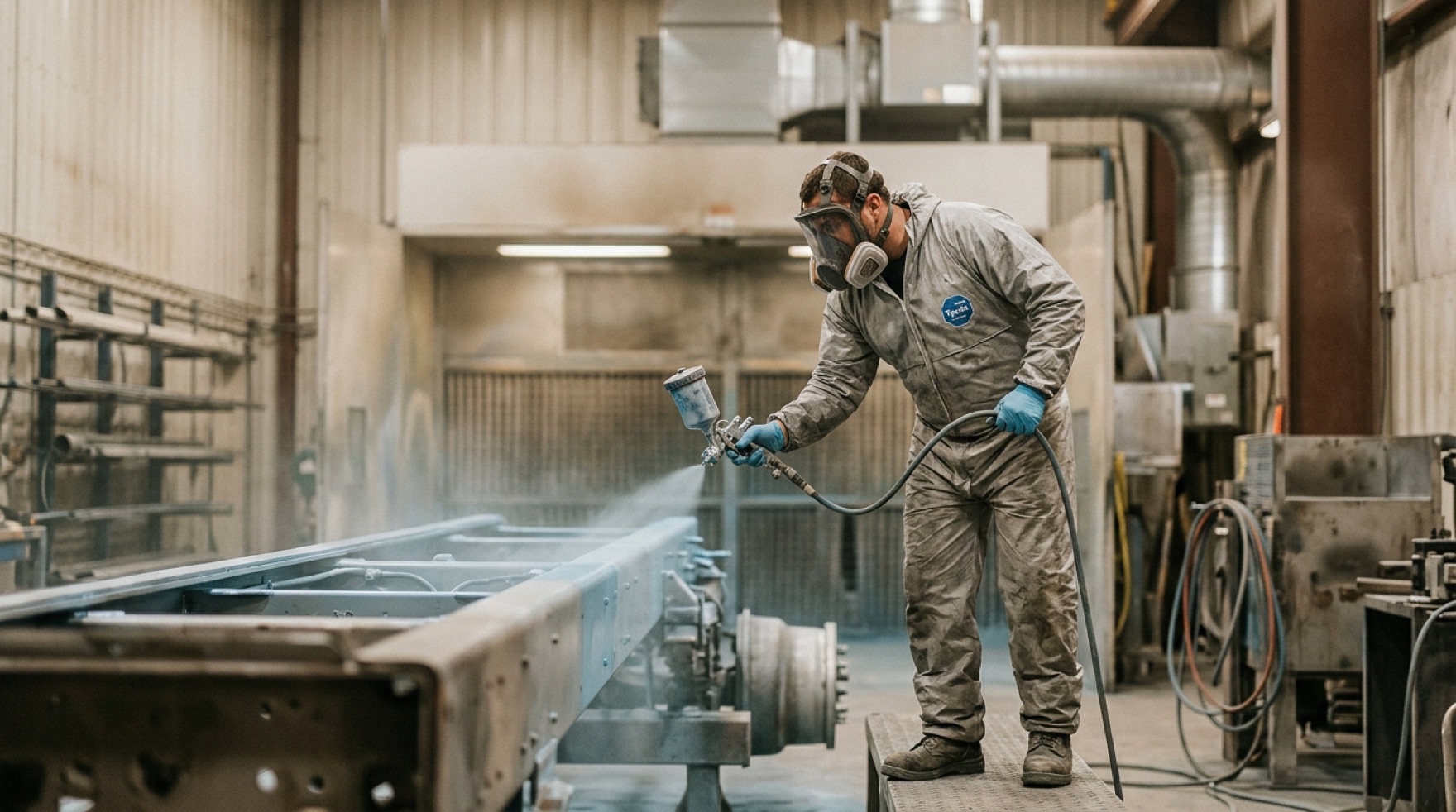
Spraying is what turns a manageable chemical into an inhalation problem. Atomizing a 2K coating through a spray gun produces a fine aerosol of paint droplets and isocyanate vapor that a worker breathes directly, and that hangs in the air of the booth and drifts into the surrounding shop. The same reactivity that builds the film also reacts with the moist tissue of the airway. That means the hazard is not limited to the person holding the gun: anyone in the spray area during and shortly after application is exposed unless ventilation clears the aerosol.
What are the exposure limits for isocyanates?
The enforceable federal limits are ceiling values, not eight-hour averages, and they do not cover every isocyanate. A ceiling limit is a concentration that must not be exceeded at any moment, which fits a sensitizer better than a shift average because a single brief peak can matter. The table below gives the limit for each common isocyanate and the document that sets it.
| Isocyanate | OSHA PEL (enforceable) | NIOSH REL / ACGIH TLV (advisory) |
|---|---|---|
| TDI (toluene-2,4-diisocyanate) | Ceiling 0.02 ppm (0.15 mg/m³), OSHA Table Z-1 | ACGIH TLV 0.001 ppm TWA, 0.005 ppm STEL |
| MDI (methylene bisphenyl isocyanate) | Ceiling 0.02 ppm (0.2 mg/m³), OSHA Table Z-1 | NIOSH REL 0.005 ppm TWA, 0.02 ppm ceiling (10 min) |
| HDI (hexamethylene diisocyanate) | None established by federal OSHA | NIOSH REL and ACGIH TLV 0.005 ppm TWA |
Two points on that table decide how a shop should read it. First, PEL means the OSHA limit and it is enforceable; TLV is the ACGIH figure and REL is the NIOSH figure, and both are advisory. Second, HDI is the isocyanate most widely used in the two-component polyurethane coatings sprayed in automotive refinish and industrial finishing, and federal OSHA has no permissible exposure limit for it at all. A shop spraying HDI-based clearcoat that treats "no OSHA limit" as "no problem" has misread the situation: the absence of a PEL is a gap in the table, not evidence of safety, and NIOSH and ACGIH both put the practical target at 0.005 ppm.
Why is the number on the data sheet not a safe target?
Because isocyanates are sensitizers, the exposure limit protects the population, not the individual who has already been sensitized. Sensitization works like an acquired allergy: after enough exposure, a worker's airways become primed, and from then on a concentration well below the limit can set off an asthmatic response. The limit is written to reduce how many workers cross that threshold; it cannot make exposure safe for a worker who already has.
That is why isocyanate asthma is one of the most common causes of occupational asthma and why it ends careers. A sensitized sprayer can react to a trace that a colleague does not notice, which usually means removal from any further isocyanate work rather than a lower dose. OSHA's own hazard material also points to a route that surprises many shops: respiratory sensitization can be related to previous skin exposure, and research it cites describes a single skin contact with TDI producing airway sensitization that persisted for a year. So skin contact is not only a dermatitis concern. It can prime the lungs, which is why glove and coverall protection belongs in an isocyanate program alongside the respirator.
What controls actually reduce isocyanate exposure?
Rank the controls the way the hierarchy demands, and the two that carry the load are engineering ventilation and a supplied-air respirator, in that order. A spray booth designed and maintained to move air across the work removes most of the aerosol at the source, and it is the control that protects everyone in the area, not just the operator. Respiratory protection then handles the exposure the booth cannot, and for spray application of isocyanates that means an atmosphere-supplying respirator, because the exposure is a mixed aerosol and vapor rather than vapor alone.
The cartridge point is where shops go wrong. OSHA's material notes that organic-vapor cartridges without a particulate filter were not effective against MDI, while cartridges with a dust and mist or high-efficiency filter removed more than 99 percent of MDI aerosol and vapor. Even so, an air-purifying respirator has no reliable end-of-service warning for isocyanates, which is why supplied air is the accepted choice for spraying. A documented fatality shows what happens when the ventilation and the respirator both fail at once.
A Michigan FACE investigation (report 03MI018) examined the February 2003 death of a 45-year-old vehicle-detailing shop manager who sprayed an isocyanate-based truck bed liner inside a van. The room had no local exhaust ventilation: air movement came from a raised overhead door and a box fan, and the same door was lowered during spraying, over the ambient-air pump that fed his supplied-air respirator. After finishing, he disconnected the airline at his hip and removed the respirator, then collapsed outside in respiratory distress and died. MIOSHA cited the employer for not providing a spray booth or spray room and for having no written respiratory protection program, medical evaluation, or fit testing. The transferable point is that a supplied-air respirator protects only while it is connected and supplied, and it is a backstop to booth ventilation, never a substitute for it.
Does OSHA require a respiratory protection program and medical surveillance?
Yes. Once a shop requires respirators for isocyanate spraying, 29 CFR 1910.134 requires a written respiratory protection program with worksite-specific procedures, administered by a trained program administrator. That program has to include a medical evaluation before an employee is fit-tested or wears a respirator, fit testing with an accepted qualitative or quantitative protocol, and training, all of which the MIOSHA citations in the Michigan case turned on. The respirator is not a stand-alone item you hand a sprayer; it only works inside the program that selects, fits, and maintains it.
Medical surveillance is the other half. There is no OSHA substance-specific standard that mandates isocyanate medical monitoring the way the lead or chromium standards do, but the sensitizer mechanism makes baseline and periodic respiratory assessment the practical control for catching sensitization early, and the Michigan investigation recommended exactly that for workers exposed to sensitizers or asthma-causing agents. For a safety leader, the program comes together as a system: keep exposure down with a real booth, protect the sprayer with supplied air inside a 1910.134 program, keep isocyanate off the skin, and watch respiratory health over time so that the first signs of sensitization pull a worker out before an attack does.