The short answer: The welding arc throws off injurious ultraviolet and infrared radiation, and OSHA requires eye and face protection with the correct filter shade under 29 CFR 1910.133, which mandates protectors meeting an ANSI Z87.1 consensus standard. The shade number rises with the intensity of the operation: 29 CFR 1910.252(b)(2)(ii)(H) lists shades from 2 for soldering up to 14 for carbon arc welding, with shielded metal arc welding on common electrodes at shade 10 to 14 depending on electrode size. Start no lighter than the listed shade, and pick the darkest that still lets you see the weld pool clearly.
What eye protection does OSHA require for welding?
OSHA requires eye and face protection with a filter lens of adequate shade whenever a worker is exposed to the arc's light radiation, and the protector has to meet a recognized consensus standard. 29 CFR 1910.133(a) requires protection against injurious light radiation, and 1910.133(b) requires devices that comply with ANSI Z87.1 (the 2010, 2003, or 1989 edition, or a demonstrated equivalent). The filter shade is the specific control for the radiation, and the marked Z87 rating is what confirms the protector itself will hold up to impact and the lens is what it claims to be.
The radiation is the reason the shade is not negotiable. The arc emits ultraviolet radiation that causes photokeratitis, the painful "arc eye" or welder's flash that shows up hours after exposure, and infrared radiation that loads the eye with heat. Because the injury is delayed and cumulative, an under-shaded lens does damage the welder does not feel at the time, which is why OSHA ties the requirement to a published shade table rather than to operator comfort.
How do you select the right welding filter shade?
Match the shade to the process and the electrode size or plate thickness using OSHA's published guide, then adjust within the safe range. 29 CFR 1910.252(b)(2)(ii)(H) gives the shade numbers below by operation. Read the table as a floor: it is the minimum protection for that operation, and the correct working shade is the darkest one through which the weld zone stays clearly visible.
| Operation | Detail | Shade No. |
|---|---|---|
| Shielded metal arc welding (SMAW) | 1/16 to 5/32 in electrodes | 10 |
| Shielded metal arc welding (SMAW) | 3/16 to 7/32 in electrodes | 12 |
| Shielded metal arc welding (SMAW) | 5/16 to 3/8 in electrodes | 14 |
| Gas-shielded arc welding (nonferrous) | 1/16 to 5/32 in electrodes | 11 |
| Gas-shielded arc welding (ferrous) | 1/16 to 5/32 in electrodes | 12 |
| Carbon arc welding | Any | 14 |
| Atomic hydrogen welding | Any | 10 to 14 |
| Gas welding, light | up to 1/8 in | 4 or 5 |
| Gas welding, medium | 1/8 to 1/2 in | 5 or 6 |
| Gas welding, heavy | 1/2 in and over | 6 or 8 |
| Oxygen cutting, light | up to 1 in | 3 or 4 |
| Oxygen cutting, medium | 1 to 6 in | 4 or 5 |
| Oxygen cutting, heavy | 6 in and over | 5 or 6 |
| Torch brazing | Any | 3 or 4 |
| Soldering | Any | 2 |
OSHA also publishes a companion guide keyed to arc current rather than electrode size. Under the filter-lens table in 29 CFR 1910.133, shielded metal arc welding runs a minimum shade of 7 below 60 amperes, 8 at 60 to 160 amperes, 10 at 160 to 250 amperes, and 11 at 250 to 550 amperes, while gas metal arc and flux-cored welding sit at shade 10 across most of that range. Use whichever reference matches how the job is specified, and never drop below the minimum it gives.
Can a welding shade be too dark, and how do you fine-tune it?
Yes. A shade darker than needed hides the weld pool and pushes the welder to lean closer, so the goal is the darkest shade that still leaves the weld zone clearly visible, never lighter than the table's minimum. OSHA's guidance is to begin with a shade that is too dark to see the weld zone, then step to a lighter shade that gives a sufficient view without dropping below the minimum protective shade for that operation. That method finds the working shade without ever trading protection for visibility.
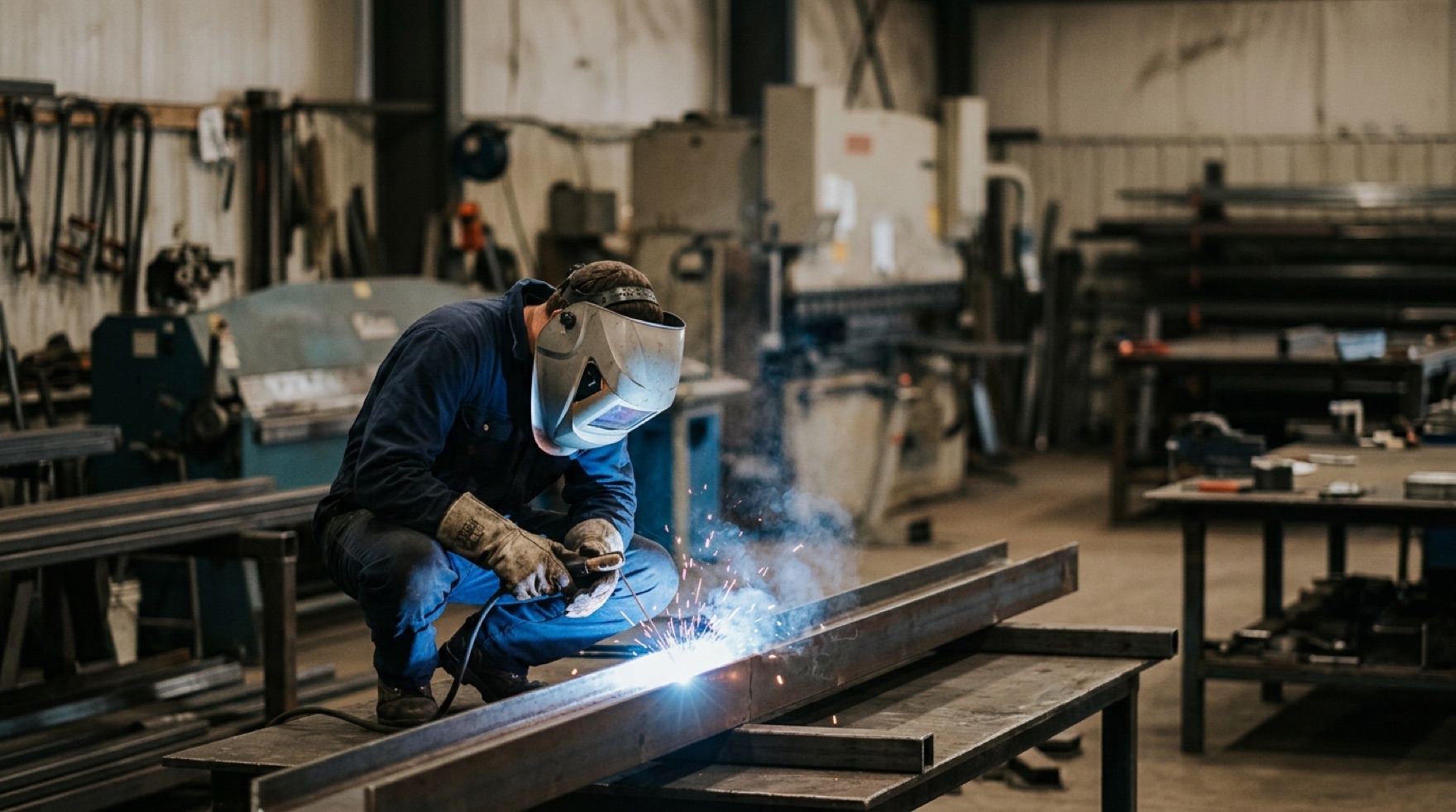
Two practical points follow. An auto-darkening welding helmet has to switch to the correct dark shade for the process, and its light-state and dark-state ratings should match the operation, not just carry a Z87 mark. And filter shade protects the eyes from radiation, not the face and neck from the same ultraviolet, so shade selection sits alongside, not instead of, the flame-resistant clothing and screens that block the arc's radiant energy from exposed skin. The shade is the control for the eyes; it is one layer of the arc-radiation protection, not the whole of it.