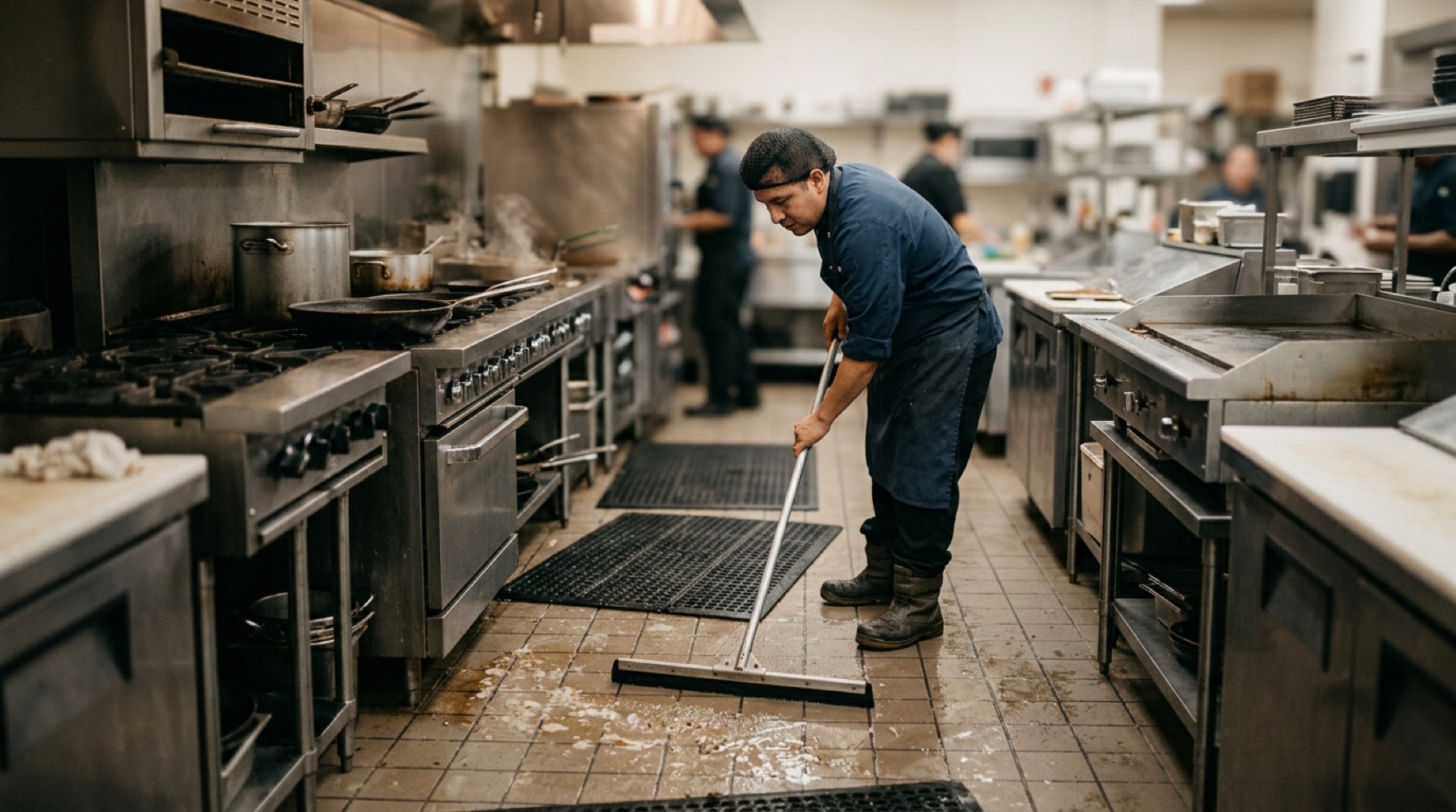
The short answer: Under 29 CFR 1910.22(a)(2), a kitchen floor must be kept clean and, to the extent feasible, dry, and where wet processes are used the employer must maintain drainage and provide dry standing places such as false floors, platforms, or mats. Slip resistance itself is measured as dynamic coefficient of friction (DCOF) under ANSI A326.3, which sets a minimum wet DCOF of 0.42 for interior surfaces walked on when wet and a higher 0.55 for surfaces exposed to oils and greases. A cook line is the oils-and-greases case, so 0.55 is the target, and mats are the last layer of that system, not the first.
Does OSHA require slip-resistant floors in a commercial kitchen?
OSHA does not name a friction number, but 29 CFR 1910.22(a)(2) requires that the floor of each workroom be maintained in a clean and, to the extent feasible, a dry condition, and that where wet processes are used, drainage be maintained and dry standing places such as false floors, platforms, and mats be provided where practicable. A cook line, a dish pit, and a prep station are wet processes by any reading, so the duty to drain the floor and provide dry standing places applies directly. The standard treats the wet floor as a condition the employer controls, not a fact of the job.
Two more parts of the same rule carry the day-to-day work. 1910.22(a)(3) requires walking-working surfaces to be kept free of hazards such as sharp objects, loose boards, and spills, and 1910.22(d) requires that surfaces be inspected regularly and as necessary, and maintained in a safe condition. That means a same-level fall on a greasy quarry tile floor is not simply bad luck: it is a walking-working surface that was allowed to drift out of the clean, drained, maintained condition the standard requires, and it is the first thing a compliance officer reconstructs after an injury.
What slip resistance does a kitchen floor actually need?
The measure that matters is dynamic coefficient of friction, and for a kitchen the target is a wet DCOF of at least 0.55. ANSI A326.3, the standard method for measuring DCOF on hard surfaces, sets a minimum measured wet DCOF of 0.42 for interior surfaces expected to be walked on when wet, and a higher minimum of 0.55 for surfaces exposed to oils and greases. Back-of-house kitchen floors fall in the oils-and-greases category, which is why specifying tile to the 0.42 water number, the value most manufacturers quote by default, leaves a cook line under-specified.
The word dynamic is doing real work here. Static coefficient of friction, the older measure, describes the force to start a stationary foot moving; DCOF describes friction once the foot is already sliding, which is the moment a slip becomes a fall. They are different tests with different thresholds, so a floor advertised only with a static number tells you little about how it behaves under a walking heel in a film of grease. When you evaluate a floor, a coating, or a replacement tile, ask for the wet DCOF measured to ANSI A326.3 and check it against 0.55, not against the general 0.42.
Why does grease make a kitchen floor so much more slippery than water?
Grease raises the friction requirement because it forms a persistent film that water-based slip resistance is not designed to defeat. Grease-laden vapor rises off the fry station and the flat top, is drawn toward the hood, and settles as a thin oily layer across nearby quarry tile, mixing with water and food debris into a surface far more slippery than either alone. That is the mechanism behind the 0.55 oils-and-greases threshold in ANSI A326.3: an oil film changes the contact between sole and floor in a way a plain wet floor does not.
It also changes how you clean. Rinsing a greasy floor with water alone spreads the film rather than lifting it, so a floor that looks clean can be more slippery after a mop than before. Controlling the grease at its source, through regular hood and filter cleaning, contained fryer-oil handling, and degreasing agents rather than water alone, is part of keeping the floor at the friction it was specified for, and it is why slip control on a cook line starts above the floor, at the hood.
Where do mats fit in the order of controls?
Mats are a supplement to a slip-resistant, well-drained floor, not a substitute for one. The reliable way to reduce same-level falls on the line is to work down the hierarchy of controls, because each step up removes more of the hazard than the step below it, and mats sit near the bottom by design. Reaching for a mat runner while the floor itself is under-specified and the grease source is uncontrolled treats the symptom and leaves the hazard.
- Eliminate and contain the source. Clean the hood and grease filters on a schedule so grease-laden vapor is captured rather than settling on the floor; handle waste fryer oil through a contained route; and enforce immediate spill cleanup with a designated person each shift. Less contaminant on the floor is the control every layer below depends on.
- Engineer the floor. Specify or restore flooring to a wet DCOF of 0.55 or greater under ANSI A326.3 for the oils-and-greases zones, maintain the floor drainage that 1910.22(a)(2) calls for so standing water clears, and re-profile or treat tile that has worn smooth. This is the layer that protects everyone on the floor at once, without depending on anyone remembering anything.
- Add mats as dry standing places. Grease-resistant drainage matting and duckboard at the fry station, the dish pit, and the service well give the wet-process dry standing places 1910.22(a)(2) describes, lifting the foot above the film and channeling liquid away. Mats earn their place here, as a targeted layer over the worst zones, covered in depth in our guide to anti-fatigue and drainage mats for the kitchen line.
- Fit slip-resistant footwear. Closed-toe, slip-resistant soled shoes are the control the worker carries from zone to zone, including the areas a mat does not cover. They are essential and also the most portable, but they are personal protective equipment sitting below the floor and the mats, not a reason to under-specify either.
- Manage behavior last. Wet floor signs, spill-response routines, and housekeeping standards reinforce the layers above them. They matter, but a program that leads with a bucket of signs while the floor sits at 0.42 and the hood is overdue for cleaning is leaning on the weakest layer.
That a slip on the line rarely stays a simple fall is what raises the stakes. A Washington State Department of Labor and Industries SHARP investigation of hospitalized restaurant scald burns found that over 30 percent, roughly one in three, were associated with a slip, trip, or fall, and that those slip-related burns carried higher average medical costs and more time-loss days than burns without a fall. As the SHARP burn-injury report describes it, a worker who slips near hot liquid reaches to steady themselves and knocks it off the stove or spills the vat they were carrying. The transferable point is that on a cook line, floor friction is also burn prevention, which is why the slip hazard and the thermal hazard on the line are best controlled together.
How do you keep the floor slip-resistant shift to shift?
A floor specified to 0.55 DCOF only stays there if it is cleaned to lift grease, drained so water clears, and inspected on the schedule 1910.22(d) requires. Build the cleaning routine around a degreasing agent rather than water alone, keep drains and any trench drains clear so liquid leaves the walking surface, and lift and clean mats regularly so grease does not build into a slippery layer underneath them. A mat that is never lifted becomes part of the hazard it was meant to solve.
Then close the loop with inspection and footwear. Walk the line for worn-smooth tile, pooling water, and grease creep out from under the hood, and treat a slick spot as a walking-working-surface defect to be corrected, not a warning to step carefully. Pair that with slip-resistant footwear and immediate spill response, and the floor holds the friction it was built for through a twelve-hour shift, which is the condition 1910.22 is written to preserve and the one that keeps a same-level fall from becoming a scald.