The short answer: Loading dock injuries concentrate at the dock-to-trailer gap, so dock safety comes down to three things done in order: immobilize the vehicle before anyone crosses (brakes set and wheels chocked, or a trailer restraint), bridge the gap with a dockboard or leveler rated and secured for the load, and keep the open edge from becoming a fall. The governing OSHA standards are 29 CFR 1910.176 for materials-handling clearances and stacking, 29 CFR 1910.26 for dockboards, and 29 CFR 1910.178(k) for securing trucks and railroad cars during loading. Use the grouped checklists below as the working procedure.
Each group below maps to one part of the gap. Work through them in sequence, because the failure modes stack: an unsecured trailer makes a well-rated dockboard useless, and a good vehicle restraint does nothing for a driver who walks off an unguarded edge.
Why is the dock edge the most dangerous point on the dock?
The dock edge is where a moving truck, an unfixed bridge, and a four-foot drop all meet, so a small error there turns into a fall or a crush. OSHA's trucking guidance is direct about the outcome: "Many fatalities occur when a worker is crushed by a forklift that has overturned or fallen from a loading dock," and it identifies 29 CFR 1910.178 as the most frequently cited standard in that work. The recurring mechanism is trailer creep or an early pull-away: the trailer separates from the dock while a forklift is part-way across, and the bridge and the truck go down into the gap.
The Michigan FACE program documented how fast that happens. In MIFACE Case 141, a 59-year-old operating engineer was fatally injured while a Genie/JLG lift was being unloaded from a flatbed trailer at a dock. Investigators recorded that the trailer's brakes had not been locked and no wheel chocks or blocks were positioned. As the machine started down the ramp, the tractor and trailer skidded away from the dock, leaving the lift dropped between the trailer and the dock, with skid marks from the tractor's axles still in the dirt. The transferable lesson is blunt: the vehicle has to be immobilized, by brakes and chocks or a powered restraint, before anyone drives a load across the gap.
How do you secure the vehicle before anyone crosses the gap?
Immobilize the trailer or railcar first, every time, and confirm it before the first wheel of a truck touches the bridge. This is the control that MIFACE Case 141 was missing, and 29 CFR 1910.178(k) sets the baseline for it.
- Set the vehicle's brakes and place wheel chocks under the rear wheels to prevent the truck from rolling, as required by 1910.178(k)(1). A powered trailer restraint that engages the rear impact guard is a stronger equivalent and is preferred where fitted.
- Use fixed jacks to support a semitrailer and prevent it from upending during loading or unloading when the trailer is not coupled to a tractor, per 1910.178(k)(2).
- Provide positive protection to prevent railroad cars from moving during loading or unloading, and to prevent them from being moved while dockboards or bridge plates are in position, under 1910.178(k).
- Control the driver: use a communication system (dock lights, or driver key or paperwork control) so a trailer cannot be pulled away while work is still inside it.
- Verify, do not assume. Confirm chocks or the restraint are engaged and the brakes are set before authorizing entry, and keep them in place until the load is finished.
How do you choose and use dock plates and levelers safely?
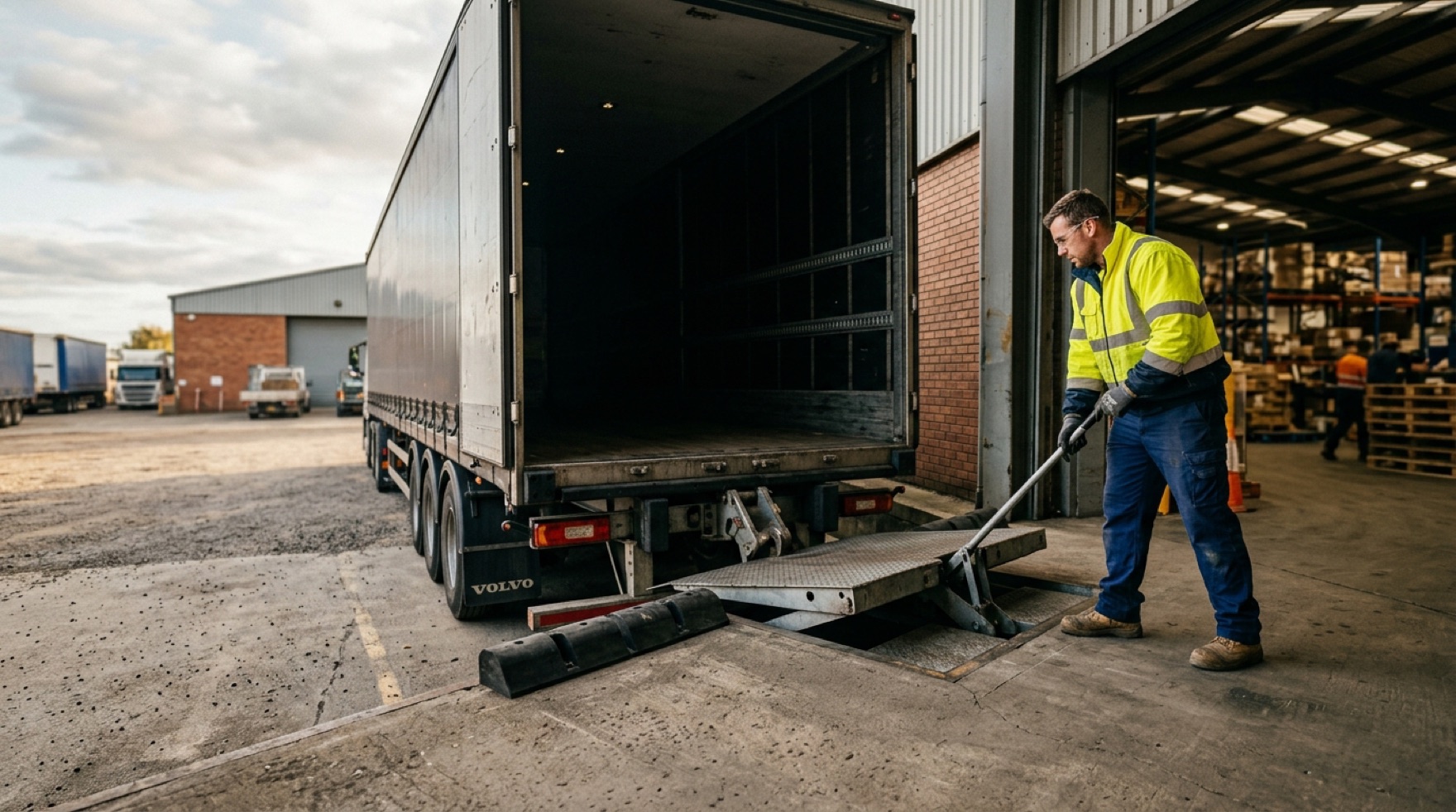
The bridge between dock and trailer has to carry the heaviest thing that will cross it and stay put while it does. Dockboards, including bridge plates and the leveling plates in dock levelers, are governed by 29 CFR 1910.26.
- Match the rating to the load. Dockboards must be capable of supporting the maximum intended load in accordance with 1910.26(a), referencing the load-capacity requirement of 1910.22(b). Know the loaded weight of the forklift plus its heaviest load, and never exceed the plate's marked capacity.
- Use run-off protection. Dockboards placed into service on or after January 17, 2017 must be designed, constructed, and maintained to prevent transfer vehicles from running off the dockboard edge, under 1910.26(b). Curbs, lips, or side rails serving that purpose should be present and undamaged.
- Secure portable dockboards. Portable dockboards must be secured by anchoring them or by using equipment or devices that prevent the board from moving out of a safe position, per 1910.26(c). A plate that can walk under traffic is the plate that drops a forklift into the gap.
- Inspect before use. Check the plate and the leveler for cracks, bent lips, worn or missing anchors, and a clean seat at both edges, and take a damaged board out of service until it is repaired.
How do you keep the open dock edge from becoming a fall?
An empty or unguarded dock position is an open drop, and the controls are clearance, marking, and a barrier at the edge. 29 CFR 1910.176 covers the materials-handling side of that.
- Allow safe clearances. Where mechanical handling equipment is used, sufficient safe clearances must be allowed for aisles, at loading docks, through doorways, and wherever turns or passage must be made, under 1910.176(a), and permanent aisles and passageways must be appropriately marked.
- Guard unused edges. Keep dock doors closed or barriers, gates, or chains across dock positions that are open but not in active use, so a worker or a truck cannot travel off the edge. Provide clearance signs to warn of clearance limits where they apply, per 1910.176(e).
- Keep stored freight stable. Material stacked in tiers near the dock must be stacked, blocked, interlocked, and limited in height so it is stable and secure against sliding or collapse, under 1910.176(b).
- Keep the surface clear. Aisles and passageways must be kept clear and in good repair with no obstruction that could create a hazard, and storage areas kept free of accumulations that cause tripping, per 1910.176(a) and 1910.176(c).
Read as one procedure, the four groups say the same thing the MIFACE case says in reverse: secure the vehicle, rate and fix the bridge, guard the edge, and keep the floor clear, in that order, before freight moves. The gap between the dock and the trailer is the job, and it is where the controls have to hold.