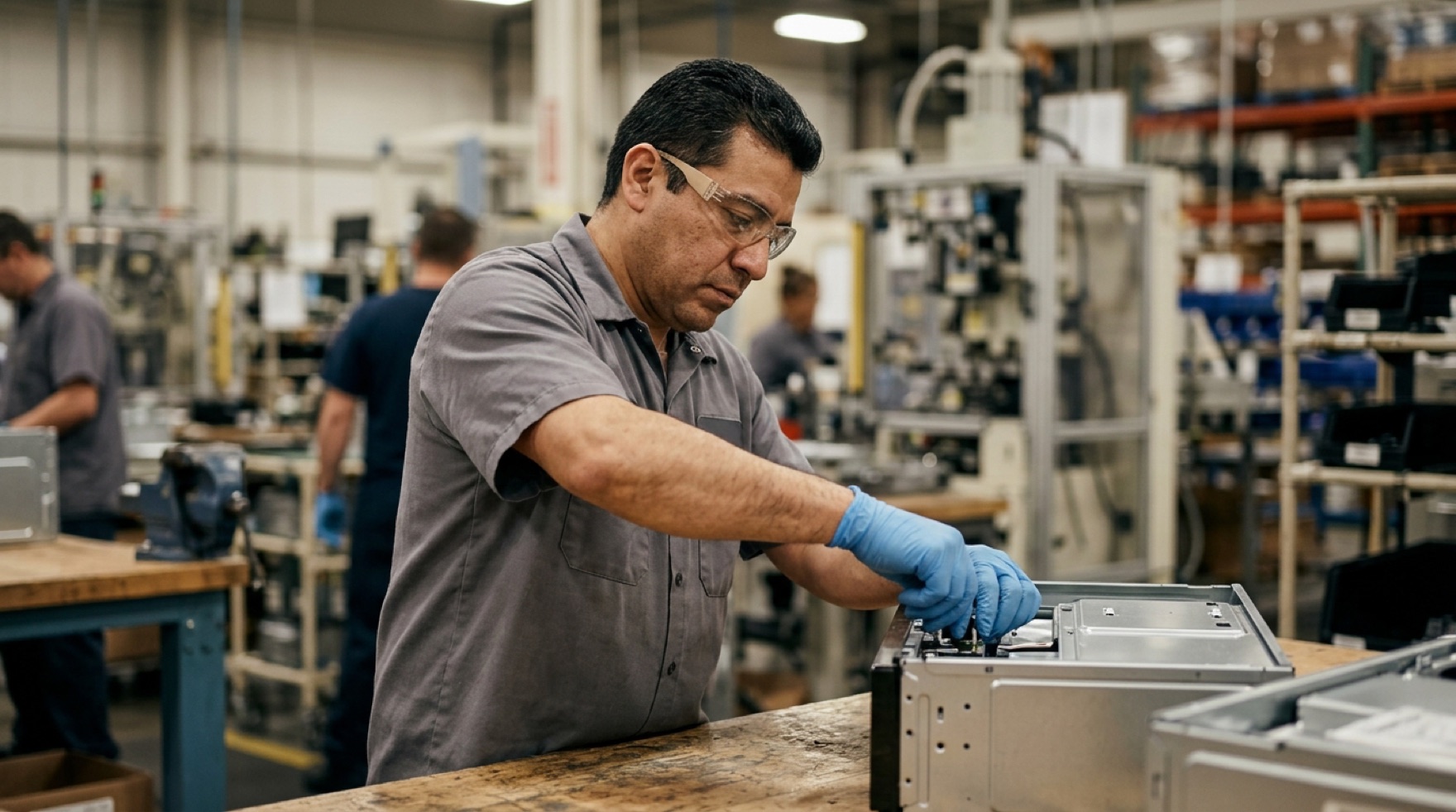
The short answer: Upper-limb repetitive strain injuries in assembly come from the interaction of hand force and hand activity, sustained over a shift with too little recovery, and the ACGIH Threshold Limit Value (TLV) for Hand Activity is the tool that makes that exposure measurable. It scores a task on two 0-to-10 scales, hand activity level (HAL) and normalized peak force, and combines them into a ratio with two lines: an Action Limit where general controls are recommended, and the TLV above which specific controls are needed. The TLV is an ACGIH guideline and is advisory, not an enforceable OSHA limit. OSHA addresses these disorders under the employer's general duty, so the TLV is best used as a design target that keeps a job below the level where hand and wrist injuries start.
What causes upper-limb repetitive strain injuries on an assembly line?
They are caused by the combination of force, repetition, awkward posture, and insufficient recovery, not by any one of those alone. Work-related musculoskeletal disorders affect the muscles, nerves, tendons, and ligaments, and OSHA's ergonomics guidance links them to performing the same or similar tasks repetitively, working in awkward postures, and forceful exertions. On a line, all four factors tend to appear in the same short cycle, which is why hand-intensive assembly is a classic setting for tendon and nerve disorders such as tendinitis and carpal tunnel syndrome.
The reason recovery belongs in that list is that tissue tolerates a lot of load if it is given time to recover between exertions. When the cycle is short and the same forceful pinch or twist recurs every few seconds, the recovery time disappears and the load accumulates, which is the exposure that ISO 11228-3:2007 on handling low loads at high frequency was written to assess, per the ISO 11228-3 record. The operational implication is that you cannot judge repetitive strain risk from the weight of the part. A light part handled forcefully hundreds of times an hour can be more damaging than a heavier one handled occasionally.
The disorders that result are specific, not vague aches. Repeated forceful gripping and wrist deviation are associated with tendinitis in the wrist and elbow, with carpal tunnel syndrome where the median nerve is compressed, and with the trigger finger that comes from repeated hard trigger pulls on powered tools. The pattern that makes them an operations problem is their onset: symptoms build over weeks, so the first signal an employer usually gets is a worker reporting numbness or a nagging ache, well after the exposure that caused it began. That lag is exactly why early symptom reporting sits at the center of OSHA's ergonomics process, because a complaint caught early is a task that can be redesigned, while one caught late is a trained operator on restricted duty.
What is the ACGIH TLV for Hand Activity, and what do the numbers mean?
The ACGIH TLV for Hand Activity rates a task on hand activity level and hand force, then combines them to say whether the exposure is acceptable, borderline, or unacceptable. Hand activity level (HAL) is rated 0 to 10 based on exertion frequency and the recovery time between exertions, averaged across the job, and normalized peak force is rated 0 to 10 for the relative effort of the most forceful part of the task, where 0 is no exposure and 10 is the greatest imaginable, as described in a peer-reviewed validation of the TLV for hand activity level.
Rating a task is an observational exercise, which is what makes the TLV usable on a real line rather than only in a lab. An assessor watches the job over several full cycles and estimates hand activity from how continuously the hand is working and how much genuine pause falls between exertions, then estimates the peak force from the most forceful moment, cross-checked against the operator's own rating of perceived exertion. Because both inputs are judgments on a 0-to-10 scale, the discipline is to score the task the operator actually performs at production pace, not a demonstration, and to record the basis so a re-score after a change is comparing like with like.
The two scores combine through the ratio of peak force to (10 minus HAL), and that ratio is read against two thresholds. Below a ratio of about 0.56, the Action Limit, the load is treated as acceptable. Between roughly 0.56 and 0.78 the job sits in a borderline zone where general controls are recommended, and above about 0.78, the TLV, the load is unacceptable and specific controls are needed. The same validation study, following workers over time, found a dose-response relationship between the ACGIH classification and carpal tunnel syndrome and concluded that the current Action Limit and TLV might not be fully protective, with increased risk seen even between the two lines. The practical reading is to treat the Action Limit, not the TLV, as the point to start designing risk out.
Is the ACGIH TLV enforceable, and does OSHA require anything?
The ACGIH TLV for Hand Activity is advisory, published by the American Conference of Governmental Industrial Hygienists as a professional guideline, and it is not an OSHA permissible exposure limit. That distinction matters: a PEL is an OSHA limit and is enforceable, while a TLV is an ACGIH recommendation with no independent legal force. Citing the TLV as if it were a federal limit is the kind of precision error that undermines an otherwise sound ergonomics case.
There is no specific federal OSHA standard that sets a numerical limit on repetitive hand work. OSHA instead addresses work-related musculoskeletal disorders through the employer's general duty to provide a safe workplace and through the prevention process in its ergonomics guidance, which is built on hazard identification, early symptom reporting, and evaluated controls. For a safety leader that is the useful framing: compliance does not hand you a number, so a recognized guideline such as the ACGIH TLV becomes the objective yardstick that turns a hand-strain complaint into a measurable design target the organization can act on.
How do you bring a repetitive hand task back under the limit?
Lower whichever input is driving the ratio, force or activity, because the TLV is a function of both. If the peak force score is high, the fastest gains come from cutting the force each exertion demands: better fixturing so the part is held rather than gripped, sharper or powered tools so a cut or a fastener needs less effort, larger and more compressible handles that spread the load, and removing pinch grips in favor of power grips. Each of those pushes the normalized peak force down, which moves the whole ratio toward the Action Limit.
If the hand activity score is high, the target is frequency and recovery. Rebalancing the line so a hand-intensive task is shared across more operators, rotating workers between high-activity and low-activity jobs, and building genuine micro-recovery into the cycle all lower the HAL and give tissue time to recover. Redesigning the workstation to keep the wrist near neutral, which our companion article on assembly-line ergonomics covers, removes the awkward-posture multiplier that makes the same force more damaging. The reason to measure before and after is simple: scoring the task against the TLV tells you which input to attack, and re-scoring it proves the control worked rather than just moved the effort somewhere else.