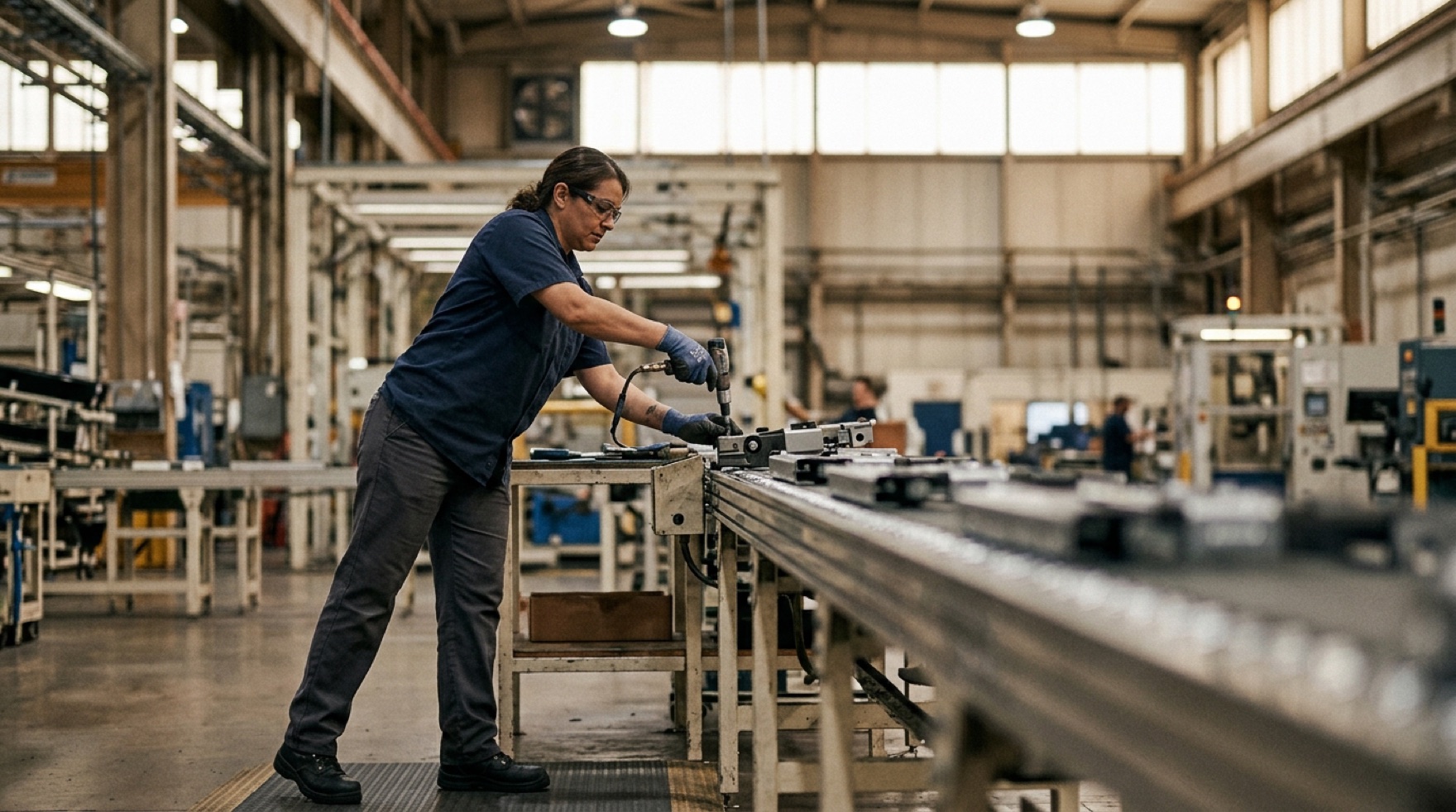
The short answer: Assembly-line work loads the body through three factors that compound: prolonged standing, reaching outside a neutral envelope, and high-frequency repetition. Prolonged standing alone produces sore feet, leg swelling, general muscular fatigue, and low back pain, according to CCOHS, while awkward reach and repetition drive the upper-limb disorders that OSHA groups under work-related musculoskeletal disorders (MSDs). The fix is to design the workstation around the worker: set work-surface height to the task, keep frequent parts inside the reach envelope, and treat repetition itself as a measurable exposure using guidance such as ISO 11228-3:2007. None of that is a single control, so the goal is a workstation and a job rotation that keep every part of the exposure below the level where injury starts.
Why does assembly-line work put workers at risk of musculoskeletal disorders?
Because the same job repeats the same load on the same tissues, thousands of times a shift, with little recovery between cycles. Work-related MSDs affect the muscles, nerves, tendons, ligaments, and blood vessels, and OSHA's ergonomics guidance ties them to lifting, reaching overhead, working in awkward postures, and performing the same or similar tasks repetitively, which is a fair description of most line-side work. The injury is rarely one event. It is the accumulation.
That accumulation is what makes assembly ergonomics an operational problem, not just a comfort one. An operator working at a poorly set bench absorbs a small penalty on every cycle, and the takt time guarantees the cycle count. Over weeks that shows up as discomfort, then as a reported strain, then as restricted duty or lost time, which is why OSHA frames MSDs as preventable through workstation and job design rather than through telling workers to be careful. The line does not get safer because people try harder. It gets safer when the workstation stops charging a penalty on every part.
How long is too long to stand at an assembly station?
There is no single time limit, but continuous static standing is the problem, and the control is variety rather than a magic number. CCOHS notes that prolonged, static standing reduces the blood supply to the loaded muscles and lets blood pool in the legs and feet, which accelerates fatigue and, over time, contributes to sore feet, swelling, varicose veins, low back pain, and stiffness in the neck and shoulders, per CCOHS guidance on working in a standing position. The body tolerates standing far better when the posture keeps changing.
That is why the strongest standing controls sit above matting and footwear. Where the task allows it, providing a seat so the operator can work either sitting or standing removes the static load rather than cushioning it, and job rotation that moves a worker between standing and non-standing tasks does the same across the shift. Anti-fatigue matting and supportive footwear help, but CCOHS is explicit that discomfort after long hours of standing is the combined effect of the design of the work, the footwear, and the flooring, so a mat is one layer inside a system rather than the answer on its own. Our companion piece on anti-fatigue matting for standing assembly stations works through where that layer belongs.
What is a neutral reach envelope, and how do you set bench height?
The neutral reach envelope is the zone an operator can reach with the upper arms relaxed at the sides and the wrists straight, and frequently handled parts, tools, and controls belong inside it. Anything the worker reaches for on every cycle that sits outside that zone forces shoulder elevation or trunk twisting hundreds of times a shift, which is precisely the awkward-posture exposure OSHA links to upper-limb and back disorders. Reach is not a fixed distance: it shrinks as the load in the hand grows and as the height moves away from the elbow.
In practice it helps to think of two zones. The primary zone is the arc the forearms sweep with the upper arms still at the sides, and it is where the highest-frequency parts, the trigger tools, and the fixture controls should sit, because those are the reaches that repeat on every cycle. The secondary zone is the wider arc reachable by extending the arm, which is acceptable for occasional items such as a replenished bin or a tool used once per unit, but not for anything the operator grabs continuously. When a high-frequency part drifts into the secondary zone, usually because a bin was moved to make room, the operator pays a shoulder and trunk penalty on every unit, and that is the kind of small change an ergonomics walkthrough is meant to catch before it turns into a reported strain.
Work-surface height is the other half of the setup, and it is set from the operator's elbow, not from a standard bench height. CCOHS recommends matching the surface to the task, and the general pattern is summarized below.
| Task at the station | Recommended work height | Why |
|---|---|---|
| Precision work (fine assembly, inspection) | About 5 cm above elbow height, with elbow support | Brings small parts close to the eyes without lowering the head, and supports the forearms |
| Light assembly / general bench work | At or just below elbow height | Keeps the shoulders relaxed and the wrists near neutral for most hand work |
| Heavier work needing downward force | Roughly 5 to 10 cm below elbow height | Lets the operator use body weight and larger muscle groups instead of the shoulders |
Those heights come from CCOHS guidance on standing work, and the practical implication is that a single fixed bench cannot suit a fine-assembly operator and a press-fit operator at the same height. Height-adjustable surfaces, or task-matched stations, are what let each job sit at the right level for the worker doing it.
When does repetition become the main hazard on the line?
Repetition becomes the dominant hazard when the cycle is short, the same motion recurs at high frequency, and recovery time between exertions is too small for the tissue to recover. At that point posture and standing still matter, but the sheer number of exertions is what drives the risk, and it needs to be assessed as an exposure rather than eyeballed. ISO 11228-3:2007, "Ergonomics. Manual handling. Part 3: Handling of low loads at high frequency," exists for exactly this case: it gives methods to identify and assess the risk factors in repetitive work so the health risk to the working population can be evaluated, per the ISO 11228-3 record.
The operational point is that repetition is measurable, and measuring it changes the conversation. Once a task is scored against a recognized method, a line balance that looked acceptable on throughput can be seen to overload one operator's hands while another's sit idle, and the fix becomes a design decision rather than a complaint. Where the exposure is upper-limb and hand-intensive, the ACGIH Hand Activity threshold gives a more specific yardstick for how much hand activity and force a job can carry before controls are needed.
The reason repetition can outrank standing and reach is recovery time. Tissue tolerates a given load if it gets time to recover between exertions, so a task with a short cycle and no micro-recovery loads the same tendons continuously, which is the condition ISO 11228-3 was written to evaluate. That points to two controls that standing and reach fixes cannot provide: rebalancing the line so a hand-intensive step is shared across more operators, and rotating workers between high-repetition and low-repetition tasks so no single set of tissues absorbs the whole shift. Neither slows the line if it is planned into the balance rather than bolted on after a complaint.
How should safety leaders build the assembly ergonomics program?
Build it as a repeating loop of finding the load, designing it out, and checking the result, not as a one-time workstation audit. OSHA's ergonomics process rests on management commitment, worker involvement, identifying problems before injuries occur, encouraging early reporting of symptoms, and implementing and evaluating controls, as its ergonomics overview sets out. The reason the loop matters is that lines change: a new product, a faster takt time, or a relocated bin quietly reintroduces the reach or the repetition the last redesign removed.
Three actions carry most of the value. First, get frequent parts and tools inside the reach envelope and set each station's height to its task, so the workstation stops charging a per-cycle penalty. Second, break up static standing and high-frequency repetition through sit-stand options and job rotation, so no single tissue takes the whole shift's load. Third, capture symptom reports early and feed them back into the workstation design, so a pattern of hand or shoulder complaints becomes a redesign trigger instead of a compensation claim. Done together, those reduce injuries, preserve workforce capacity, and keep the line running with the people who know it.