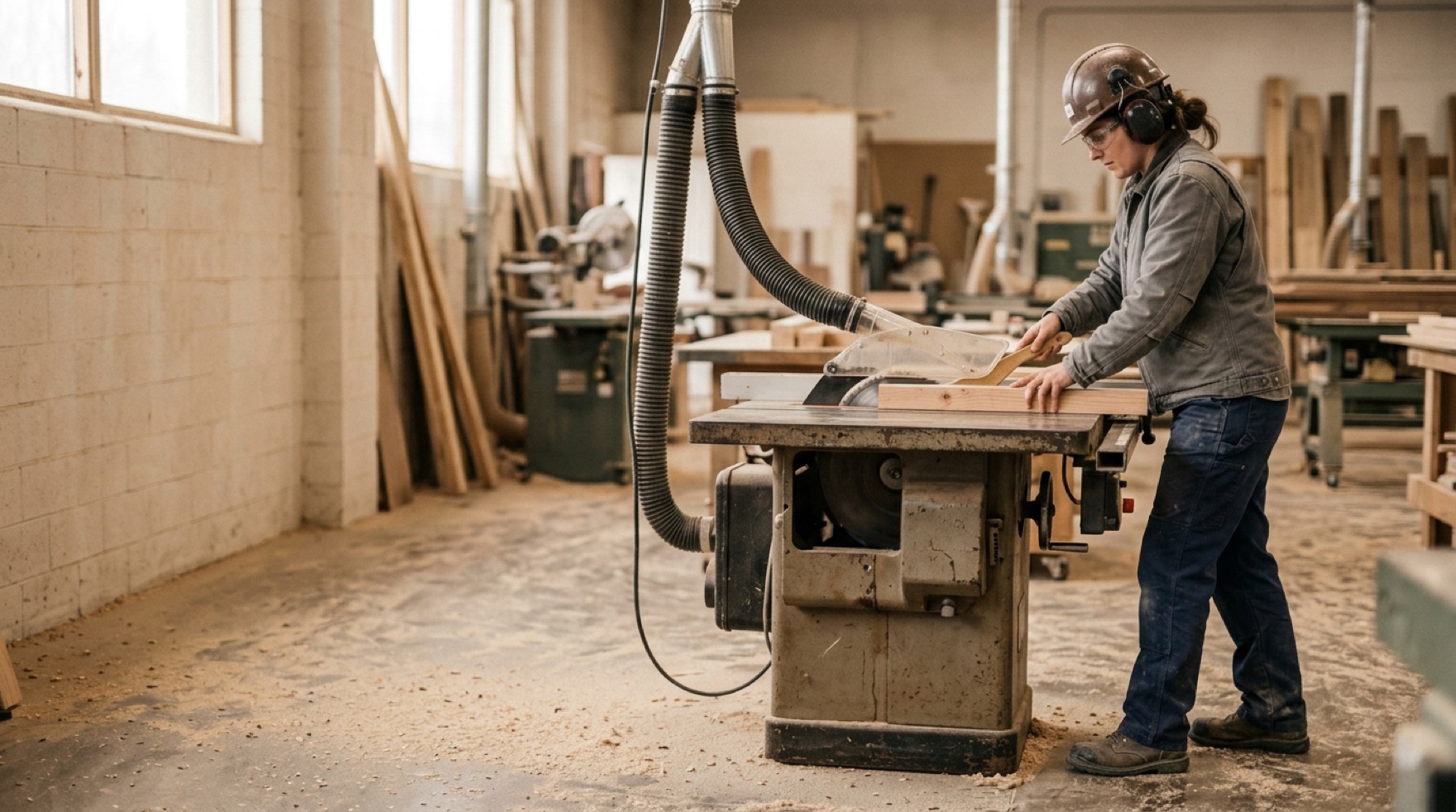
The short answer: Woodworking machine guarding is governed by 29 CFR 1910.213, which sets specific guard requirements machine by machine, on top of the general point-of-operation duty in 1910.212. A hand-fed circular saw needs a self-adjusting hood over the blade, a spreader thinner than the saw kerf, and non-kickback fingers or dogs. A jointer needs an automatic guard over the cutterhead, knife projection held within 1/8 inch of the cylindrical body, and no more than 1/8 inch clearance behind the rear table. The table below maps each common machine to its guard and its clause; the rule that ties them together is that the guard has to be in place and working before the blade turns.
Because 1910.213 is written per machine rather than as one general rule, the fastest way to use it is as a lookup: find your machine, confirm the guard it requires, and check the clause. The reference table below covers the machines a millwork or cabinet shop runs most, with the exact paragraph designation for each requirement.
Which guard does each woodworking machine require?
Every machine on this list has a defined guard in 1910.213, and the requirement is specific to how that machine cuts. The point of operation, the blade or cutterhead itself, is the focus, and the transmission parts (belts, pulleys, gears, shafts) are guarded separately under 1910.213(a)(9), which points to 1910.219.
| Machine | Primary hazard | Required guard | Clause |
|---|---|---|---|
| Hand-fed circular ripsaw | Contact, kickback | Hood completely enclosing the blade above the table, self-adjusting to stock thickness | 1910.213(c)(1) |
| Hand-fed circular ripsaw | Kickback (binding) | Spreader of hard tempered steel, thinner than the saw kerf, behind the blade | 1910.213(c)(2) |
| Hand-fed circular ripsaw | Kickback (ejection) | Non-kickback fingers or dogs to oppose the saw throwing stock back | 1910.213(c)(3) |
| Hand-fed crosscut table saw | Contact, kickback | Same self-adjusting hood as the ripsaw | 1910.213(d)(1) |
| Circular resaw | Contact, broken teeth | Hood or shield of metal above the saw | 1910.213(e)(1) |
| Self-feed circular saw | Contact, in-running rolls | Guard reaching within 3/8 inch of the plane of the feed-roll bottoms | 1910.213(f)(1) |
| Radial (radial arm) saw | Contact, kickback | Upper hood fully enclosing the upper blade, self-adjusting lower guard | 1910.213(h)(1) |
| Radial (radial arm) saw | Kickback | Non-kickback fingers or dogs on both sides of the blade | 1910.213(h)(2) |
| Jointer (hand-fed) | Amputation | Knife projection no more than 1/8 inch beyond the cylindrical cutterhead body | 1910.213(j)(1) |
| Jointer (hand-fed) | Amputation | Rear-table clearance to the cutterhead not more than 1/8 inch | 1910.213(j)(2) |
| Jointer (hand-fed) | Contact | Automatic guard covering the cutterhead on the working side of the fence | 1910.213(j)(3) |
| Transmission parts | Caught-in, entanglement | Belts, pulleys, gears, shafts guarded per 1910.219 | 1910.213(a)(9) |
What causes kickback, and which guards stop it?
Kickback is the saw seizing the stock and hurling it back toward the operator, and 1910.213 defends against it with three separate devices on a hand-fed circular saw. It happens when the material twists and binds against the sides of the blade or catches in the teeth, so the wood is thrown back along the line of the cut, often faster than a person can react. Dull blades, incorrect blade height, and knots or embedded metal in the stock all raise the odds, but the guarding is what limits the outcome.
The three devices do different jobs. The spreader, required behind the blade under 1910.213(c)(2) and thinner than the saw kerf, holds the cut open so the wood cannot pinch the blade and be launched. The non-kickback fingers or dogs, under 1910.213(c)(3), bite down to resist stock being picked up and thrown. The hood over the blade, under 1910.213(c)(1), limits contact and confines flying pieces. Removing any one of them, a common shortcut when an operator wants a clearer view of the line, defeats a control the standard treats as mandatory, and it is precisely the configuration that turns a bind into an injury.
What happens when the guard is missing?
An unguarded saw is one of the most consistently cited and most lethal conditions in the sawmill and woodworking trades. OSHA's enforcement file for a 2023 fatality makes the point starkly. According to OSHA's news release of July 13, 2023, a 21-year-old worker at Missouri Mats in Brashear, Missouri, less than a month into the job, was caught and pulled into the vertical edger blades of a saw while learning to operate it, and was killed. When inspectors returned weeks later, they found employees still running the same unguarded saw under the same conditions, along with saw blades, pulleys, belts, and grinding wheels without guards. OSHA cited two willful and dozens of serious violations, proposed $346,954 in penalties, and placed the company in its Severe Violator Enforcement Program. The transferable lesson is that the guarding requirements in 1910.213 only protect anyone if the guard stays on the machine, which is the gap this investigation records.
The rule that ties the standard together
Every clause in 1910.213 rests on the same duty: the guard has to be in place and functioning before the machine runs, and it does not come off for convenience. General machine guarding under 1910.212 requires point-of-operation protection on every machine, and 1910.213 spells out what that protection looks like for each saw and cutterhead. The failure mode is almost always the same, a guard removed for a clearer sightline, a faster feed, or a quick changeover and never replaced, and the fix is a shop discipline that treats a running machine with a missing or defeated guard as an out-of-service machine. Read the table for the specification, and enforce the one rule underneath it: no guard, no cut.