The short answer: Bar work packs same-level falls, lacerations, and musculoskeletal strain into a small, fast, wet workspace. 29 CFR 1910.22(a)(2) requires the floor of each workroom to be kept clean and, to the extent feasible, dry, and where wet processes are used it requires drainage and, to the extent feasible, dry standing places such as mats. Broken-glass cuts are controlled by never clearing glass by hand or with compressed air and by matching glove cut resistance to the task using the ANSI/ISEA 105 A1 to A9 scale. Strain from reaching at the speed rail and lifting kegs is an ergonomics problem: a full keg far exceeds the 51-pound load constant in the NIOSH Lifting Equation, so it is moved with equipment and team lifts, never wrestled and never pressurized with plant air.
Behind the bar, the hazards are the kind that get normalized because they are constant. The floor is wet from the first pour to last call, glass breaks in the dish pit and the service well, and the body spends the shift reaching, twisting, and bending to low coolers. The consequences show up as slips, as cuts that need stitches, and as the wrist and back complaints that quietly drive turnover. Each one has an established control, and the controls cost far less than the injuries and the lost shifts they prevent.
What does OSHA require for wet bar floors?
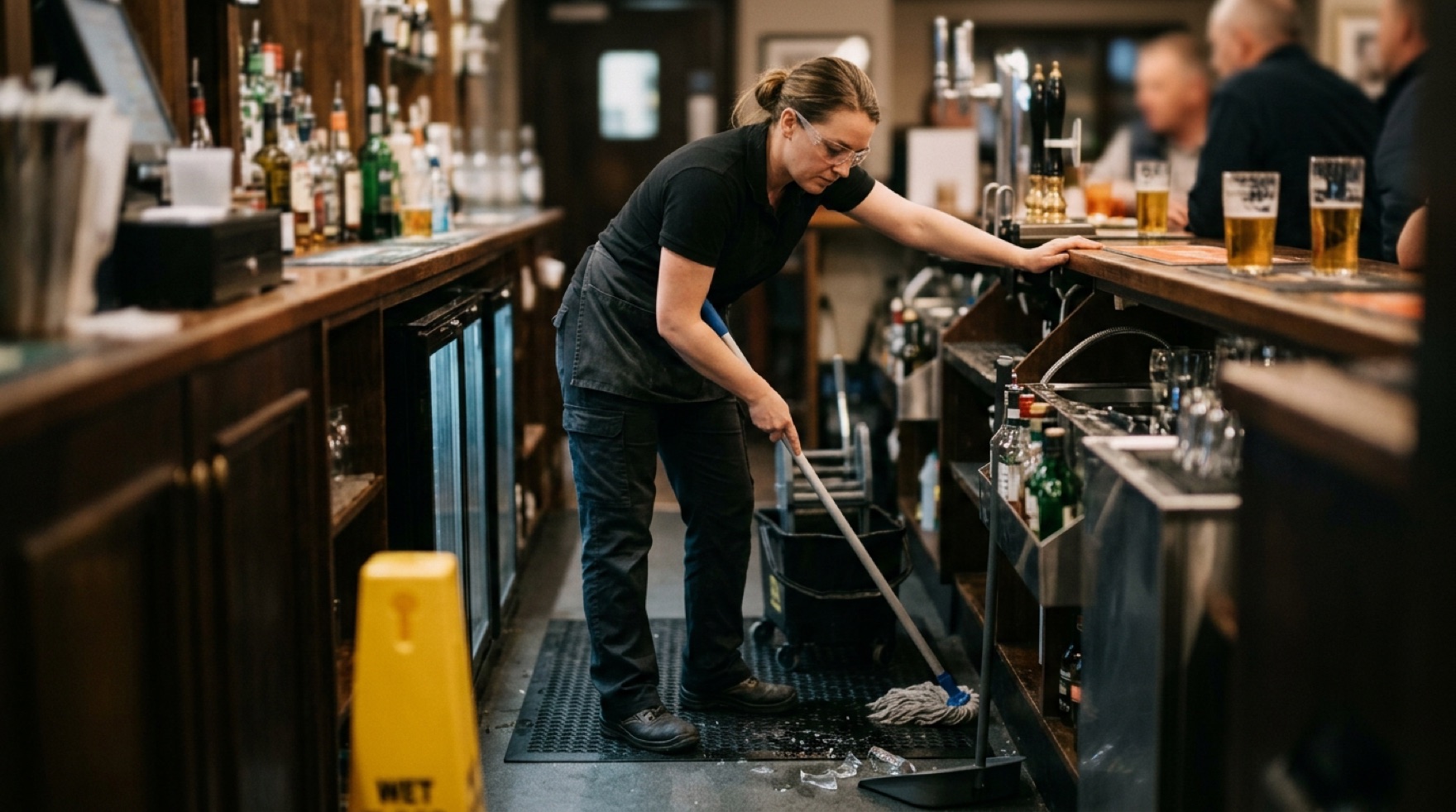
OSHA's walking-working surface rule requires the floor to be kept clean and, so far as feasible, dry, and where a process keeps a floor wet it requires drainage and dry standing places such as mats. 29 CFR 1910.22(a)(2) states that the floor of each workroom must be maintained in a clean and, to the extent feasible, dry condition, and that when wet processes are used, drainage must be maintained and, to the extent feasible, dry standing places such as false floors, platforms, and mats must be provided. A bar is a wet process by any reasonable reading: melting ice, spillage, condensation off cold glassware, and rinse water keep the floor behind the well damp for the entire service.
That means the mat behind the bar is not an amenity, it is one of the controls the standard points to. A slip-resistant, drainage-style mat or duckboard gives staff a dry standing surface above the water, and the standard's own language pairs mats with maintained drainage rather than treating either alone as the fix. The same rule adds, at 29 CFR 1910.22(a)(3), that walking-working surfaces must be kept free of hazards such as spills, so a spill-response habit, cleaning and drying it or coning it off as it happens, is part of compliance rather than an extra. A mat sits below elimination and engineering in the hierarchy of controls: keep ice wells and drains working and clean spills at the source first, then use the mat to protect the standing places that stay wet anyway.
The operational point for anyone running a venue is that the two failure modes reinforce each other. A wet floor is a slip risk on its own, but a wet floor plus a dropped glass turns a same-level fall into a laceration, because the hands and knees land where the glass is. Controlling the floor is therefore the first move in controlling the glass.
How should bar staff handle broken glass to prevent lacerations?
Broken glass is never cleared with bare hands or with compressed air; it is contained with a broom, dustpan, or tongs, and the residue is picked up with a damp paper towel, then discarded into a separate, rigid glass-only bin. Reaching into a sink, an ice well, or a bus tub that may hold a broken stem is how most bar lacerations happen, so the rule is simple: if glass has broken in water or ice, the water is drained or the ice is scooped out with a scoop before any hand goes in. Compressed air has no place near broken glass, because it turns shards into projectiles aimed at the eyes and skin of everyone nearby.
Where a cut hazard remains, glove selection follows the ANSI/ISEA 105 cut-resistance scale. The current edition, ANSI/ISEA 105-2024, rates cut resistance on a nine-level scale from A1 to A9 using the ASTM F2992 test method, where A1 is the lowest level and A9 the highest. Handling and disposing of broken glassware sits in the medium-risk band that typically calls for a mid-range level rather than the lightest food-prep glove, and the selection has an ergonomic side: a heavier, stiffer high-level glove reduces dexterity, so the right choice is the lowest level that actually addresses the cut hazard for the task while preserving the grip and feel the work needs. The table below maps the three bar hazard clusters to their controls and the source that governs each.
| Hazard | Primary control | Governing reference |
|---|---|---|
| Same-level fall on a wet floor | Maintain drainage, provide dry standing places such as mats, clean spills at the source | 29 CFR 1910.22(a)(2), (a)(3) |
| Laceration from broken glassware | Never clear glass by hand or with compressed air; use a broom, tongs, and a glass-only bin; match glove cut level to the task | ANSI/ISEA 105 (A1 to A9 cut levels) |
| Strain from reach and keg handling | Neutral working heights, anti-fatigue standing surface, team lift and keg carts, no compressed air on kegs | NIOSH Lifting Equation; General Duty Clause |
Two habits close the gap that the standard cannot legislate. Chipped or cracked glassware is pulled from service before it fails in someone's hand, and broken glass is bagged and binned separately so it never becomes a hazard for the person emptying the trash or the porter compacting it. A cut that a bartender works through is still a recordable injury and a bloodborne-pathogen exposure risk behind a bar handling other people's drinks, which is why containment, not toughing it out, is the expectation.
How do you reduce repetitive strain and awkward reach behind the bar?
Strain behind the bar comes from sustained standing, repetition, and awkward reach, so the controls are neutral working heights, a supportive standing surface, and rotation that breaks up the repetitive tasks. A bartender spends the shift on a hard floor, reaching into the speed rail, scooping ice from a low well, twisting to the back bar, and bending into under-counter coolers, each of which loads the wrist, shoulder, or lower back in a posture held for hours. There is no OSHA standard that sets a maximum for any of this, so it is governed by the General Duty Clause and by treating the recognized ergonomic hazard the way any other exposure is treated: identify it, then engineer it down.
Practically, that means arranging the well so the highest-frequency items, the speed rail, the ice, the most-used glassware, sit within a close, neutral reach envelope rather than at the edges of the workspace, so the common motions happen with the elbows near the body rather than at full stretch. It means an anti-fatigue standing surface that also serves the wet-floor duty from the first section, so one mat does two jobs: traction and drainage above the water, and cushioning that reduces the static standing load on the legs and lower back over a long shift. And it means scooping ice with a scoop, never with a glass, both to avoid the strain of a bad wrist posture and to remove the risk of a glass shattering in the ice well and seeding the exact broken-glass hazard the second section is about.
What is the safe way to handle and move kegs?
A full keg is moved with equipment and a team lift, never carried solo and never pressurized or purged with compressed air. A full half-barrel keg holds 15.5 gallons, so the liquid alone weighs well over a hundred pounds and the full keg comes to several times the 51-pound load constant that the NIOSH Lifting Equation uses as the maximum recommended load under ideal conditions before any adjustment for how far it is reached, how often it is lifted, or how it is gripped. OSHA does not set a numeric limit on how much a person may lift, as the agency confirms in its own interpretation of the question, but the General Duty Clause still requires the employer to address a recognized manual-handling hazard, and a 160-pound object with no good handhold, moved down cellar stairs onto a wet floor, is exactly that. Kegs are moved on a keg cart or hand truck, down a ramp rather than stairs where possible, and lifted onto a coupler by two people or with a lift aid, not muscled by one.
The compressed-air point is not incidental, and a documented fatality makes it concrete. According to an OSHA investigation reported by Occupational Health & Safety, a 26-year-old worker at the Redhook Brewery in Portsmouth, New Hampshire was killed on 24 April 2012 while using a compressed-air line to purge liquid from the inside of a plastic keg, which over-pressurized and exploded, striking him. OSHA found the line lacked a regulator to hold the pressure below the roughly 60 psi that keg manufacturers set as the limit, and cited the company for 14 serious violations with $63,500 in proposed penalties. This was a brewery rather than a bar, but the failure transfers directly: a keg is a pressure vessel, plant air can drive it far past its rated pressure, and the only gases that belong on a keg are the regulated CO2 or beer-gas blends the system is designed for. The transferable lesson for any venue that taps, cleans, or moves kegs is that compressed shop air and kegs do not mix, and that a regulator is not optional.
Treating the bar as a workspace, not just a service point
The bar earns its safety the same way any other workstation does, by naming the hazards it actually presents and controlling them before the shift starts rather than after an incident. The wet floor is a walking-working surface that 29 CFR 1910.22 expects to be drained, matted, and cleared of spills; the glassware is a laceration source that is contained with tools and the right cut-level glove rather than a bare hand or an air line; and the reach and the kegs are an ergonomics exposure that neutral heights, a standing mat, keg carts, and team lifts bring back within reach of the NIOSH limits. Handled together, these controls protect the people who keep the venue running and cut the slips, stitches, and strain injuries that otherwise read as just part of the job. They are not, and a bar run as a designed workspace proves it every shift.