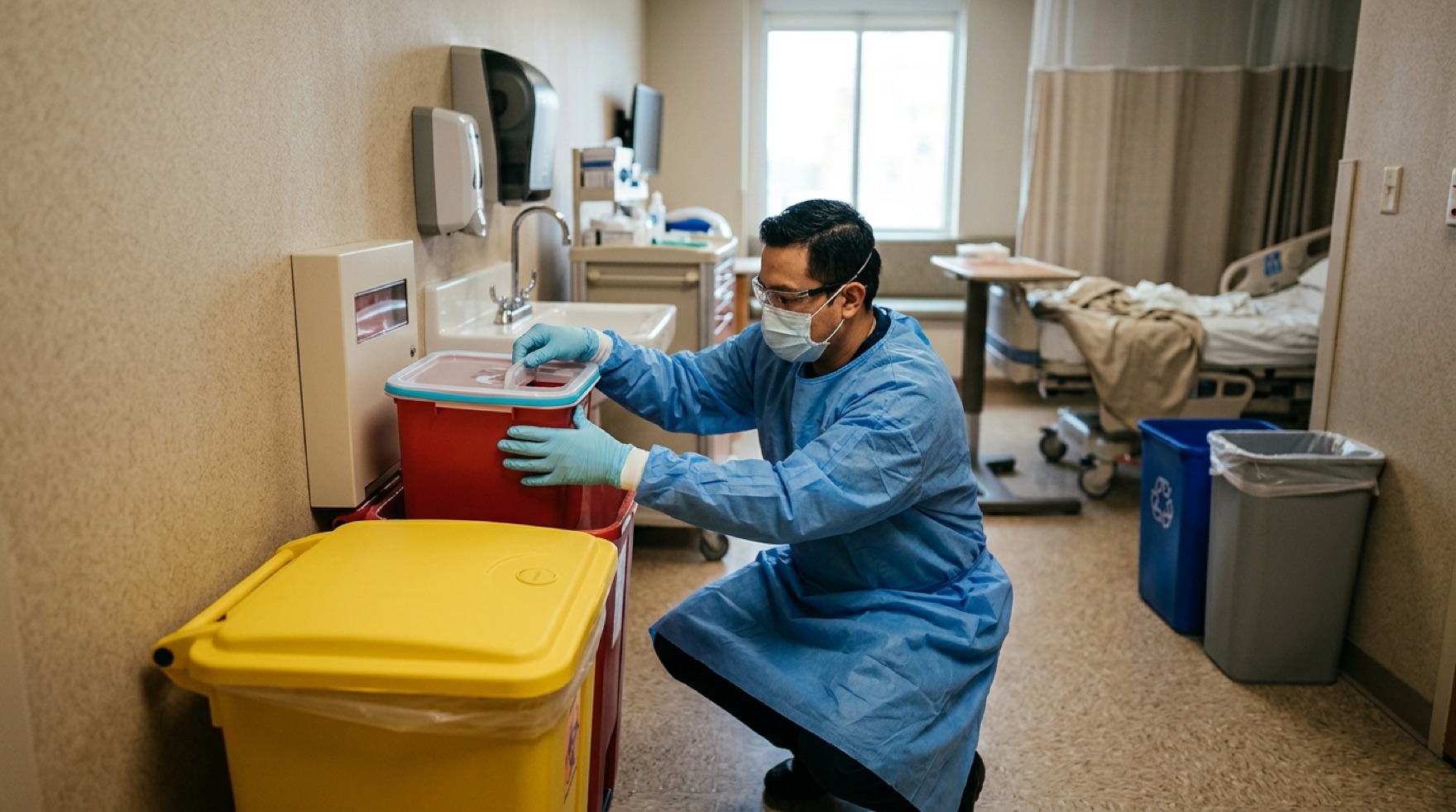
The short answer: If a cleaning or custodial worker can reasonably be expected to contact blood or other potentially infectious materials, for example emptying trash that may hide discarded needles or cleaning up a blood spill, that worker is covered by OSHA's Bloodborne Pathogens Standard, 29 CFR 1910.1030. The employer must have a written Exposure Control Plan, offer the hepatitis B vaccine at no cost, provide gloves and other PPE, supply proper sharps and biohazard containers, and train the crew at least annually. On the floor, the crew treats all blood and body fluids as infectious, never recaps or hand-picks a found needle, and reports any exposure immediately for medical follow-up.
The rest of this article is built as working checklists, because that is how the standard actually gets used on a cart and a spill. Two clauses anchor everything below: coverage under 1910.1030(a) and (b) turns on whether exposure is reasonably anticipated, and universal precautions under 1910.1030(d)(1) mean you treat every fluid as if it carries a bloodborne pathogen.
Are cleaning and custodial crews covered by the bloodborne pathogens standard?
You are covered if your job can reasonably be expected to bring you into contact with blood or other potentially infectious materials, and for a lot of cleaning work it can. 1910.1030(b) defines occupational exposure as reasonably anticipated skin, eye, mucous membrane, or parenteral (needlestick) contact with blood or other potentially infectious materials, and 1910.1030(a) applies the standard to any employee with that exposure. Cleaning restrooms and locker rooms, handling regulated waste, and picking up trash in settings where sharps get discarded all put a custodial worker inside that definition.
Whether it applies to your specific crew is a determination your employer has to make and write down, not a guess you make on the floor. If the answer is that exposure is reasonably anticipated, every item in the checklists below is owed to you. If your employer has decided the standard does not apply, that decision should be documented, and the presence of a single sharps injury or a routine of cleaning up blood is a strong signal the determination needs another look.
What must your employer have in place before you clean? (program checklist)
Before a covered crew works, the employer owes a set of program elements, each tied to a clause. Use this as an audit list; a gap here is a gap in your protection.
- A written Exposure Control Plan designed to eliminate or minimize exposure, under 1910.1030(c)(1)(i), reviewed and updated at least annually and whenever tasks change, under 1910.1030(c)(1)(iv).
- Hepatitis B vaccine offered at no cost, made available to all workers with occupational exposure under 1910.1030(f)(1)(i), and offered within 10 working days of initial assignment after training under 1910.1030(f)(2)(i).
- PPE provided at no cost, under 1910.1030(d)(3)(i): gloves whenever hand contact with blood or contaminated items can be anticipated (1910.1030(d)(3)(ix)), plus eye protection and gowns where splashing is possible.
- Proper sharps containers that are closable, puncture-resistant, leakproof on the sides and bottom, and labeled or color-coded, under 1910.1030(d)(4)(iii)(A)(1).
- Biohazard labeling on regulated-waste containers and storage, fluorescent orange or orange-red with contrasting symbols, under 1910.1030(g)(1)(i); red bags or red containers may be used instead.
- Training at no cost, during work hours, at initial assignment and at least annually thereafter, under 1910.1030(g)(2)(i) and (g)(2)(ii).
What do you do when you find a sharp? (found-sharps checklist)
A discarded needle is handled with a tool and a rigid container, never with your fingers, and never by recapping it. 1910.1030(d)(2)(vii) prohibits bending, recapping, or removing contaminated needles unless no alternative is feasible, and then only with a mechanical device or a one-handed technique. Work the found sharp like this:
- Stop and look before you reach. Never push a bare or gloved hand into a trash bag, a bin, or a crevice you cannot see into. Sharps hide in restroom bins, under paper towels, and in the seams of furniture.
- Use a mechanical means to pick it up: tongs, forceps, a brush and dustpan, or a grabber. Keep the point aimed away from you and anyone nearby.
- Do not recap, bend, break, or hand-carry the needle. Move it directly to the container.
- Place it in a closable, puncture-resistant, leakproof, labeled sharps container that meets 1910.1030(d)(4)(iii)(A)(1). Do not use a soda bottle or a trash bag as a substitute.
- Do not overfill. Replace a sharps container before it reaches the fill line; an overfilled container is itself a needlestick hazard.
- Report the find and any injury so the employer can log it, restock, and address why a sharp reached an unprotected area.
How do you clean up a blood or body-fluid spill? (spill checklist)
Treat every spill as infectious and put a barrier between it and you before anything else. Universal precautions under 1910.1030(d)(1) mean all blood and, where you cannot tell fluids apart, all body fluids are handled as potentially infectious, no exceptions for how minor it looks. Work the spill in order:
- Put on gloves and, if splashing or spatter is possible, eye protection and a gown, per 1910.1030(d)(3)(ix) and (d)(3)(i). Replace disposable gloves as soon as they are contaminated or torn.
- Confine the spill and remove any broken glass or sharps with a mechanical tool, not your hands, then place them in the sharps container.
- Absorb and clean the visible material, then apply an appropriate disinfectant registered as effective against bloodborne pathogens, following the product's SDS and contact time.
- Bag contaminated materials as regulated waste in labeled or red biohazard containers per 1910.1030(g)(1)(i); do not put wet, saturated waste in ordinary trash.
- Remove gloves without touching the outside, and wash your hands with soap and running water immediately afterward.
What do you do after an exposure? (post-exposure checklist)
An exposure is a medical event to report the same day, not something to shrug off. 1910.1030(f)(3) requires the employer to make a confidential medical evaluation and follow-up available immediately after an exposure incident, at no cost. If a needle sticks you, or blood reaches your eyes, mouth, or broken skin:
- Wash the site right away: soap and water for a needlestick or skin contact; flush the eyes or mouth with water.
- Report it to your supervisor immediately, so the incident is documented and the follow-up clock starts.
- Get the post-exposure evaluation, which under 1910.1030(f)(3) includes documenting how the exposure happened, identifying and testing the source where feasible, testing your blood with your consent, offering post-exposure prophylaxis when medically indicated, and counseling.
- Keep it confidential and cost-free: the evaluation and any follow-up are provided at no cost to you, and the hepatitis B vaccine remains available if you had previously declined it.
The thread through all four checklists is that bloodborne pathogen protection for cleaning crews is a system the employer builds and the worker runs: the plan, the vaccine, the PPE, and the containers have to be in place first, and then universal precautions, safe sharps handling, and immediate reporting do the rest. Custodial staff carry a real share of this exposure precisely because the needles and spills they meet were left by someone else, which is why the standard puts the program burden on the employer and the moment-to-moment habits on a crew that knows what to do before it happens.