The short answer: The cleaning products janitorial staff use every shift are hazardous chemicals covered by OSHA's Hazard Communication Standard, 29 CFR 1910.1200. That means the employer must maintain a written hazard communication program, keep a safety data sheet (SDS) for every product readily accessible during the shift, make sure each container is labeled, and train workers on the hazards and safe handling before they use the product. The single hazard the standard most directly guards against on a cleaning cart is mixing incompatible chemicals: combining a bleach product with an acid descaler releases chlorine gas, and combining bleach with ammonia releases chloramine gases, both of which can send a cleaner to the hospital or worse.
Does OSHA's Hazard Communication Standard apply to everyday cleaning products?
Yes. If a cleaning product carries a hazard, and most disinfectants, degreasers, drain openers, oven cleaners, and acid descalers do, it falls under 29 CFR 1910.1200, and the employer's duties attach the moment it is used at work. There is no exemption for a spray bottle just because the same brand sits under a sink at home. The standard treats the chemical by its hazard, not by the setting, so a janitorial cart of consumer-looking products is a workplace inventory of hazardous chemicals that has to be managed like any other.
That framing matters because it decides who is responsible for what. The manufacturer classifies the hazard and supplies the label and the SDS, and the employer builds the program that gets that information to the person holding the trigger. For a cleaning crew, the practical test is simple: if a product can burn skin, irritate lungs, catch fire, or react dangerously with another product, HazCom applies, and the worker is entitled to know it before the cap comes off.
What has to be in a janitorial hazard communication program?
A compliant program is a written plan plus the three things it delivers: labels, safety data sheets, and training. 1910.1200(e)(1) requires the employer to develop, implement, and maintain a written hazard communication program at each workplace, describing how the labeling, SDS, and training requirements are met and including a list of the hazardous chemicals present. For a cleaning operation, that chemical list is essentially the cart and the supply closet inventoried by product.
The written plan is not the point on its own; it is the map to the three worker-facing controls. Each one answers a different question a cleaner has in the moment: the label on the bottle says what this is and how bad it is, the SDS says what to do with it and what to do if it goes wrong, and the training makes both usable. A program that exists as a binder nobody opens, while the secondary spray bottles are unlabeled and the SDS folder is locked in an office, meets the paperwork and fails the worker.
Where do safety data sheets and container labels fit in?
Safety data sheets and labels are the reference layer, and both have to be present where the work happens. Under 1910.1200(g)(2), every SDS follows a standardized 16-section format covering identification, hazards, first-aid, firefighting, handling and storage, and exposure controls, and 1910.1200(g)(8) requires the employer to keep those sheets readily accessible to employees during each work shift, in their work area. An SDS that a cleaner cannot reach in the minutes after a splash is not readily accessible in any meaningful sense.
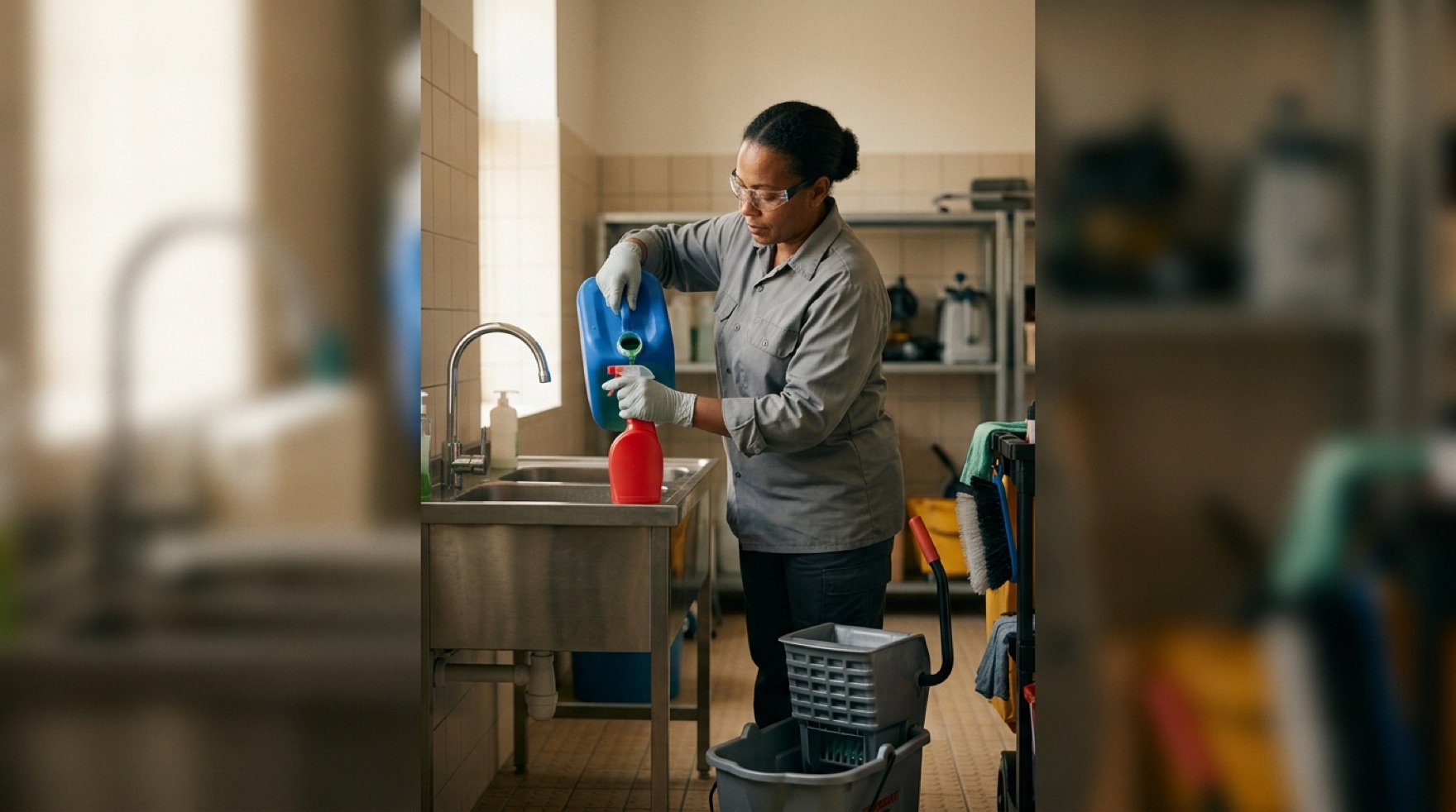
Labeling runs on two tracks. 1910.1200(f)(1) requires shipped containers to carry the full GHS label: product identifier, signal word, hazard statements, pictograms, precautionary statements, and the supplier's name and contact information. When a cleaner decants a concentrate into a spray bottle or bucket, 1910.1200(f)(6) requires that workplace container to be labeled too, either with the same information or at least the product identifier plus words, pictures, or symbols conveying the hazards. The unlabeled blue spray bottle of "cleaner" is one of the most common HazCom violations on a cart, and it is exactly the condition that lets someone grab the wrong product.
Why is mixing cleaning chemicals the hazard HazCom is built to prevent?
Mixing incompatible products turns two ordinary cleaners into a toxic gas in seconds, and it is the failure that hazard communication is meant to stop upstream. According to the New Jersey Department of Health, mixing chlorine bleach with an acid, such as a toilet-bowl cleaner, a rust or lime remover, or some dishwasher detergents, produces chlorine gas, and mixing bleach with ammonia produces chloramine gases; both cause coughing, shortness of breath, chest pain, and eye and throat irritation, and higher exposures can lead to fluid in the lungs and can be fatal. A worker who has read the label and the SDS knows not to combine them. A worker who was handed a bottle and told to clean does not.
A Massachusetts fatality shows how fast this happens when the information does not reach the person cleaning. The Massachusetts FACE program, part of the state Department of Public Health's occupational health surveillance work, investigated a November 2019 incident in which a 32-year-old restaurant manager died after cleaning products were mixed on a kitchen floor. A worker had poured a bleach-based product, then reached for the next container on the shelf, an acid-based product, and the two reacted into a toxic vapor. The manager tried to squeegee the foaming liquid out a rear door and was overcome; several other people were treated at hospitals. The investigators pointed to hazard communication, training, and keeping products in labeled original containers. This was a restaurant kitchen rather than a janitorial closet, but the mechanism is identical to a custodial cart: two incompatible cleaners, used together by someone who did not have the hazard information that 1910.1200 is written to deliver.
Which cleaning chemicals should never be mixed?
Bleach is the common denominator in the combinations that hurt cleaners, and the safe rule on a cart is to never mix products and to keep bleach away from acids and ammonia entirely. The table below summarizes the dangerous combinations documented in the New Jersey Department of Health worker hazard alert. Treat it as a hard "do not," not a "ventilate and proceed."
| Mix | What it releases | Common products that hide the ingredient |
|---|---|---|
| Bleach + acid | Chlorine gas | Toilet-bowl cleaners, lime/rust/scale removers, some dishwasher detergents, oven cleaners |
| Bleach + ammonia | Chloramine gases | Glass cleaners, some all-purpose and floor cleaners |
| Bleach + vinegar or lemon | Chlorine and chloramine vapors | "Natural" or citrus cleaners, descaling solutions |
| Bleach + rubbing alcohol | Chloroform and other irritants | Disinfectant wipes and sprays used alongside bleach |
| Two different drain cleaners | Violent reaction, heat, and gas | Any two drain openers combined in a clogged line |
The operational point behind the table is that the ingredient is usually invisible on the front of the bottle, which is why the SDS and the label carry the warning and why reading them is the control. A cleaner cannot see the acid in a descaler or the ammonia in a glass cleaner, so the defense is procedural: one product at a time, rinsed between, in a ventilated space, with the labels intact.
What training does 1910.1200 require, and by when?
Training has to happen before the worker uses the chemical, and it has to be effective, not just handed over. 1910.1200(h)(1) requires effective information and training at the time of initial assignment and whenever a new chemical hazard is introduced into the work area, and 1910.1200(h)(3) sets the content: how to detect a release, the physical and health hazards, the protective measures available, and how to read the labels and the SDS. For a cleaning crew, the highest-value part of that content is the specific "never mix these" instruction and how to use PPE such as gloves and eye protection, delivered in a language the crew actually understands.
There is also a live compliance date worth planning around. OSHA updated the Hazard Communication Standard to align with a newer edition of the Globally Harmonized System (GHS Revision 7), and under 1910.1200(j)(2) employers must have updated their program, labels, and training for hazardous chemical substances by 20 November 2026; the corresponding employer deadline for mixtures is 19 May 2028. For janitorial employers, that means refreshed SDS binders and a training touch that confirms crews can still read the label and find the sheet. Hazard communication is a baseline, and the real protection comes from a crew that treats every product as one chemical to be understood on its own and never combined with another, which is the habit that would have prevented the Massachusetts fatality and prevents the everyday chlorine-gas call that never makes the news.