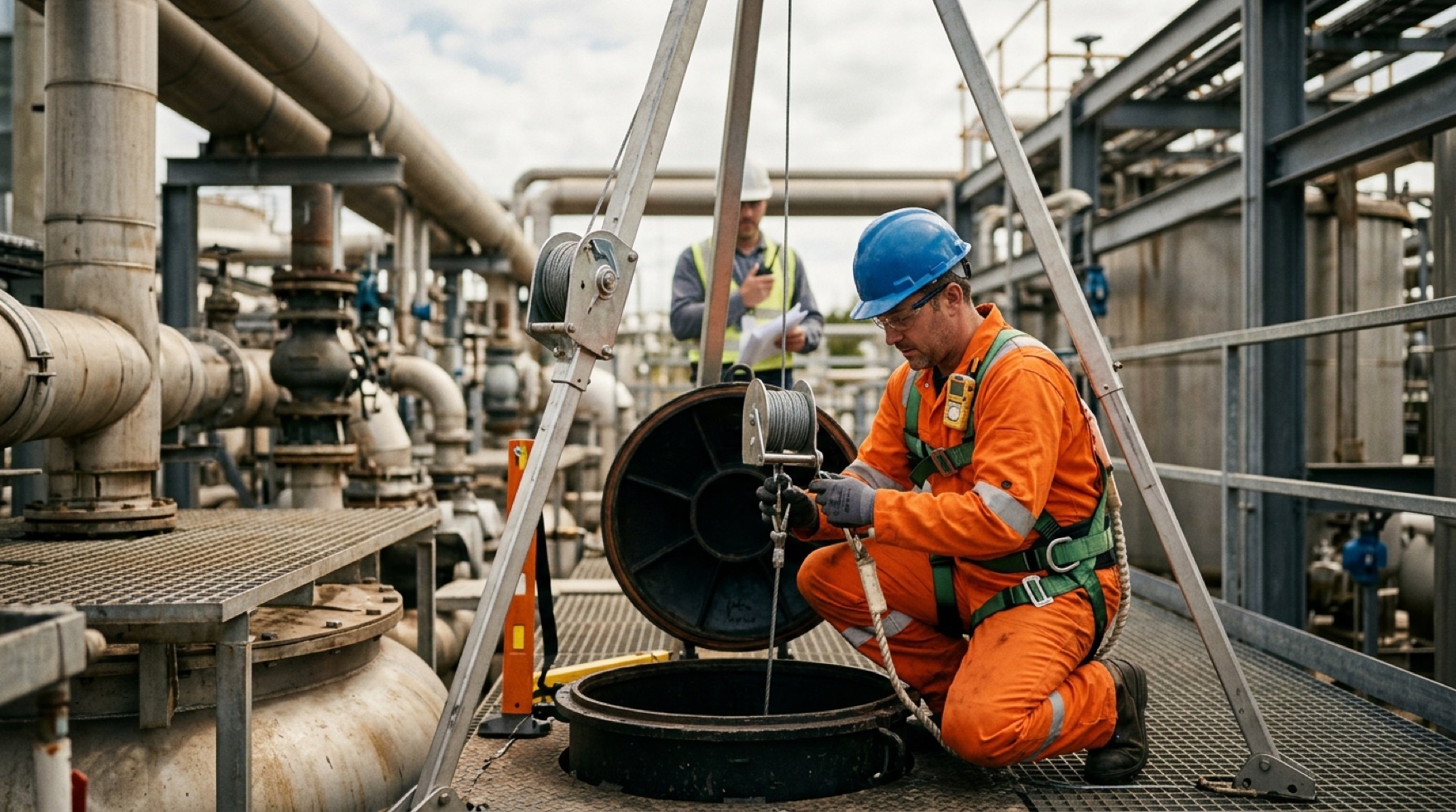
From fatal falls to toxic vapors, confined spaces can contain serious hazards. In this article, we’ll break down the difference between confined spaces and permit spaces, as well as the importance of hazard elimination, permit programs, and training.
Confined Spaces
In OSHA’s Permit-Required Confined Spaces publication, they differentiate spaces that are “confined” from those which are so hazardous that require a permit for a worker to enter. The former (“confined spaces”) include spaces such as tanks, hoppers, manholes, tunnels, pipelines, pits, and equipment housings. The latter (“permit spaces”) are confined spaces that additionally pose a health or safety hazard that can’t be eliminated, as we’ll discuss in the next section.
As OSHA describes in the publication, a confined space is any space that “is large enough for an employee to enter fully and perform assigned work,” that is “not designed for continuous occupancy by the employee”, and “has a limited or restricted entry or exit.”
Of course, these spaces alone pose their own kinds of risks, such as restricted airflow, proximity to machine components, or entrapment hazards that wouldn’t normally arise in the open workplace. However, as long as these hazards are eliminated, the space can be reclassified as a “confined space” rather than a permit space.
Permit-Required Confined Spaces
On the other hand, a “permit space,” also called a permit-required confined space, refers to spaces that “contain a hazardous atmosphere; contains material that has the potential to engulf an entrant; has walls that converge inward or floors that slope downward and taper into a smaller area which could trap or asphyxiate an entrant; or contains any other recognized safety or health hazard, such as unguarded machinery, exposed live wires, or heat stress.”
Under OSHA’s standard for confined spaces (1910.146), employers are required to protect their workers from the hazards of permit spaces. This requires a workplace evaluation to be regularly conducted to address the eliminable hazards of confined spaces and, where hazards can’t be eliminated, reclassification as “permit spaces” and informing workers about the dangers they pose, such as by posting a danger sign.
For instance, a permit space may regularly fill with combustible or toxic gases and vapors. Employers must ensure that these atmospheric conditions are controlled and brought to safe levels before worker entry is allowed – such as by ventilating the space or equipping the worker with proper gear to safely enter it.
A permit space program will then need to be developed to control access to the space and only allow entry when acceptable entry conditions are verified – such as through atmospheric condition tests, properly equipped entrants, or a rescue team (or the means to summon them) is made available. A comprehensive breakdown of what this program must entail begins on page six of the Permit-Required Confined Spaces publication linked above.
Training is another crucial component of a confined space entry program. Workers and rescue teams must receive comprehensive training to recognize the hazards associated with confined spaces, understand the proper use of personal protective equipment, and follow emergency procedures so they can navigate the permit spaces safely, rescue endangered entrants, and programmatically reduce the risk of future accidents.
This is particularly important for construction job sites, in which confined space identification can be harder than in manufacturing (which is comparably more static and standardized) due to the variety and ever-changing nature of construction site environments and spaces.