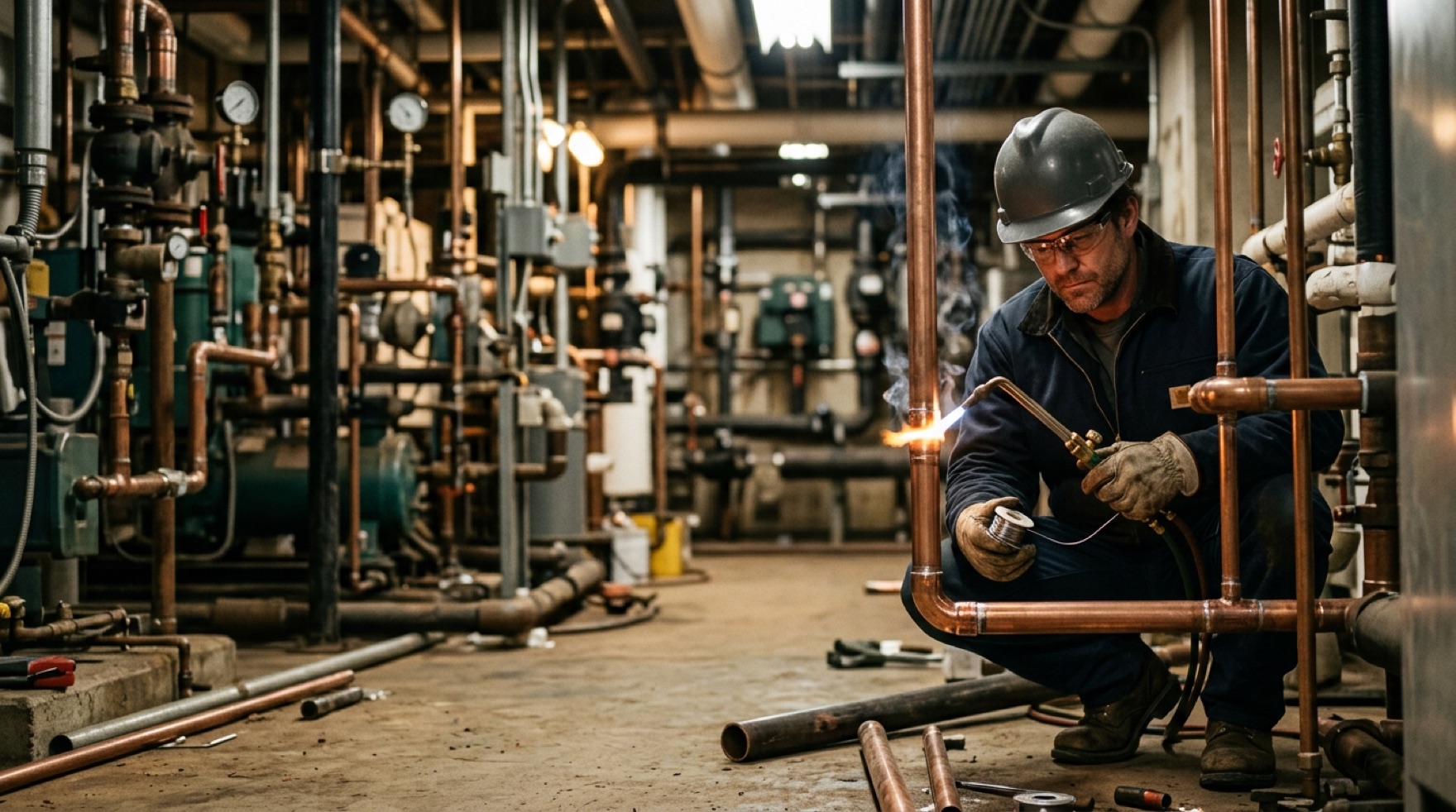
Plumbing & Pipefitting
Trenches, tanks, and sewer lines put the worst air at the bottom.
Plumbing and pipefitting take workers into the places where hazardous atmospheres collect: tanks, vaults, sewers, and trenches. Confined-space and sewer-gas exposure lead the risk, alongside the lead and solder chemistry of pipe work, the hot work of brazing and soldering joints, and the ergonomic load of the trade.
The defining hazard of the trade is the confined space. Plumbers and pipefitters enter tanks, vaults, sumps, and sewer systems where the atmosphere can be oxygen-deficient, toxic, or flammable, and hydrogen sulfide from sewage is both poisonous and quick to deaden the sense of smell that might warn of it. An atmosphere is considered oxygen-deficient below 19.5 percent oxygen, and most confined-space deaths include a would-be rescuer who entered without testing.
The chemistry and the hot work add exposure on top of the atmosphere. Lead solder and older lead pipe carry a heavy-metal hazard with an OSHA permissible exposure limit of 50 micrograms per cubic meter, and soldering and brazing joints is hot work that requires fire precautions, often in tight spaces. Trenching brings cave-in risk, and the trade's constant lifting, carrying, and awkward positions load the back and joints. The practical program tests and ventilates before entry, controls lead exposure, manages hot work, and protects trenches.
The hazards, and the controls that move the needle
Ordered by the hierarchy of controls — eliminate and engineer first, then treat matting, footwear, and PPE as the layers that catch what remains.
Confined-space and sewer-gas atmospheres
Tanks, vaults, and sewers can hold atmospheres that are oxygen-deficient, toxic, or flammable, with the worst air at the bottom. An atmosphere is oxygen-deficient below 19.5 percent oxygen.
- Identify and label permit-required confined spaces
- Test the atmosphere at all levels before and during entry
- Ventilate and control hazards before anyone enters
- Use an entry permit, attendant, and rescue plan
- Never enter to rescue without proper equipment
Hydrogen sulfide exposure
Sewage and decomposing waste generate hydrogen sulfide, which is toxic and quickly deadens the sense of smell so workers cannot rely on odor as a warning. High concentrations can cause collapse within a few breaths.
- Test for hydrogen sulfide before and during entry
- Ventilate to clear and dilute the gas
- Use gas detection with alarms during work
- Provide appropriate respiratory protection for the exposure
- Do not depend on smell to judge safety
Lead from solder and older pipe
Lead solder and older lead pipe expose workers to a cumulative heavy-metal hazard through ingestion and fume. The OSHA permissible exposure limit for lead is 50 micrograms per cubic meter as an 8-hour time-weighted average.
- Substitute lead-free solder and materials where possible
- Control fume and dust when heating or cutting leaded materials
- Provide hygiene facilities and prohibit eating in work areas
- Provide respiratory protection where exposure is significant
- Monitor exposure and provide medical surveillance where required
Brazing and soldering hot work
Soldering and brazing joints uses an open flame, often in tight spaces near combustible building materials. Unmanaged hot work is a leading cause of structure fires.
- Clear or protect combustibles before starting hot work
- Use a hot-work permit and fire watch where required
- Keep an extinguisher at hand during and after the work
- Ventilate confined spaces where brazing occurs
- Monitor the area after finishing for smoldering ignition
The programs that anchor the floor
Confined-space entry program
Tanks, vaults, and sewers are treated as permit-required spaces, tested at all levels, and ventilated before entry, with an attendant and rescue plan in place. Sewer gas gives little warning, so entry on assumption is exactly the mechanism behind confined-space fatalities.
Lead exposure control
Lead-free materials are used where possible, and fume, dust, and hygiene are controlled when leaded materials are heated or cut, measured against the OSHA limit. Lead is cumulative, so control protects the worker's long-term health, not just the shift.
Hot-work fire safety
Soldering and brazing follow hot-work precautions: combustibles cleared or protected, an extinguisher at hand, and post-work monitoring. In tight building spaces the ignition often smolders out of sight before it flares.
In-depth guidance
View all 1 →
Plumbing hazard self-assessment
Check your confined-space, gas-detection, lead, and hot-work practices against the plumbing and pipefitting hazard pattern.
Start the assessment →Plumbing safety guides
Practical guidance on confined-space entry, lead control, and hot-work fire safety for plumbers and pipefitters.
Browse the guides →
Stay ahead of safety.
New articles, free templates, and regulatory updates in your inbox. No spam — unsubscribe anytime.