The short answer: The deadliest exposure for a delivery driver is the vehicle and the roadway, not the load being delivered. Transportation incidents are the largest single cause of work-related fatalities: OSHA attributes 39 percent of all occupational fatalities to transportation incidents in its 2018 to 2022 data. The controls that reduce that risk keep the driver belted inside a maintained vehicle, keep them out of the path of moving traffic when they are on foot, and keep them clear of a truck that can roll. Federal hours-of-service rules from the FMCSA govern fatigue for commercial motor vehicle drivers, and OSHA's General Duty Clause, Section 5(a)(1) of the OSH Act, covers the recognized driving and roadside hazards that no single vehicle standard names.
What is the biggest safety risk for delivery drivers?
The biggest risk is a motor vehicle crash, by a wide margin. OSHA reports that transportation incidents account for 39 percent of occupational fatalities in its 2018 to 2022 data, which makes the road the leading killer of workers across the economy and the defining hazard of any job spent driving. For a delivery or route-sales driver, that means the moments in traffic, not the moments handling freight, carry the most severe consequences.
The cost of that exposure reaches well past the individual crash. OSHA puts the total cost of motor vehicle crashes to employers at 72.2 billion dollars in 2018, a figure that captures medical care, workers' compensation, vehicle damage, lost productivity, and the disruption of pulling a driver and a route out of service. An injured driver is not only an injury: it is a customer route that goes uncovered, a replacement who has to be hired and trained, and a workers' compensation claim that runs for months. That business-consequence chain is why fleet safety earns the resource allocation it does, and why the programs that work treat the crash as a preventable operational failure rather than an accident.
How do delivery drivers get struck by their own vehicle?
A stopped delivery vehicle becomes a struck-by hazard the moment the driver dismounts without securing it against movement. The two recurring mechanisms are a rollaway, when a parked truck moves off on a grade because the parking brake was not set or the wheels were not chocked, and a backing incident, when the driver reverses without a clear view of what is behind. Both put the driver, or a bystander, in the path of a vehicle that weighs many times what a person can resist.
A Kentucky FACE investigation shows how the vehicle itself becomes the hazard. In report 20KY040, a 52-year-old commercial truck driver parked for the night in a lot after the customer's facility had closed, on a sloping surface. Dash-camera footage recorded him noticing debris near the front passenger tire, stepping out, and kneeling to clear it without setting the parking brake. The roughly 77,000-pound truck rolled forward, struck him, and came to rest on top of him. Investigators identified the unset parking brake and the graded surface as the contributing factors, and recommended rollaway-prevention procedures, in-cab reminders to set the brake, and rollaway-prevention technology. The transferable point is that a dismounted driver stands in the path of a vehicle that only a set brake and chocked wheels hold in place, which is exactly the sequence a parking procedure is written to prevent.
The controls are unglamorous and effective. Set the parking brake every time the driver leaves the seat, turn the front wheels toward the curb, chock a wheel when parked on any grade, and remove the ignition key. For backing, the reliable practice is to reduce the need for it through pull-through parking and route planning, then to require a walk-around and a spotter or camera where a reverse cannot be avoided, because the driver's own sightline is the weakest control in the sequence.
What protects a driver working at the roadside in traffic?
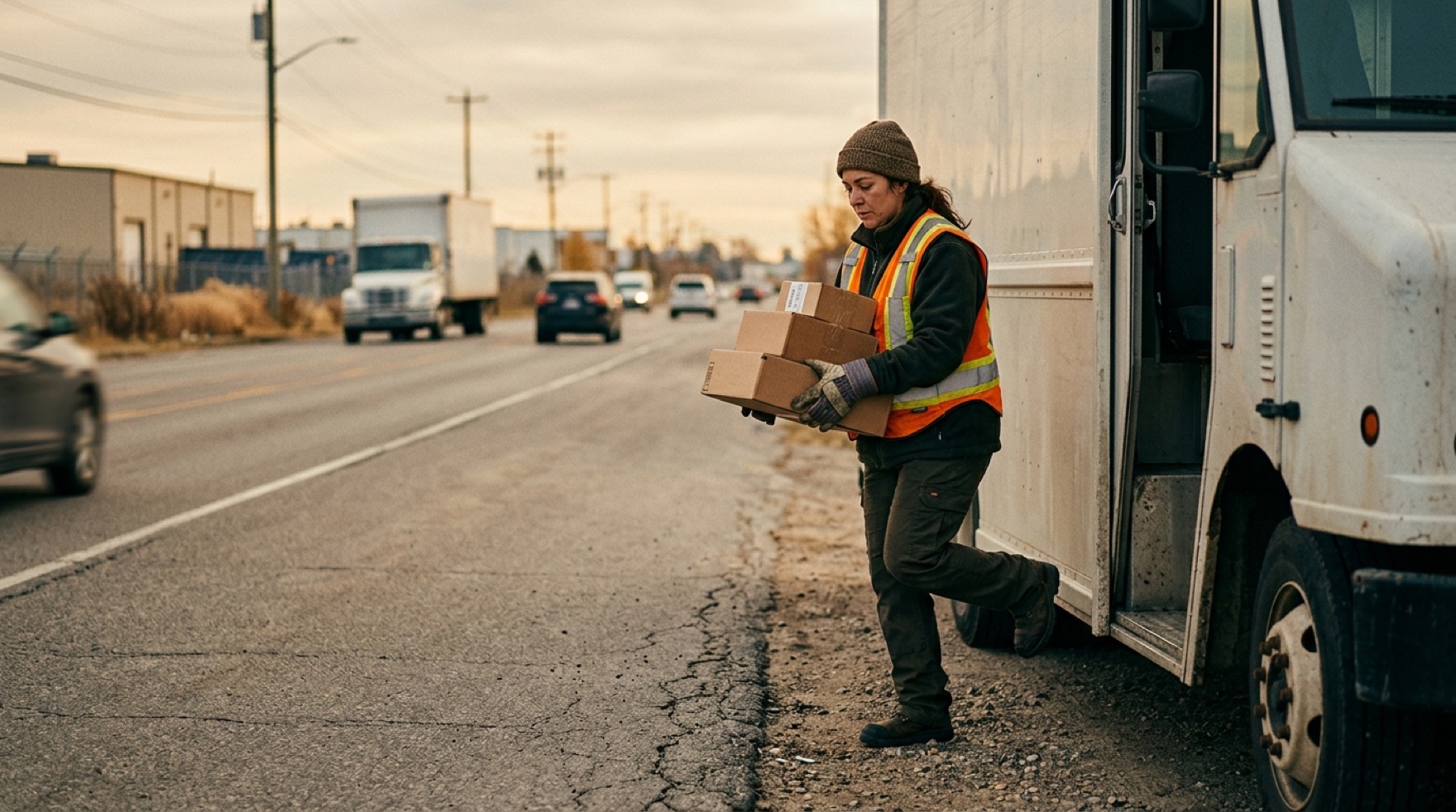
When a driver is on foot beside the vehicle in or near live traffic, the priority is to stay visible and stay out of the travel lane. Passing traffic is a struck-by exposure the driver cannot control, so the controls work by making the driver conspicuous and by keeping the work off the roadway. High-visibility safety apparel meeting ANSI/ISEA 107 is the baseline, worn whenever the driver is exposed to vehicle traffic, and it earns its place because a driver in a dark uniform at dusk is effectively invisible until it is too late.
Positioning does the rest. Park so that deliveries and loading happen on the curb side rather than the traffic side wherever the route allows, use hazard flashers and the vehicle body as a shield between the driver and oncoming traffic, and treat the space between the tailgate and the lane as a zone to minimize, not to work in. Where a driver must repeatedly cross or stand in traffic, the exposure has outgrown apparel and positioning, and the route or the delivery point needs to change. Conspicuity buys attention from other drivers, but it does not stop a vehicle, so it sits below keeping the worker off the roadway in the order of controls.
What do employers have to do about driver safety?
Employers have to manage driving as the serious hazard it is, through policy, scheduling, maintenance, and training, not leave it to the individual behind the wheel. OSHA's guidance for employers is direct: implement and enforce a mandatory seat belt policy, review operational procedures so that dispatching and routing do not create distracted driving, and ensure that workloads and schedules let drivers keep to a safe speed and obey any applicable hours-of-service rules. Each of those is an employer control over the conditions the driver works in, rather than a rule aimed only at the driver's behavior.
Distraction is the exposure employers most often build in without realizing it. OSHA specifically advises employers to review their operational procedures so that dispatching, rerouting, and delivery-tracking systems do not create cognitive, visual, or manual distraction for a driver in motion. A route app that pings for a delivery confirmation while the driver is moving is not a driver-behavior problem to discipline away: it is a procedure the employer designed, and it is the employer who can require that contact wait until the vehicle is stopped. Pair that with a hands-free or no-contact policy and the enforcement to back it, and distraction moves from an individual failing to a managed condition.
Fatigue is where the regulatory line matters. FMCSA hours-of-service regulations limit how long a commercial motor vehicle driver may drive and be on duty and require minimum off-duty rest, specifically to control drowsy driving. Those rules apply to commercial motor vehicles, generally larger and heavier trucks and certain hazmat and passenger vehicles, so a large share of light-vehicle delivery and route-sales work falls outside FMCSA and under the employer's general duty instead. That is the trap for a growing last-mile fleet: the van driver is not covered by hours-of-service, but the fatigue risk is real, which means the employer has to set its own scheduling limits rather than assume a federal rule already has. The table below maps each exposure to the control that addresses it.
| Exposure | Leading control | Supporting controls / basis |
|---|---|---|
| Crash while driving | Mandatory seat belt use, enforced | Safe-speed scheduling, defensive-driving training, vehicle maintenance |
| Fatigue / drowsy driving | Realistic schedules and rest | FMCSA hours-of-service for CMVs; employer limits for light vehicles |
| Distracted driving | Hands-free / no-contact policy | Review dispatch and routing so procedures do not create distraction |
| Struck by own vehicle | Parking brake, chock, key out every stop | Pull-through parking, spotter or camera for backing |
| Struck by passing traffic | Work off the roadway, curb-side delivery | High-visibility apparel to ANSI/ISEA 107, hazard flashers |
Where the controls have to sit
A delivery-driver safety program works when it treats the vehicle and the road as the primary hazard and puts the strongest controls where the exposure is highest. Seat belts and realistic schedules cut the fatal crash risk; a fixed parking-and-chocking routine closes the rollaway path that the Kentucky investigation records; curb-side positioning and high-visibility apparel keep a driver on foot out of the traffic that can strike them. None of that depends on a single dramatic intervention. It depends on making the safe action the default one, every stop and every route, so that the moment a driver is distracted by debris near a tire or a delivery running late, the brake is already set and the vehicle is already between them and the traffic.