The short answer: The catalyst in a two-part (2K) polyurethane primer, basecoat, or clearcoat is an isocyanate, usually an HDI-based polyisocyanate, and isocyanates are respiratory sensitizers. A painter who becomes sensitized can suffer occupational asthma at concentrations well below any measured limit, and NIOSH has documented deaths from spraying 2K paint. Because HDI has no substance-specific OSHA permissible exposure limit, control rests on engineering (a properly ventilated spray booth under 29 CFR 1910.107) plus a supplied-air respirator during spraying, not on an air-purifying cartridge. The goal is to keep the painter, and everyone near the booth, out of the isocyanate mist on every job.
What makes isocyanates in refinishing so hazardous?
Isocyanates are hazardous because they sensitize the respiratory tract, which means the danger grows with exposure history rather than staying fixed. OSHA describes the main effects of hazardous isocyanate exposure as "occupational asthma and other lung problems, as well as irritation of the eyes, nose, throat, and skin," and notes that isocyanates react with alcohols to form the polyurethane polymers used in "polyurethane paints." In a body shop those paints arrive as a color or clear plus a hardener, and the hardener is where the isocyanate lives.
The mechanism that matters for a refinish tech is sensitization. NIOSH puts it plainly: isocyanates "can also sensitize workers, making them subject to severe asthma attacks if they are exposed again, even at concentrations below the NIOSH REL," and available data "do not indicate a concentration at which TDI vapor fails to produce adverse reactions in sensitized persons." Read operationally, that means there is no reliably safe exposure for a painter who has already been sensitized. Once the immune response is set, the control cannot aim for a number; it has to aim for near-zero inhalation, which changes how a shop equips and runs the booth.
Sensitization is not only an inhalation story, which is why glove and coverall discipline belongs in the same conversation as the respirator. OSHA notes that "respiratory sensitivity to isocyanates may be related to previous dermal exposure," meaning isocyanate landing on bare skin during mixing, spraying, or gun cleanup can help set up the airway reaction that later shows up as asthma. That is a different failure mode than a bad respirator seal, and it means a painter who protects the lungs but works with hardener on the hands is still building toward sensitization. Covering skin is part of preventing the respiratory disease, not a separate housekeeping nicety.
Does OSHA set an exposure limit for the isocyanate in clearcoat?
Not for the one that is actually in most clearcoats. The hardener in modern 2K automotive clear is typically an HDI-based polyisocyanate (hexamethylene diisocyanate chemistry), and HDI has no substance-specific permissible exposure limit in OSHA's air-contaminant table. The airborne mist is still covered as an air contaminant under 29 CFR 1910.1000, and the closest listed isocyanate limit is the ceiling for methylene bisphenyl isocyanate (MDI) at 0.02 ppm in Table Z-1, but that value governs a different compound. The practical takeaway is that a shop cannot manage this hazard by comparing a sampling result to a comfortable federal number, because for HDI that number does not exist.
That absence is the reason the sensitizer point drives the program. Because a sensitized painter can react below any limit anyone would set, and because HDI has no PEL to begin with, the defensible position is to treat every isocyanate spray as an exposure to be engineered and respirator-protected down to nothing, not measured up to a threshold. The table below shows why the limit column is the wrong place to look for reassurance.
| What is on the label / in the air | OSHA exposure limit | Source |
|---|---|---|
| HDI-based polyisocyanate hardener (typical 2K clearcoat) | No substance-specific OSHA PEL; covered generally as an air contaminant | 1910.1000 |
| Methylene bisphenyl isocyanate (MDI), if present | 0.02 ppm ceiling (0.2 mg/m³) | 1910.1000 Table Z-1 |
| A worker already sensitized to isocyanate | No concentration is reliably safe | NIOSH Alert 96-111 |
What respirator does a painter spraying two-part urethane need?
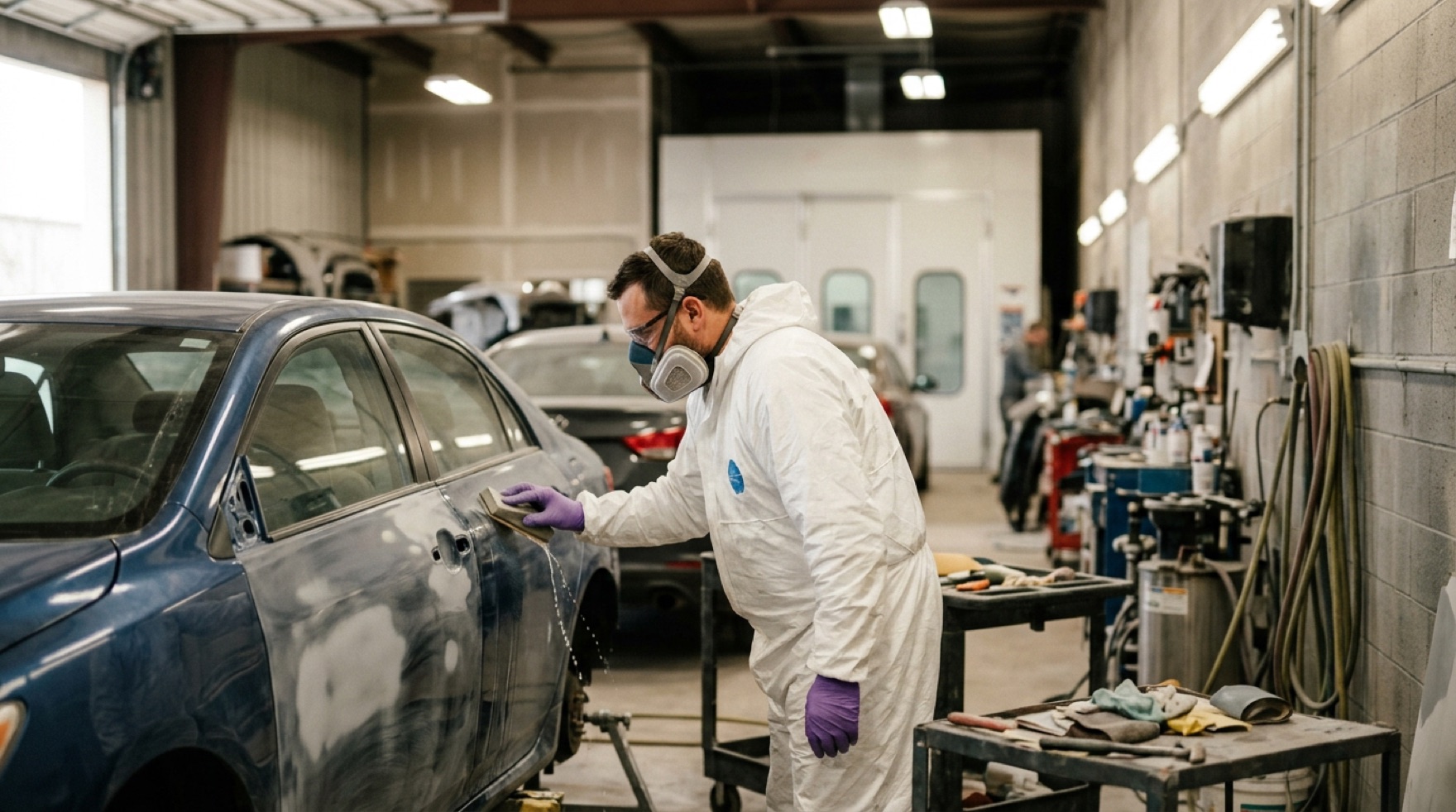
Spraying 2K isocyanate paint calls for a supplied-air respirator, not a cartridge half-mask. NIOSH's recommendation for isocyanate spray application is "any supplied-air respirator with a full facepiece operated in a pressure-demand or other positive-pressure mode," and its guidance points to supplied-air protection whenever ventilation is not sufficient to keep air levels down. The reason is chemistry and warning: isocyanate aerosol has poor warning properties, so a painter cannot smell the point at which an organic-vapor cartridge is saturated, and a positive-pressure air-supplied hood keeps the isocyanate mist out of the facepiece even if the seal is imperfect.
NIOSH Alert 96-111 records how badly this can end. In Preventing Asthma and Death from Diisocyanate Exposure (NIOSH Publication No. 96-111), the first case describes a 37-year-old self-employed car painter who had five years of breathing symptoms while continuing to spray. Wearing only a mask, he suffered a severe, prolonged asthma attack while spray-applying two-component polyurethane paint; after treatment he returned to work, sprayed again, and this time the attack was fatal, and NIOSH records that he died in the ambulance on the way to the hospital. The transferable lesson is that a "mask" is not a supplied-air respirator, and that a painter who is already reacting is the one for whom the next ordinary spray is most dangerous.
How do spray booths and ventilation control the exposure?
Engineering controls come first, and for refinishing that means spraying inside a properly ventilated booth. 29 CFR 1910.107 requires spray finishing to be done in appropriately constructed and ventilated spray areas or booths, and a downdraft or crossdraft booth is what pulls the isocyanate mist and solvent vapor away from the painter's breathing zone and out of the shop. Ventilation is the control that reduces how much isocyanate is airborne in the first place, which is exactly the condition NIOSH ties to whether supplied-air protection is enough. Respirators protect the individual; the booth protects the exposure.
Two operational details decide whether the booth actually works. First, the isocyanate does not vanish when the gun stops: mist lingers and the coating off-gasses while it cures, so the booth has to keep exhausting and the painter has to keep the supplied-air hood on through flash and cure time, not strip it off at the last coat. Second, the hazard does not respect the booth wall. Bystanders, the tech mixing hardener at the bench, and anyone who opens the booth door mid-cycle can inhale isocyanate, so mixing, spraying, and curing all belong in controlled areas with the ventilation running and unprotected people kept out.
A booth is also only as good as its maintenance, which is where a lot of shops quietly lose the control. Loaded intake and exhaust filters cut airflow, and a booth that no longer moves its rated volume of air stops clearing mist at the rate the painter's protection assumed. Makeup air has to balance what the exhaust pulls out, or the booth cannot maintain the airflow that keeps the breathing zone clear. Treating filter changes, airflow checks, and booth housekeeping as scheduled tasks rather than as things done when spray finish quality drops is what keeps the engineering control doing its job on the hundredth car, not just the first.
What has to be in place before a shop sprays isocyanate paint?
A refinishing shop should treat isocyanate work as a defined program, not a task, because the hazard is chronic and the injury is often permanent. Sensitization ends careers: once a painter reacts, the protective step is usually removal from further isocyanate exposure, which is a workforce and continuity problem as much as a medical one. Building the controls in the right order is what keeps a skilled painter working and keeps the shop out of a recordable occupational-asthma case.
The program rests on a few non-negotiables. Spraying happens in a ventilated booth kept in working order under 1910.107; the painter wears a supplied-air respirator in positive-pressure mode during spraying and curing, backed by a respiratory protection program under 29 CFR 1910.134 including breathing-air quality, fit, and training; skin is covered, because dermal contact contributes to sensitization; mixing and cleanup follow the safety data sheet; and anyone reporting new wheeze, chest tightness, or shortness of breath is evaluated promptly, since early symptoms are the warning that sensitization is underway.
Two of those pieces deserve emphasis because they are the ones shops most often shortcut. Breathing air for a supplied-air respirator is not the same as shop compressed air: it has to meet a breathing-air grade and be delivered through the right filtration and monitoring, because feeding a hood with contaminated or carbon-monoxide-laden air replaces one hazard with another. And symptom reporting only works if a painter can raise early wheeze without fear of losing the booth, because the natural instinct is to push through the first few reactions, which is exactly the pattern the NIOSH fatality followed. A shop that watches for the early respiratory complaint, and acts on it before the painter is fully sensitized, keeps a skilled tech behind the gun. Handled that way, the isocyanate stays in the coating and out of the painter, which is the only outcome that protects both the worker and the shop's capacity to keep refinishing cars.