The short answer: There is no OSHA standard written specifically for burns in a commercial kitchen, so cook-line thermal injuries are governed by the General Duty Clause, Section 5(a)(1) of the OSH Act, which requires employers to furnish a workplace free from recognized hazards likely to cause death or serious physical harm. Scald burns from hot cooking oils are the single largest source of serious restaurant burns, and at line temperatures the margin is thin: water at 155 degrees Fahrenheit can cause a third-degree burn in about one second, per the American Burn Association. The fix is engineering the hazard down, splash guards, contained oil handling, floor friction, then layering PPE and training on top.
Does OSHA have a standard for burns in a commercial kitchen?
No specific OSHA standard covers kitchen burns, which means the governing requirement is the General Duty Clause. Section 5(a)(1) of the OSH Act requires each employer to furnish employment and a place of employment free from recognized hazards that are causing or are likely to cause death or serious physical harm. Hot oil, steam, and hot surfaces on a cook line are exactly the kind of recognized hazard that clause exists to reach, even though no numbered regulation prescribes a fryer splash guard or a maximum oil temperature.
That absence is the point safety leaders should sit with. When a hazard has no dedicated standard, compliance becomes a matter of demonstrating that the employer identified the recognized burn hazard and took feasible steps to abate it, rather than checking a box against a paragraph. Related standards still apply around the edges, including the personal protective equipment duty in 29 CFR 1910.132 to assess and provide PPE for identified hazards, but the core obligation for burns is the risk-assessment logic the General Duty Clause forces: find the recognized hazard, then reduce it.
How hot is hot enough to cause a serious burn?
At cook-line temperatures the time to a full-thickness burn is measured in seconds, not minutes. The American Burn Association thresholds, reproduced in the Washington State L&I SHARP burn-injury report, show how quickly hot water alone reaches third-degree damage, and cooking oil is worse because it heats far higher than water and clings to skin longer. Boiling water sits at 212 degrees Fahrenheit, fryer oil commonly runs near 350, and hot beverages are served between 160 and 180, so the everyday liquids on a line are all well inside the danger band.
| Water temperature | Time to a third-degree burn |
|---|---|
| 155 °F (68 °C) | about 1 second |
| 148 °F (64 °C) | about 2 seconds |
| 140 °F (60 °C) | about 5 seconds |
| 133 °F (56 °C) | about 15 seconds |
| 127 °F (52 °C) | about 1 minute |
The operational implication is that there is no safe pause once hot liquid reaches skin. A splash the worker cannot wipe away in time has already done its damage, which is why controls on the line aim at preventing contact, containing the liquid and keeping the worker upright, rather than relying on a fast reaction that the thresholds show is not possible.
What are the biggest burn hazards on the cook line?
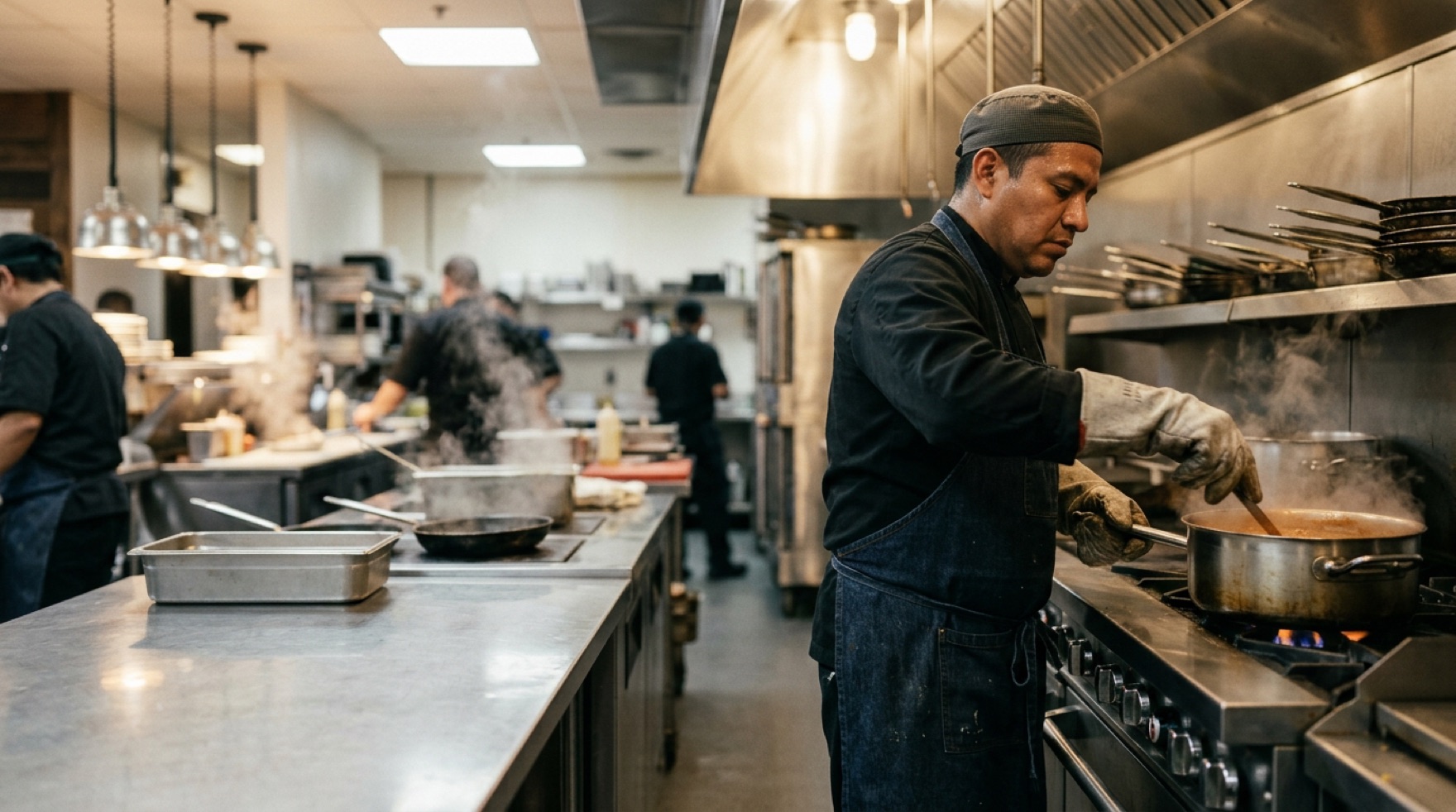
Hot cooking oil is the leading source of serious kitchen burns, ahead of water and steam. In the Washington L&I SHARP review of restaurant food workers hospitalized for scald burns, cooking oils accounted for 49 percent of cases, water for 32 percent, other liquids for 12 percent, and steam for 7 percent. The hazards cluster at the fry station and the flat top, around moving or straining hot oil, cleaning fryers, carrying full containers of hot liquid, and lifting lids off pressurized or covered vessels where trapped steam vents at over 200 degrees.
A single investigated case shows how these combine. The Washington L&I SHARP report documents a 24-year-old cook who was moving a vat of hot oil when he slipped and spilled it on himself, splattering his face, chest, both arms, and right flank. He sustained second-degree burns to 18 percent of his body, required skin grafts to his arm, spent more than two weeks in hospital, and was out of work for over eleven weeks. The same dataset found that roughly one in three of these hospitalized scald burns involved a slip, trip, or fall. The transferable lesson is that a burn on the line is often a slip first, so controlling floor friction, covered in our guide to slips and falls on the kitchen line, is part of controlling burns.
How do you actually reduce cook-line burns?
Design the contact out before you rely on the worker to avoid it. Because the thermal thresholds leave no time to react, the strongest controls are the ones that stop hot liquid from reaching skin in the first place, and the General Duty Clause asks for exactly those feasible abatement steps. Work from engineering to behavior:
- Engineer the equipment. Fit splash guards and screens on fryers and frying stations so oil that bubbles over is contained, install a gravity feed chute so workers drain waste oil without carrying a hot vat, use automatic food-lowering devices where available, and place microwaves at a height where the user's face stays above the door. Each removes a specific contact path the SHARP report ties to real injuries.
- Control the floor. Keep floors clean and slip-resistant so a worker carrying hot liquid stays upright, because the slip-into-hot-oil sequence is one of the most damaging on the line. This is where burn prevention and the walking-working-surface duty in 29 CFR 1910.22 overlap.
- Handle hot liquids deliberately. Carry vessels no more than half full, secure lids and use splash guards when transferring, and cool and cover fryer oil before anyone cleans around it. Moving less hot liquid, less full, is the cheapest control on the list.
- Provide and require PPE. Long-sleeved cotton clothing, oven mitts or dry pot holders sized to the task, and closed-toe slip-resistant footwear, with open-toed shoes and sandals kept out of areas where oil can pool. This is the 1910.132 layer, protecting the worker where the engineering controls end.
- Train and prepare a response. Train workers on the hazards of hot liquids and safe transfer, make sure someone each shift can deliver burn first aid, cool a burn with running water rather than ice, and keep the routes around fryers clear. Preparation does not prevent the burn, but it limits how bad it becomes.
Why does the General Duty Clause matter if there's no burn standard?
The lack of a burn standard does not lower the duty, it shifts it from checklist to judgment. Under Section 5(a)(1), an employer is expected to recognize that a cook line carries a serious, well-documented burn hazard and to take the feasible steps to abate it, which the SHARP data and OSHA's own restaurant guidance describe in detail. A kitchen that has assessed its fry stations, fitted splash guards, controlled its floors, and trained its cooks has met that duty in substance, whether or not any single measure is spelled out in a numbered rule.
For safety leaders, that reframes the question. Compliance is not "which paragraph requires this," but "have we identified the recognized thermal hazards on this line and reduced them as far as is feasible." Answered honestly, that question drives the same controls a prescriptive standard would, and it protects workers from the injuries the thermal thresholds make clear are severe, disabling, and measured in weeks of lost work, not a bad afternoon.