The short answer: 29 CFR 1910.147 covers the servicing and maintenance of machines where the unexpected energization, start-up, or release of stored energy could injure an employee. Before anyone reaches into a machine to service it, 1910.147(c)(1) requires the energy to be isolated and the machine rendered inoperative under a documented energy-control procedure, with training and periodic inspection behind it. Lockout/tagout is a different duty from machine guarding: a guard stops routine contact while the machine runs, but the moment an operator reaches past the guard to clear a jam or adjust a part, only isolating and locking the energy protects them. Control of hazardous energy is consistently one of OSHA's most frequently cited standards.
What is lockout/tagout, and does it apply to machine operators?
Lockout/tagout is the control of hazardous energy during servicing and maintenance, and it applies to any employee doing that work, operators included. 1910.147(a)(1) scopes the standard to servicing and maintenance where the unexpected energization, start-up, or release of stored energy could cause injury, and 1910.147(c)(1) requires an energy-control program of written procedures, employee training, and periodic inspections so that a machine is isolated from its energy source and rendered inoperative before the work begins. The energy in question is not only electrical. It includes hydraulic and pneumatic pressure, gravity on a raised ram or plate, springs, and residual motion, any of which can move a machine part after the power switch is off.
This is a standard machine operators cannot treat as someone else's paperwork. Control of hazardous energy ranked fourth in OSHA's fiscal year 2025 most-cited standards, and it holds a top-five place year after year. Operators are often the people closest to a jam or a fouled part, which is exactly the moment the standard is written for. Knowing when you personally must lock out, and being trained and authorized to do it, is what separates a routine clearance from a fatality.
When does an operator have to lock out, and what is the minor-servicing exception?
You have to lock out whenever you service or maintain a machine in a way that could expose you to unexpected energization or stored energy, unless the task fits the narrow minor-servicing exception. 1910.147(a)(2)(ii) distinguishes normal production from servicing: the full standard applies during production only when an employee must remove or bypass a guard or other safety device, or place a part of the body into the point of operation or a danger zone. That is the line between the two duties. Routine running behind a guard is machine-guarding territory; reaching past the guard into the machine is energy-control territory.
The exception is real but small. 1910.147(a)(2)(ii) exempts minor tool changes, adjustments, and other minor servicing activities that take place during normal production only if they are routine, repetitive, and integral to using the equipment for production, and only if they are performed with alternative measures that provide effective protection. Miss any of those conditions, and the exception does not apply. Clearing a jam by reaching into the point of operation, or opening an enclosure to adjust a part while a hydraulic or gravity hazard remains live, is not minor servicing under this paragraph, and it triggers full lockout/tagout.
What does it look like when an operator reaches in without locking out?
When a trained operator enters a machine without isolating its energy, the guarding that protected normal production offers nothing, because the person is now inside the danger zone with the energy still live. A California FACE investigation shows how completely the two controls diverge.
In CA/FACE report 03CA006, a 48-year-old machine operator with 19 years at a plastics manufacturer was crushed inside an automated injection-molding machine. The machine was enclosed for safety, and its access panels were interlocked to shut it off when opened, guarding that worked as intended during production. The operator instead crawled in through the conveyor opening, apparently to adjust a shield so product would stop bouncing off the belt, and was caught between the pedestal frame and the moving mold plate when the machine cycled. The investigators noted he was trained and authorized on lockout/tagout, with refresher training just one week earlier, and that the machine had clearly identifiable, accessible shut-off and isolation devices he did not use. CA/FACE recommended operators implement the lockout/tagout procedure when applicable. The transferable point is that the interlocked guard was never designed to protect someone who bypasses it to work inside the machine: that is the job of 1910.147, and only locking out the energy would have kept the plate from cycling.
What are the steps of a lockout?
A compliant lockout is a fixed sequence, not a single click of a switch. 1910.147(d) sets out the application of controls in order, and the order matters because each step removes a source of movement the previous one did not. Skipping straight to "the power is off" is how residual hydraulic pressure, a gravity-loaded plate, or a second energy source still injures the person inside.
- Prepare. The authorized employee identifies the type and magnitude of the energy, its hazards, and how to control it, using the machine's specific energy-control procedure.
- Shut down. Turn the machine off using its normal stopping procedure, in an orderly way.
- Isolate. Operate every energy-isolating device, the electrical disconnect, the hydraulic and pneumatic valves, so the machine is physically separated from each energy source.
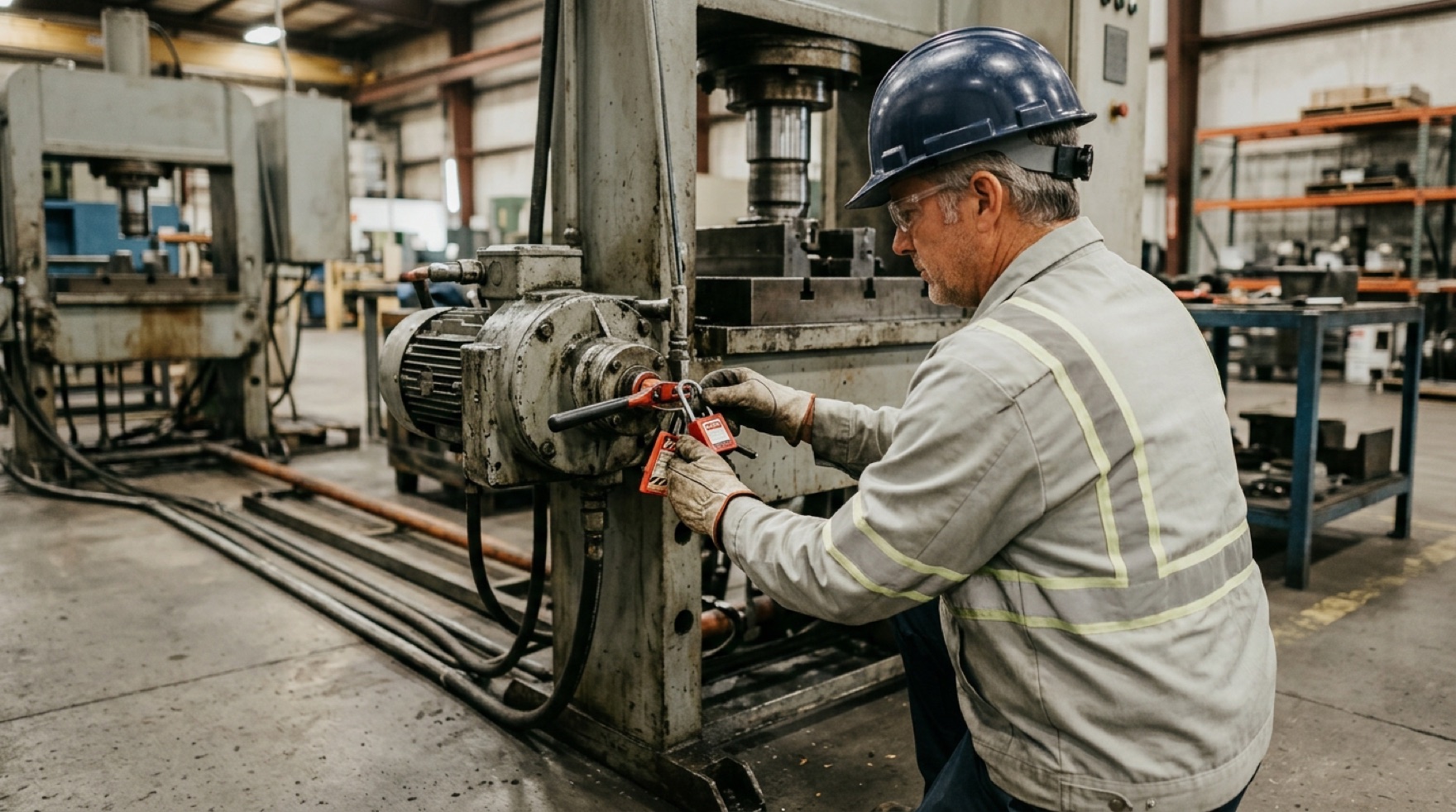
- Apply the locks. Affix a lockout device, or a tagout device where lockout is not possible, to each isolating device so it is held in the safe or off position by the authorized employee.
- Relieve stored energy. Release, disconnect, restrain, or otherwise render safe all stored and residual energy: bleed hydraulic and pneumatic pressure, block a raised ram or plate, discharge capacitors, relieve spring tension.
- Verify. Before touching the danger zone, confirm the machine is isolated and de-energized, including by trying the normal start controls to be sure nothing moves, then returning them to off.
That verification step, sometimes called the try step, is the one operators skip and the one that catches the machine that was isolated on paper but not in fact. It is the last check before a body part enters the point of operation, and 1910.147(d) puts it there deliberately.
Why isn't a stop button or a tag on its own enough?
A stop button pauses the machine but does not isolate its energy, and a tag warns but does not physically restrain anything. 1910.147(c)(7) requires training to cover the recognition of hazardous energy sources and the limitations of tagout, and the standard's own logic treats a tag as a warning device, not a lock. A machine paused on a stop button can restart on a timer, a signal, a second operator, or a stored-energy release; a machine held only by a tag will move if anyone operates the switch the tag is hanging on. Neither addresses the hydraulic pressure, the gravity load, or the pneumatic charge still sitting in the system.
That is why the durable protection is a physical lock on an isolating device plus verified relief of stored energy, not a control-circuit stop. Interlocks and guards belong to normal production, where they keep an operator out while the machine runs. Once the task requires reaching in, the operator has left the world the guard was built for, and only the lockout sequence under 1910.147 keeps the energy from returning while their hands are inside. Where guarding ends and energy control begins is covered from the other side in our companion piece on machine guarding for machine operators.
What does the employer's energy-control program have to include?
The operator's lockout only holds up because a program stands behind it. 1910.147(c)(1) requires an energy-control program built from three parts: documented energy-control procedures, employee training, and periodic inspections. 1910.147(c)(4) requires the procedures to be developed, documented, and used for the machines in scope, so an operator has a machine-specific procedure to follow rather than improvising. 1910.147(c)(6) requires the employer to inspect each energy-control procedure at least annually, performed by an authorized employee other than the ones using the procedure, to confirm it is still being followed correctly.
Training closes the loop. 1910.147(c)(7) requires authorized employees to be trained to recognize hazardous energy sources, understand the type and magnitude of energy in the workplace, and know the methods to isolate and control it, with retraining when procedures change or an inspection finds a gap. For a machine operator, that training is what makes lockout a task they are authorized and equipped to perform, not a rule they are told to respect. The CA/FACE injection-molding case is the caution in reverse: the operator had the training, the authorization, and accessible isolation devices, and the fatal step was reaching in without using any of them.