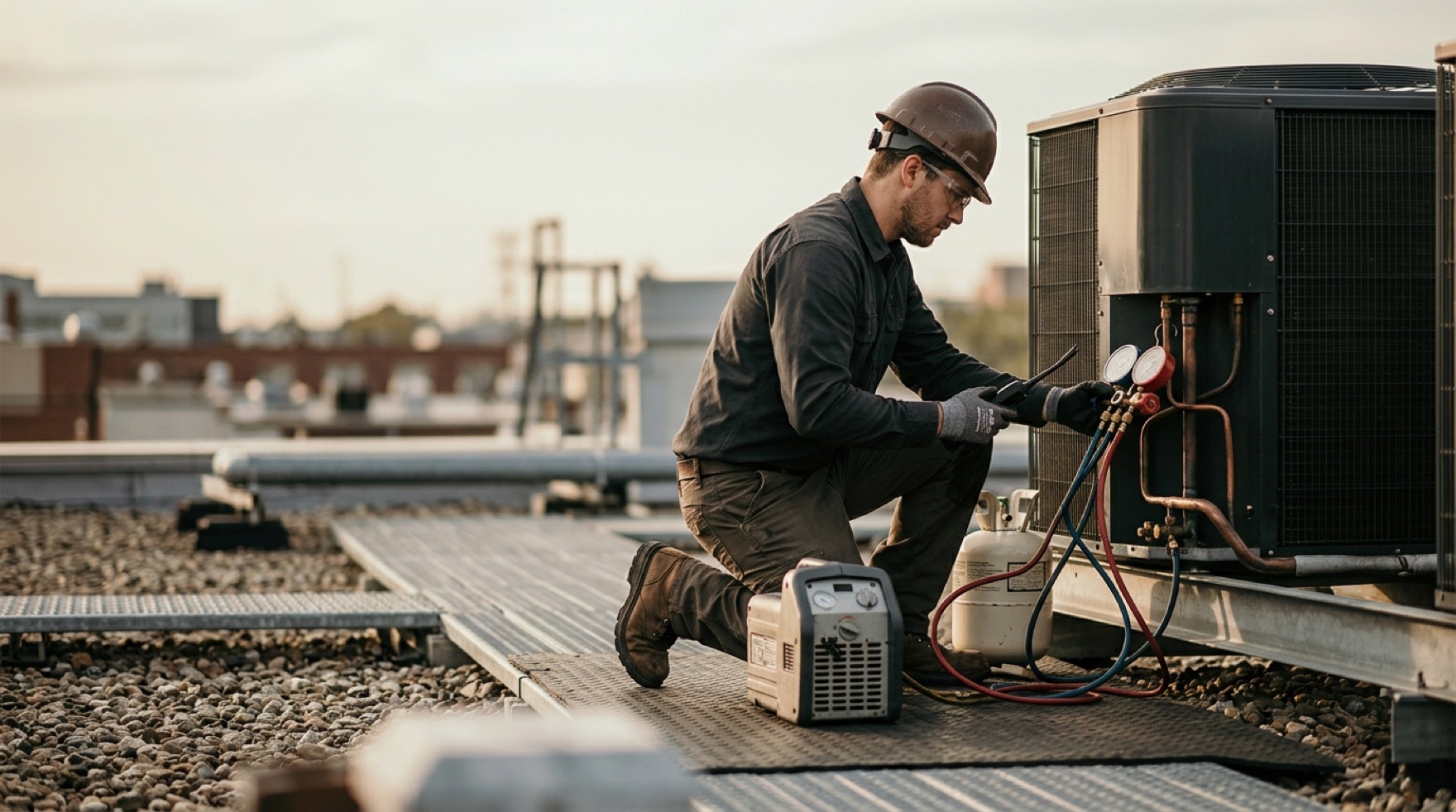
The short answer: A2L refrigerants such as R-32 and R-454B are classified by ASHRAE Standard 34 as lower in toxicity but mildly flammable, a class the R-410A they replace does not carry. That flammability is why ASHRAE Standard 15 sets machinery-room detection and ventilation requirements, and why service work has to control ignition sources the way older systems never demanded. Separately, EPA Section 608 of the Clean Air Act requires anyone who maintains, services, repairs, or disposes of refrigerant-containing equipment to be certified, and it prohibits knowingly venting refrigerant, including these substitutes, to the atmosphere. Handling A2L safely means treating the refrigerant as both an asphyxiation hazard and a fuel.
What makes A2L refrigerants different from the ones they replace?
A2L refrigerants sit in a specific box of the ASHRAE Standard 34 safety matrix: lower toxicity, mildly flammable with a low burning velocity. R-410A, the refrigerant in most existing residential and light-commercial equipment, is class A1, meaning lower toxicity and no flame propagation under the standard's test conditions. As the industry moves to lower global-warming-potential refrigerants, new equipment is shipping charged with R-32 and R-454B, both A2L, so the technician who has spent a career on non-flammable A1 systems is now opening systems that will burn under the right mix of leak, concentration, and ignition source.
ASHRAE Standard 34 builds each safety class from two independent judgments. The letter is toxicity: class A is lower toxicity, class B is higher. The number is flammability: class 1 shows no flame propagation, class 2 is flammable, class 3 is higher flammability, and the "2L" subclass is a flammable refrigerant that burns slowly enough to be treated as mildly flammable. The point for a service organization is that the safety class is a design input, not a label. It determines the charge limits, the machinery-room rules, and the leak-response plan the equipment was built around.
The transition is not a preference; it is the HFC phasedown. High global-warming-potential refrigerants like R-410A are being restricted, and manufacturers have moved new residential and light-commercial equipment to lower-GWP A2L refrigerants, chiefly R-32 and R-454B, to meet those limits. That means the change reaches the field as a fleet turnover: existing A1 systems keep running for years, while every new install and eventually most replacements arrive with a mildly flammable charge. A service organization ends up maintaining both classes at once, so the safe assumption on any unfamiliar unit is to read the nameplate for the refrigerant before assuming it behaves like the R-410A next to it.
| ASHRAE 34 class | What it means | Common examples |
|---|---|---|
| A1 | Lower toxicity, no flame propagation in the standard test | R-410A, R-134a |
| A2L | Lower toxicity, mildly flammable, low burning velocity | R-32, R-454B, R-1234yf |
| A2 / A3 | Lower toxicity, flammable / higher flammability | R-152a (A2), R-290 propane (A3) |
| B1 / B2L | Higher toxicity, non-flammable / mildly flammable | R-123 (B1), R-717 ammonia (B2L) |
Does EPA require certification to handle refrigerant, and can you vent it?
Yes to the first, no to the second. Under EPA Section 608 of the Clean Air Act, technicians who maintain, service, repair, or dispose of equipment that could release refrigerant must hold an EPA-approved technician certification, and the Section 608 prohibition on venting makes it illegal to knowingly release refrigerant to the atmosphere during that work. These are federal requirements, they apply to A2L refrigerants as substitutes, and they sit underneath everything else a technician does with the charge.
Section 608 certification comes in four types: Type I for small appliances, Type II for high-pressure equipment, Type III for low-pressure equipment, and Universal for all of them. The credential does not expire, and apprentices are exempt only while closely and continually supervised by a certified technician. The venting prohibition has been in force for ozone-depleting refrigerants since 1 July 1992 and was extended to their substitutes, which includes HFCs and the A2L blends, on 15 November 1995 under section 608(c)(2). The only releases allowed are de minimis amounts during a good-faith attempt to recover the refrigerant, such as the small loss when connecting or disconnecting recovery hoses. Recovery, not release, is the default for every service and disposal job.
What does ASHRAE 15 require in a refrigeration machinery room?
ASHRAE Standard 15 governs the safe design of refrigeration systems, and where a machinery room is required it has to have refrigerant detection and mechanical ventilation that responds to a leak. A refrigerant detector must alarm and activate the ventilation system when concentration rises, because the failure mode the standard is written around is a refrigerant that leaks into an enclosed room and accumulates. For A2L refrigerants that accumulation is two hazards at once: enough refrigerant to displace oxygen, and, at higher concentrations, enough to reach a flammable mixture.
A NIOSH Alaska FACE investigation shows why detection and ventilation are life-safety systems and not paperwork. In report 92AK036, a 24-year-old assistant manager at a shopping-mall ice rink entered the compressor room to shut off a leak of R-22 that the refrigeration system had been developing for some time. He and two coworkers collapsed; the coworkers were rescued and resuscitated, but he died of asphyxiation from oxygen displacement. He was wearing a cartridge respirator, which does nothing in an oxygen-deficient atmosphere, and an estimated several hundred pounds of refrigerant had escaped into the room. The investigators pointed to the absence of a safety program, the need for room ventilation and monitoring, and the wrong respiratory protection for the hazard. The transferable point is that a heavier-than-air refrigerant filling an enclosed machinery room is deadly before it is ever flammable, which is exactly the condition ASHRAE 15 detection and ventilation exist to catch. With an A2L charge, the same leak adds a fire risk on top of the asphyxiation risk.
How does a technician manage the flammability of an A2L system?
Treat the refrigerant as a fuel: keep it below a flammable concentration by controlling the leak and ventilating, and keep ignition sources away from where it can collect. The two conditions a fire needs are a flammable mixture and an ignition source, and A2L service work is built around never allowing both at once. That means leak-checking with a detector rated for the refrigerant before and during work, ventilating the space rather than working a leak in a closed room, and being deliberate about the torch.
Brazing and other hot work are the obvious ignition source, and the sequence matters: recover the charge, then confirm the system and the surrounding air are clear before introducing a flame. Refrigerant that has pooled low in a mechanical closet or a pit will not announce itself, which is why the detector and the ventilation come first. Portable ignition sources, from a torch to a work light with a hot element, all belong on the far side of a confirmed-clear reading. Equipment designed for A2L includes its own mitigations, such as charge limits matched to room size and, in some systems, leak-detection and mitigation controls built into the unit, and those features only work if the technician leaves them intact and follows the manufacturer's service procedure for that model.
The tools change with the class as well. A halide torch or a leak detector calibrated for an A1 refrigerant is the wrong instrument for confirming an A2L space is safe, so leak detection has to be rated for the refrigerant in the system. Recovery equipment, hoses, and vacuum pumps rated for A2L service keep the recovery step from becoming the ignition event, and the disposal end of the job still runs through Section 608 recovery rather than release. Where a leak is suspected inside a building, the response is to ventilate and clear the space to below a flammable concentration before energizing anything, because switching on a fan or a light in a refrigerant-filled room is itself an ignition source. These are additions to the A1 routine, and a crew that treats an A2L unit exactly as it treated R-410A is the crew that gets surprised.
None of this replaces the fundamentals that applied to A1 systems. Recover the refrigerant rather than venting it, keep the Section 608 certification current, and use respiratory protection matched to the actual atmosphere, which for a displaced-oxygen machinery room is supplied air, not a cartridge respirator. The A2L transition adds a flammability layer to those habits; it does not excuse skipping them.
Building the A2L transition into service practice
The refrigerant class is a design decision the technician inherits, and the safe response is to read it and respect it. R-32 and R-454B are lower toxicity and mildly flammable, ASHRAE 15 tells the equipment how it must be detected and ventilated, ASHRAE 34 tells the technician what the refrigerant will do, and Section 608 sets the certification and no-vent floor under all of it. Organizations moving crews from A1 to A2L work are best served by updating leak-detection equipment, machinery-room surveys, and hot-work procedures together, because the failure the Alaska investigation records, a refrigerant filling a room that no one was monitoring, is the same failure that turns an A2L leak into a fire. Detection, ventilation, recovery, and ignition-source control are the controls that keep the transition from costing a technician their life.