The short answer: In a retail store the two injuries that cause the most lost time are same-level slips, trips, and falls and overexertion from manual handling while stocking and unloading. 29 CFR 1910.22 requires employers to keep walking-working surfaces clean, orderly, and dry to the extent feasible, free of hazards such as spills and protruding objects, and inspected and repaired before a worker uses them again. Manual handling injuries are controlled through the equipment and work-practice changes in OSHA and NIOSH retail ergonomics guidance: mechanical assists, adjustable storage, and keeping loads close to the body. Both patterns are predictable, which means both are largely preventable before a shift starts.
Does OSHA regulate floors and walking surfaces in a retail store?
Yes. 29 CFR 1910.22, the general requirements for walking-working surfaces, applies to the sales floor, the backroom, and the receiving area alike. It is written around conditions a store creates every day: spills in a customer aisle, water tracked in at the entrance, a pallet drop left blocking a lane, a box cutter or strapping left where someone steps.
The specific duties are concrete. 1910.22(a)(1) requires that walking-working surfaces be kept "in a clean, orderly, and sanitary condition." 1910.22(a)(2) requires the floor of each workroom to be maintained "in a clean and, to the extent feasible, in a dry condition," and where wet processes are used, that drainage be maintained and dry standing places such as mats be provided. 1910.22(a)(3) requires surfaces to be kept free of hazards "such as sharp or protruding objects, loose boards, corrosion, leaks, spills, snow, and ice." And 1910.22(d)(1) requires that surfaces be inspected "regularly and as necessary" and maintained in a safe condition, with hazardous conditions corrected or repaired before an employee uses the surface again under 1910.22(d)(2). A spill program and a walk-the-floor inspection habit are not extras. They are how a store meets 1910.22.
What causes most slips, trips, and falls on the retail floor?
Most same-level falls come from a contaminant on the floor or an object in the path, and both are conditions the store introduces and can remove. Water at the entrance on a wet day, a spilled drink in a customer aisle, a leaking cooler, product and packaging left in a lane, and cords or floor displays set across a walkway are the recurring causes. The coefficient of friction between a shoe and the floor collapses the moment a contaminant is present, so the control is to keep the surface dry and clear rather than to ask people to walk carefully on it.
That points to a small number of high-value controls. Put a three-zone entrance mat system at every customer door to capture tracked-in water before it reaches smooth floor, and keep slip-resistant matting at known wet points such as coolers, the deli, and behind registers, which is exactly the "dry standing places" that 1910.22(a)(2) calls for. Run a clean-as-you-go spill routine with spill kits and wet floor signs staged on the floor, not in a back closet. Keep customer aisles and the register lane clear of pallet drops, U-boats, and flatbed carts during trading hours. Then inspect on a schedule, because 1910.22(d) makes the store responsible for finding the hazard, not just for reacting after someone reports it.
Why do retail workers fall from height, and what prevents it?
Falls from height in retail almost always trace to a worker reaching stock on high shelving without the right equipment, usually by climbing the shelving or standing on a box instead of using a stockroom ladder. The fix is to make a rated step stool or ladder available at the point of use and to make climbing the racking a non-option, because the fall is short but the landing is onto a hard floor or fixtures.
A NIOSH FACE investigation shows how quickly that ends badly. In NIOSH FACE In-house Report 88-46, a 33-year-old receiving clerk at a wholesale merchandise distributor was assigned to locate misplaced stock and fell while trying to reach merchandise on 7-foot-high steel shelving, landing head first on the concrete floor; she did not survive. Investigators noted the company had no written safety program and conducted all task training on the job. The case is old, but the failure mechanism has not changed: a worker sent to retrieve high stock, no ladder used, and a fall onto concrete. The transferable point is that a store cannot leave reaching-at-height to improvisation. A rated ladder at the point of use, a rule against climbing shelving, and basic training are what 1910.22 and general fall-prevention practice exist to make routine.
How does manual handling injure stockers, and how do you reduce it?
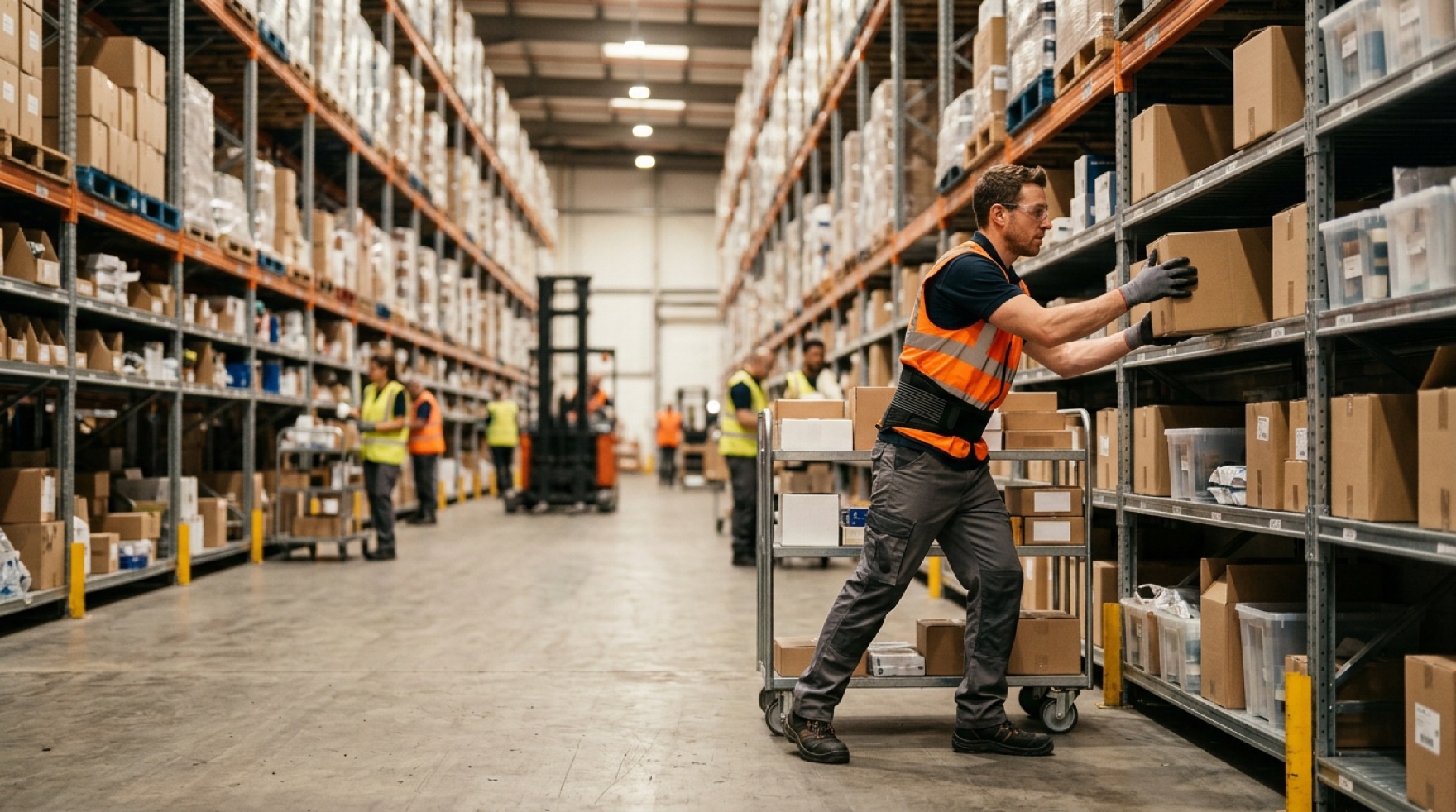
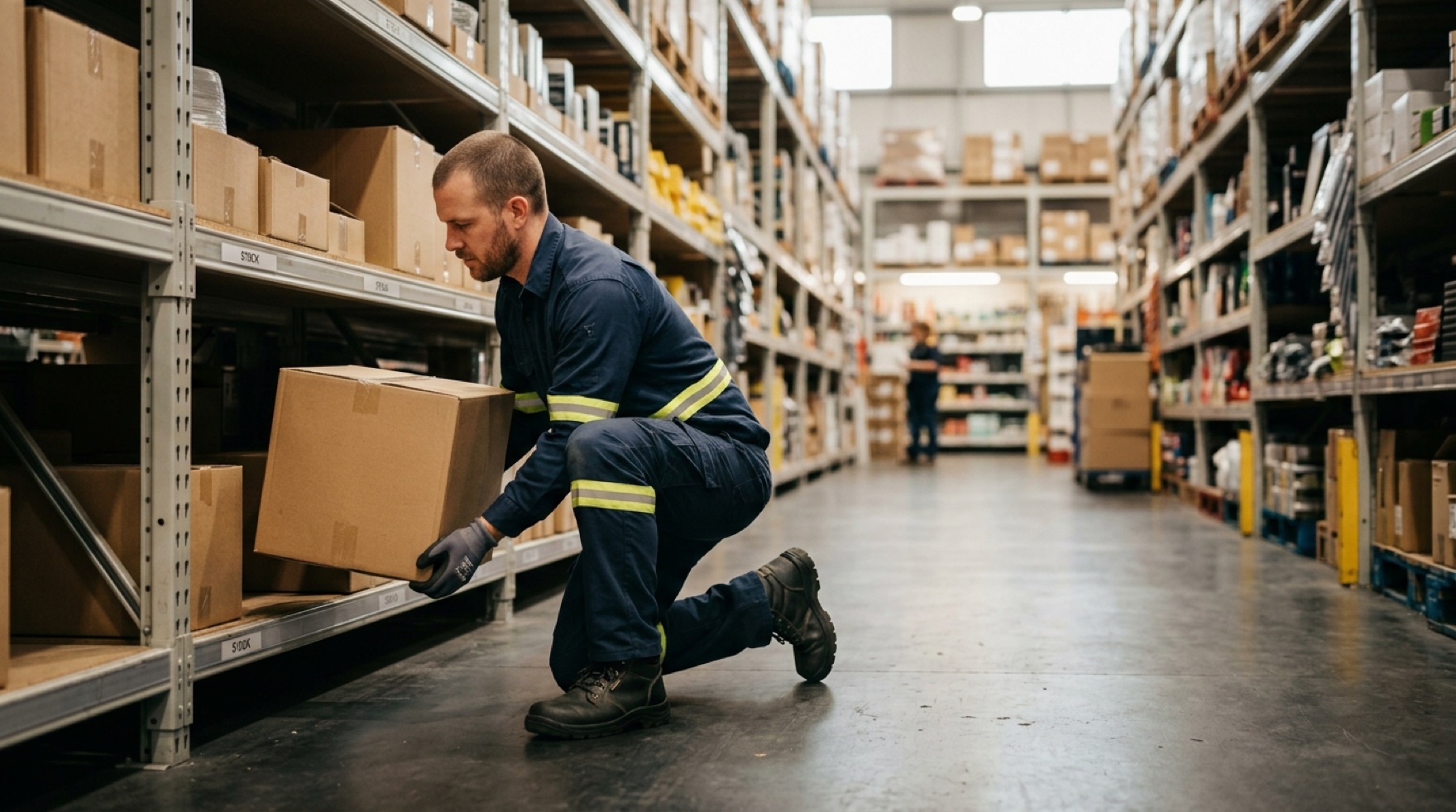
Overexertion from manual material handling is the leading source of injury in grocery and general retail, and it comes from the ordinary motions of the job: lifting cases off a pallet on truck day, loading and pushing U-boats, reaching overhead to face an endcap, and bending low to stock a bottom shelf. NIOSH's guidance for retailers frames these as engineering and work-organization problems rather than worker-carefulness problems, which is why the durable controls change the task, not the worker.
OSHA's Guidelines for Retail Grocery Stores (Publication 3192) and NIOSH's Ergonomic Solutions for Retailers point to the same short list of controls. Use mechanical assists, powered pallet movers, height-adjustable carts, and conveyors, so a worker moves a case rather than carries it. Keep loads close to the body and between knee and shoulder height, because a load held away from the trunk or lifted from the floor multiplies the force on the lower back. Reduce excessive reach through where product is slotted, so the heaviest and most frequently handled items sit at waist height rather than on the top or bottom shelf. Break up sustained awkward postures with task rotation, and evaluate the demanding lifts with the NIOSH Lifting Equation, which gives a recommended weight limit and a lifting index for a specific lift so a store can target the worst tasks first. The table below maps the common retail tasks to the control that removes the most risk.
| Task | Dominant hazard | Highest-value control |
|---|---|---|
| Unloading cases on truck day | Overexertion, awkward lift from floor | Powered pallet mover and roller conveyor; lift within the power zone, knee to shoulder |
| Loading and pushing U-boats and flatbed carts | Push/pull force, sustained posture | Maintained casters and clear paths; push rather than pull; limit load height for sightlines |
| Stocking top shelves and facing endcaps | Overhead reach, fall from height | Rated step stool or stockroom ladder at point of use; no climbing shelving |
| Stocking bottom shelves and pallet drops | Sustained stooping, low reach | Slot heavy fast-movers at waist height; kneel rather than bend; rotate the task |
| Standing at the register lane | Static standing load, venous pooling | Anti-fatigue matting at the till; foot-rest and posture variation |
How do you build a floor-safety routine that actually holds?
Treat the floor and the backroom as a system that is inspected, corrected, and re-checked, rather than a place you clean up after an incident. Assign the spill routine, the entrance-mat check, the aisle-clearance sweep, and the ladder-at-the-point-of-use check to named shifts, and log them, because 1910.22(d) makes regular inspection and correction a duty and an undated, unassigned routine proves nothing after someone falls. Give new stockers real instruction on lifting, mechanical assists, and the rule against climbing racking in their first week, which is precisely the gap the NIOSH FACE case recorded.
The reason this matters beyond compliance is that both injury patterns feed directly into staffing and continuity. A strained back or a fall takes a stocker or a cashier off the floor during the hours the store most needs them, adds workers' compensation cost, and pulls a trained person into recovery and a replacement into a rushed onboarding. Reducing the exposure protects the worker first and preserves the store's capacity to run the shift. Slips, falls, and manual handling are the least glamorous hazards in retail and the ones most worth engineering out before the doors open.