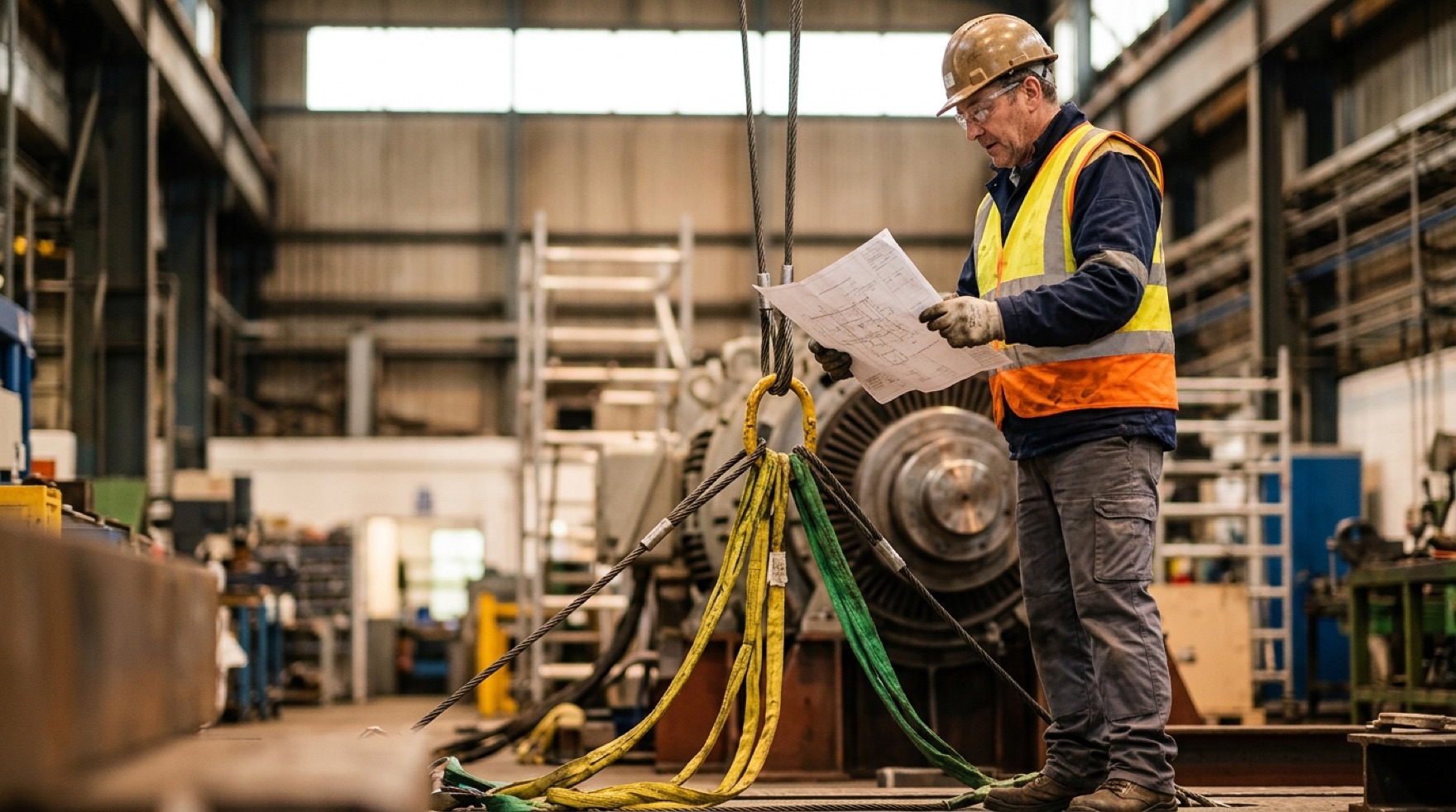
The short answer: A lift plan for machinery maintenance is a short written document that fixes the load weight, the rigging and hitch, the crane or hoist capacity, the path, and the people, before the load leaves the floor. OSHA does not mandate a written lift plan for every general-industry lift, but 29 CFR 1910.184 makes the sling rules enforceable: slings must not be loaded beyond their rated capacity (1910.184(c)(4)), damaged or defective slings must not be used (1910.184(c)(1)), and every sling must be inspected each day before use by a competent person (1910.184(d)). Written lift plans and critical-lift planning come from the ASME B30 consensus series. The single rule underneath all of it: nobody stands under or reaches into a suspended load.
What must a lift plan for machinery maintenance contain?
A lift plan answers, on paper and before the lift, every question that a dropped or swinging load would otherwise answer for you. It does not need to be long, but it needs to be specific, because the weight of a motor or a die is not something to estimate with a crane already hooked up. Build the plan around these items:
- Load weight and center of gravity. The actual weight from the nameplate, drawing, or scale, not a guess, plus where the load's center of gravity sits so the hitch keeps it level.
- Rigging selection and hitch. Sling type, length, and configuration (vertical, choker, or basket), plus shackles, eyebolts, and any below-the-hook lifting device, each with a rated capacity at or above the load with its sling angle accounted for.
- Sling angle. The angle each leg makes with horizontal, because a lower angle sharply increases the tension in each leg above the share of the load it appears to carry.
- Crane or hoist capacity. The rated capacity of the crane, hoist, or gantry, confirmed against the load plus the rigging weight.
- Lift path and set-down point. Where the load travels, what it must clear, and a prepared, stable landing area with blocking or cribbing ready.
- Roles. A qualified rigger, a single designated signal person, and the equipment operator, with the tag-line handler if the load needs one.
- Exclusion zone. The area kept clear of all personnel while the load is suspended, and how it is controlled.
Why does a suspended load justify a plan this detailed?
A suspended load is stored energy waiting for a failure point, and the moment to control it is before it is in the air, not after something jams. Once a heavy load is up and a problem appears, the options narrow fast, and the temptation to reach in or troubleshoot under it is exactly what turns a stuck lift into a fatality.
A Michigan FACE investigation shows the pattern. In MiFACE report 04MI074, a 62-year-old millwright was killed on June 22, 2004, after an overhead crane holding a draw die of about 42.5 tons, raised roughly 15 to 25 feet above the plant floor, could no longer be raised or lowered. He responded to troubleshoot it, removed a gearbox cover, saw a piece of metal caught between the drum and pinion gears, and tried to dislodge it with channel locks while the hoist motion was being jogged. A catastrophic failure followed, the unsupported load fell, and he was struck by the cables as they unspooled from the drum. MiFACE recommended controlling all sources of energy during crane troubleshooting and, where a load is suspended, providing a means of support to dissipate its potential energy. The transferable point is that a lift plan does not end when the load stops moving: a suspended load that cannot be lowered must be supported or landed before anyone works on the equipment holding it.
What does OSHA actually require for slings and rigging?
OSHA's enforceable rules for the rigging itself live in 29 CFR 1910.184, and they are worth reading as the non-negotiable base beneath any lift plan. These are the safe operating practices the standard requires whenever a sling is used:
- Do not exceed rated capacity. 1910.184(c)(4) prohibits loading a sling in excess of its rated capacity, which is why the load weight and sling angle in the plan are not optional detail.
- Do not use a damaged sling. 1910.184(c)(1) prohibits using slings that are damaged or defective, and 1910.184(c)(3) prohibits kinked sling legs.
- Keep hands clear while tightening. 1910.184(c)(10) prohibits placing hands or fingers between the sling and the load while the sling is being tightened around it.
- Never shock load. 1910.184(c)(11) prohibits shock loading, the sudden jerk that can multiply the force on the rigging well beyond the load's static weight.
- Do not pull a trapped sling. 1910.184(c)(12) prohibits pulling a sling out from under a load that is resting on it.
- Keep people clear. 1910.184(c)(8) requires suspended loads to be kept clear of all obstructions, and 1910.184(c)(9) requires all employees to be kept clear of loads about to be lifted and of suspended loads.
- Inspect before use. 1910.184(d) requires that each day before being used, the sling and all fastenings and attachments be inspected for damage or defects by a competent person, with additional inspections during use where service conditions warrant, and any damaged or defective sling removed from service.
The consensus detail behind these practices sits in ASME B30.9 for slings and the wider ASME B30 series for cranes and below-the-hook devices. That series is advisory rather than a federal regulation, but it is where rejection criteria, inspection intervals, and critical-lift planning are spelled out, and it is what a competent person applies when deciding whether a worn sling passes.
What goes on the pre-lift rigging check, right before the lift?
The pre-lift check is the last gate between the plan and the load in the air, and it is done at the equipment with the crew present. Walk it in order:
- Load weight confirmed against the plan, and within crane and rigging capacity with the sling angle counted.
- Each sling inspected today by the competent person: no cuts, no broken wires or crushed strands, no chemical or heat damage, no kinks, and a legible capacity identification tag present.
- Shackles, eyebolts, hooks, and any below-the-hook device rated, undamaged, and correctly seated, with hook latches closed.
- Hitch correct for the load and center of gravity, with edge protection (softeners) where the sling crosses a sharp corner.
- Landing area prepared: stable, clear, and cribbing or blocking staged.
- One signal person identified, signals agreed, and the tag line rigged if the load can rotate or swing.
- Exclusion zone set and clear, with no one under the load path.
- A trial lift of a few inches to confirm the load is level, the rigging is holding, and the brakes set before the full lift proceeds.
Treat any failed item as a stop, not a note for later. A missing capacity tag, a sling with a broken wire, or a landing area that is not yet clear each pulls the rigging out of service or holds the lift until it is fixed, in the same way a failed brake grounds a machine. The plan and the check only reduce risk if a red item actually stops the load from leaving the floor.