The short answer: There is no OSHA standard written specifically for safe patient handling. OSHA addresses the musculoskeletal injuries that manual lifting causes under the General Duty Clause, Section 5(a)(1) of the Occupational Safety and Health Act, and several states have passed their own safe patient handling laws. A safe patient handling and mobilization program replaces manual lifting with assistive equipment, ceiling lifts, mobile floor lifts, sit-to-stand devices, and friction-reducing lateral transfer aids, and OSHA's guidance for nursing homes recommends that manual lifting of residents "be minimized in all cases and eliminated when feasible."
Does OSHA have a standard for safe patient handling?
No. There is no federal OSHA standard written specifically for safe patient handling, so the hazard is regulated through the General Duty Clause, Section 5(a)(1) of the Occupational Safety and Health Act, which requires each employer to furnish a workplace free from recognized hazards that are causing or likely to cause death or serious physical harm. OSHA's own ergonomics guidance confirms the principle plainly: under the General Duty Clause, employers must keep their workplaces free from recognized serious hazards, including ergonomic hazards. That means a facility cannot treat patient-handling injury as unregulated simply because no numbered standard names it.
The regulatory gap has been filled from two directions. NIOSH and OSHA both recommend engineering the manual lift out of care rather than training staff to lift more carefully, and several states have enacted safe patient handling laws that require covered health-care employers to run a formal program. For a safety leader, the operational implication is that compliance here is not a checklist against a single clause. It is a defensible demonstration that a recognized hazard, manual patient handling, has been assessed and controlled.
Why is manual patient handling one of the leading causes of injury in nursing?
Because patients are heavy, unpredictable loads handled in awkward, sustained postures, and no lifting technique makes that safe. OSHA reports that in 2017 nursing assistants had the second highest number of musculoskeletal disorder cases of any occupation, with 18,090 days-away-from-work cases at an incidence rate of 166.3 per 10,000 workers, more than five times the average for all industries. That rate is a statement about mechanism as much as scale: the injuries come from overexertion and cumulative trauma to the back and shoulders during transfers, repositioning, and mobilization.
The consequence for a unit extends past the individual injury. A nurse or aide with a back injury means absenteeism, restricted duty, workers' compensation cost, and the loss of an experienced caregiver at a time when staffing is already tight. When the injury drives an experienced worker out of direct care entirely, the facility absorbs recruitment and retraining on top of the claim. Reducing manual handling protects the worker and preserves the workforce capacity the unit depends on to run.
What does a safe patient handling and mobilization program require?
A working program replaces manual lifting with equipment and builds the organization around keeping that equipment available and used. OSHA's ergonomics guidance for nursing homes frames it as a process that provides management support, involves employees, identifies problems, implements solutions, addresses reports of injuries, provides training, and evaluates ergonomics efforts. Each of those elements does specific work, and a program missing one tends to fail at exactly that point.
Management support is what funds the lifts and protects the time to use them. Employee involvement matters because the aides and nurses on the unit know which transfers hurt and which equipment sits unused because it is stored two floors away. A worksite analysis identifies the high-risk tasks per unit, bariatric transfers, bed-to-chair moves, repositioning, and toileting, so equipment is matched to the actual work. Care planning assigns each patient a documented handling method based on their mobility and weight-bearing ability, so the transfer decision is made before the caregiver is at the bedside. Training then covers the specific devices in use, and program review checks whether injuries and near-misses are actually falling. The point is that equipment alone is not a program: the surrounding process is what keeps the lift plugged in, charged, and reached for.
What equipment actually removes the manual lift?
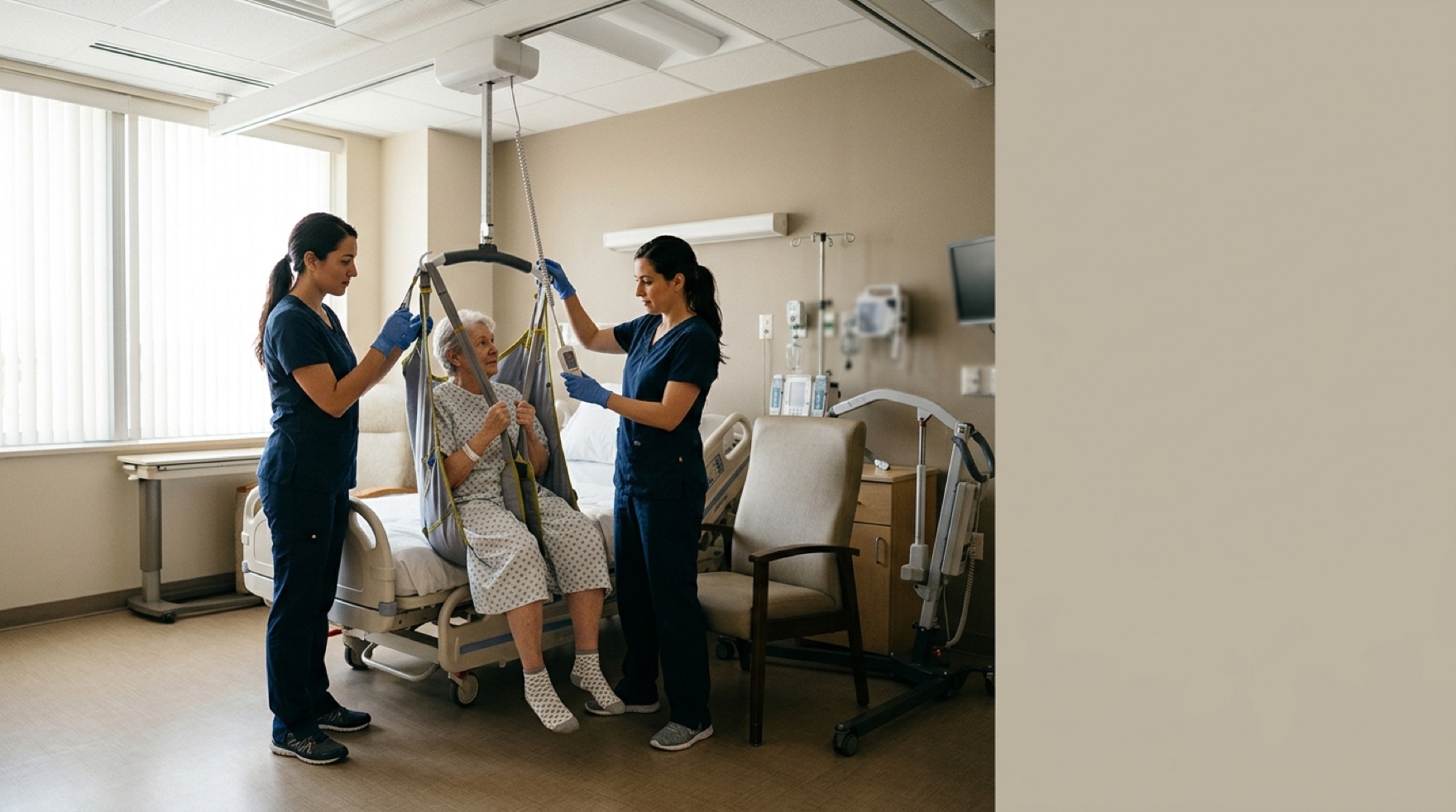
The controls that work are the ones that take the patient's weight off the caregiver entirely: ceiling-mounted lifts, mobile floor lifts, powered sit-to-stand devices, and friction-reducing lateral transfer aids. OSHA's nursing-home guidance recommends that manual lifting of residents "be minimized in all cases and eliminated when feasible," which places these engineering controls at the top of the hierarchy and puts gait belts and body mechanics well below them. Body mechanics training alone does not reduce injury rates, because no posture makes a dependent transfer of a heavy patient safe for the spine.
Matching the device to the task is what makes the program credible on the floor. A fully dependent patient needs a full-body sling lift, ceiling-mounted or mobile. A patient who can bear some weight but cannot stand independently is a candidate for a powered sit-to-stand device. A bed-to-stretcher or bed-to-bed move is a lateral transfer, best handled with an air-assisted or friction-reducing sheet rather than a team of caregivers dragging on a drawsheet. Once the right equipment is specified, availability and maintenance decide whether it gets used: slings laundered and in stock, batteries charged, and lifts stored where the transfer happens rather than in a distant supply room. Equipment that is hard to reach is equipment that gets skipped, and the skipped transfer is where the injury occurs.
Which states require a safe patient handling program?
Several states have enacted safe patient handling laws that require covered health-care facilities to establish a program, most mandating a written policy and a move toward minimal manual lifting. The table below lists the state laws OSHA documents on its safe patient handling page and when each was signed. Even where a state law does not reach a facility, the General Duty Clause still requires the recognized hazard to be controlled, so the table marks where a formal program is a statutory duty rather than where the hazard first becomes real.
| State | Safe patient handling law | Signed |
|---|---|---|
| Texas | Senate Bill 1525 | June 2005 |
| Washington | House Bill 1672 | March 2006 |
| Maryland | SB 879 | April 2007 |
| Minnesota | HB 712.2 | May 2007 |
| New Jersey | S-1758 / A-3028 | January 2008 |
| California | AB 1136 | October 2011 |
| New York | Title 1-A, Article 29-D, Public Health Law | 2014 |
The pattern across these laws is consistent: a written program, a hazard assessment, an equipment commitment, and worker involvement. That is the same structure OSHA recommends nationally, which means a facility building a program to the guidance is largely building to the state statutes as well.
Building the program around the equipment, not the technique
Every element of a safe patient handling and mobilization program serves one instruction: get the patient's weight off the caregiver. Assessing each unit's high-risk transfers, assigning each patient a documented handling method, investing in the right lifts and lateral transfer aids, and reviewing whether injuries are actually falling all serve that goal, and OSHA's guidance and the state laws are built around it. The facilities that still lead with body mechanics training are controlling the hazard at its weakest layer, while the ones that engineer the manual lift out of care protect their nurses and hold onto the experienced staff the unit cannot easily replace.