The short answer: Formaldehyde in hair-smoothing treatments is regulated by OSHA under 29 CFR 1910.1048, which sets a permissible exposure limit of 0.75 ppm as an 8-hour time-weighted average and a short-term exposure limit of 2 ppm over 15 minutes. Many products marketed as formaldehyde-free contain methylene glycol or formalin, which release formaldehyde gas when the treated hair is heated with a blow dryer and flat iron, and OSHA's own air testing in salons found formaldehyde at levels above its protective limits. A salon that uses these products has to treat formaldehyde as the regulated chemical it is: monitor the air, control the exposure, and meet the hazard communication requirements of 29 CFR 1910.1200.
Does OSHA regulate formaldehyde in salon smoothing products?
Yes. Formaldehyde is covered by a substance-specific standard, 29 CFR 1910.1048, that applies to all occupational exposures regardless of the source, and a salon using keratin or Brazilian-style smoothing products falls squarely inside it. The standard exists because formaldehyde is a respiratory and skin sensitizer and a cancer hazard, so OSHA does not leave its control to the product label or the manufacturer's marketing.
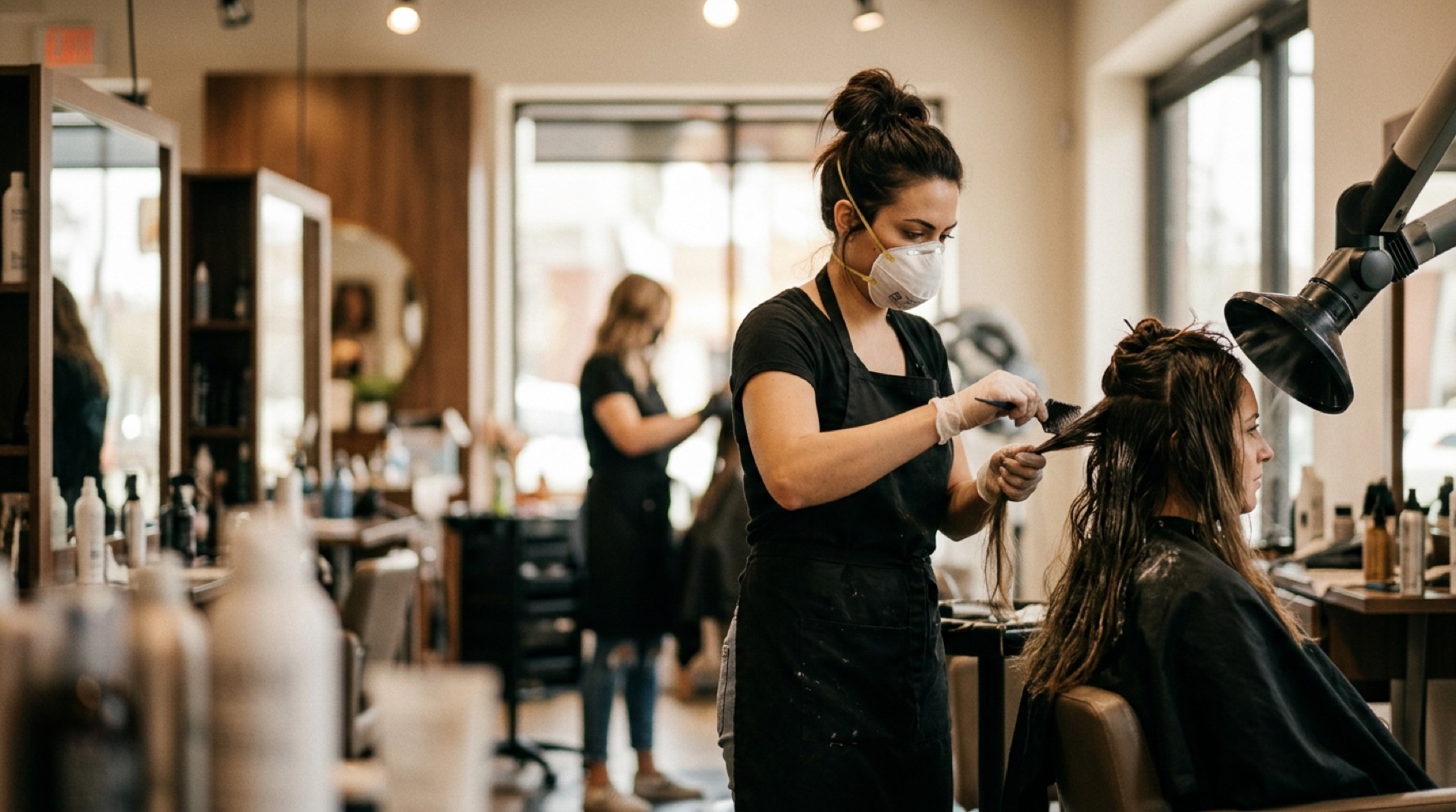
That matters operationally because the exposure in a salon is not a spill or a stored drum. It is generated on demand at the styling station, when the developer or smoothing solution on the hair is heated during blow-drying and flat-ironing and formaldehyde comes off as a gas into the stylist's breathing zone. The person most exposed is the stylist doing the service, and the client and neighboring stations share the air. OSHA's Hair Salons guidance and its 2011 hazard alert and news release describe air tests in salons that found formaldehyde at levels higher than the agency's protective limits, which is what moved the exposure from a theoretical concern to a monitored one.
What are the OSHA exposure limits for formaldehyde?
OSHA sets three numbers that drive everything else, all in 29 CFR 1910.1048. The permissible exposure limit is 0.75 ppm as an 8-hour time-weighted average under 1910.1048(c)(1); the short-term exposure limit is 2 ppm measured over any 15-minute period under 1910.1048(c)(2); and the action level is 0.5 ppm as an 8-hour TWA under 1910.1048(b). These are OSHA limits and they are enforceable, which is the distinction that matters when a vendor cites a different advisory value.
The action level is the trigger, not just a lower number. Once an employee's exposure reaches or exceeds 0.5 ppm as an 8-hour average, the standard's periodic monitoring and medical surveillance obligations switch on, and once exposure exceeds the STEL the same is true. The table below sets out the limits and the clause that carries each, so the salon owner can see which number turns on which duty.
| Limit | Value | Basis | Clause |
|---|---|---|---|
| Permissible exposure limit (PEL) | 0.75 ppm | 8-hour time-weighted average | 1910.1048(c)(1) |
| Short-term exposure limit (STEL) | 2 ppm | 15-minute average | 1910.1048(c)(2) |
| Action level | 0.5 ppm | 8-hour time-weighted average | 1910.1048(b) |
| Exposure monitoring | Initial and periodic | Required to determine exposure | 1910.1048(d) |
| Regulated areas | Where PEL or STEL is exceeded | Posted and access-limited | 1910.1048(e) |
| Medical surveillance | At or above action level, or above STEL | Exams and questionnaire | 1910.1048(l) |
Why do formaldehyde-free products still release formaldehyde?
Because the formaldehyde is present in a form that only becomes a gas when heated, so a label reading the liquid does not describe what the stylist breathes. Many smoothing solutions contain methylene glycol, the water-dissolved form of formaldehyde, or formalin, and when the treated hair is heated with a blow dryer and flat iron the equilibrium shifts and formaldehyde gas is released into the air. A product can be labeled formaldehyde-free and still put formaldehyde into the breathing zone during the service.
OSHA's air monitoring at salons documents the gap between the label and the exposure. In its Hair Salons background materials, OSHA describes products sold as "formaldehyde free" that contained methylene glycol, which the FDA warning letter it cites identifies as releasing formaldehyde when the treated hair is heated. A NIOSH health hazard evaluation at an Ohio salon using a Brazilian Blowout product, reported in OSHA's Hair Salons guidance, found formaldehyde in the air above the NIOSH ceiling of 0.1 ppm during most steps of the treatment for the stylist applying the product, while the results stayed below OSHA's own limits. What was in place was a stylist relying on a formaldehyde-free label and no exposure monitoring; what the investigation showed was measurable formaldehyde released at the flat iron. The transferable point is that the label is not an exposure assessment, and 1910.1048(d) exists because the only way to know a stylist's exposure is to measure the air during an actual service.
What must a salon do if it uses these products?
A salon that uses formaldehyde-releasing products has to manage them as a regulated chemical exposure, starting with air monitoring and hazard communication. Under 1910.1048(d) the employer must determine each stylist's exposure by monitoring the air during product use, and where the results reach the 0.5 ppm action level or the 2 ppm STEL the standard requires periodic monitoring at least every six months, medical surveillance under 1910.1048(l), and, where the PEL or STEL is exceeded, engineering and work-practice controls plus regulated areas under 1910.1048(e).
The controls follow the usual order. Substitution comes first: choosing a smoothing system that does not contain or release formaldehyde removes the hazard rather than managing it. Where a formaldehyde-releasing product stays in use, local exhaust ventilation at the station that captures the gas during blow-drying and flat-ironing is the engineering control that keeps the stylist's breathing zone below the limits, and respiratory protection under 29 CFR 1910.134 is the fallback when ventilation alone cannot. Alongside the exposure controls, the hazard communication standard, 29 CFR 1910.1200, requires the employer to keep the safety data sheet for each product, label containers, and train stylists on the formaldehyde hazard and how to read the label and the SDS. Training is not a formality here, because the stylists are the ones deciding whether a product is safe to use on the next client.
How often does a salon have to monitor the air?
Monitoring starts with an initial exposure determination and then repeats on a schedule tied to the results. Under 1910.1048(d) the employer must first monitor to determine each stylist's exposure, and OSHA's Hair Salons guidance on protecting worker health describes testing the air during product use to see whether stylists are exposed at or above the limits, with monitoring repeated at least every six months where the level is at or above the 0.5 ppm action level. The result is not a one-time check but a recurring measurement that follows the actual work.
Two things reset the clock. A change in the products, the process, or the ventilation that could raise exposure requires the employer to monitor again, because the previous result no longer describes the new conditions. So does any stylist complaint of the eye, nose, throat or skin irritation that signals formaldehyde. Treat a switch to a new smoothing brand or a busier service schedule as a trigger to re-measure, rather than assuming an old air test still holds, which is the assumption 1910.1048(d) is written to close.
Turning the label question into an exposure decision
The recurring mistake in salons is treating the formaldehyde-free claim on the bottle as the end of the analysis, when 29 CFR 1910.1048 treats the air at the station as the thing that has to be checked. A stylist can read a reassuring label and still work a full day inside a formaldehyde exposure that reaches OSHA's action level, because the gas is generated by the heat of the service, not stored in the container. Substituting to a genuinely formaldehyde-free system removes the question. Where a releasing product stays in use, monitoring the air, ventilating the station, and training stylists to the hazard under 1910.1200 are what convert an unverified marketing claim into a controlled, documented exposure that protects the person standing over the flat iron.