The short answer: Under OSHA 1910.253, oxygen cylinders in storage must be separated from fuel-gas cylinders and combustibles by 20 feet or a noncombustible barrier at least 5 feet high with a half-hour fire rating; acetylene must never be used above 15 psig; and valve-protection caps must be hand-tight whenever a cylinder isn't in use. Cylinders are secured upright, moved by cart, and inspected before use. Most cylinder incidents trace to skipping one of these basics.
Two hazards in one steel bottle
Every cylinder holds gas under high pressure — enough that a sheared-off valve can turn the cylinder into an uncontrolled rocket. Fuel-gas cylinders add flammability, and oxygen, while not flammable itself, dramatically accelerates combustion. The storage and handling rules exist to keep the pressure contained and the oxygen away from the fuel and the grease.
Storage: separate oxygen from fuel gas
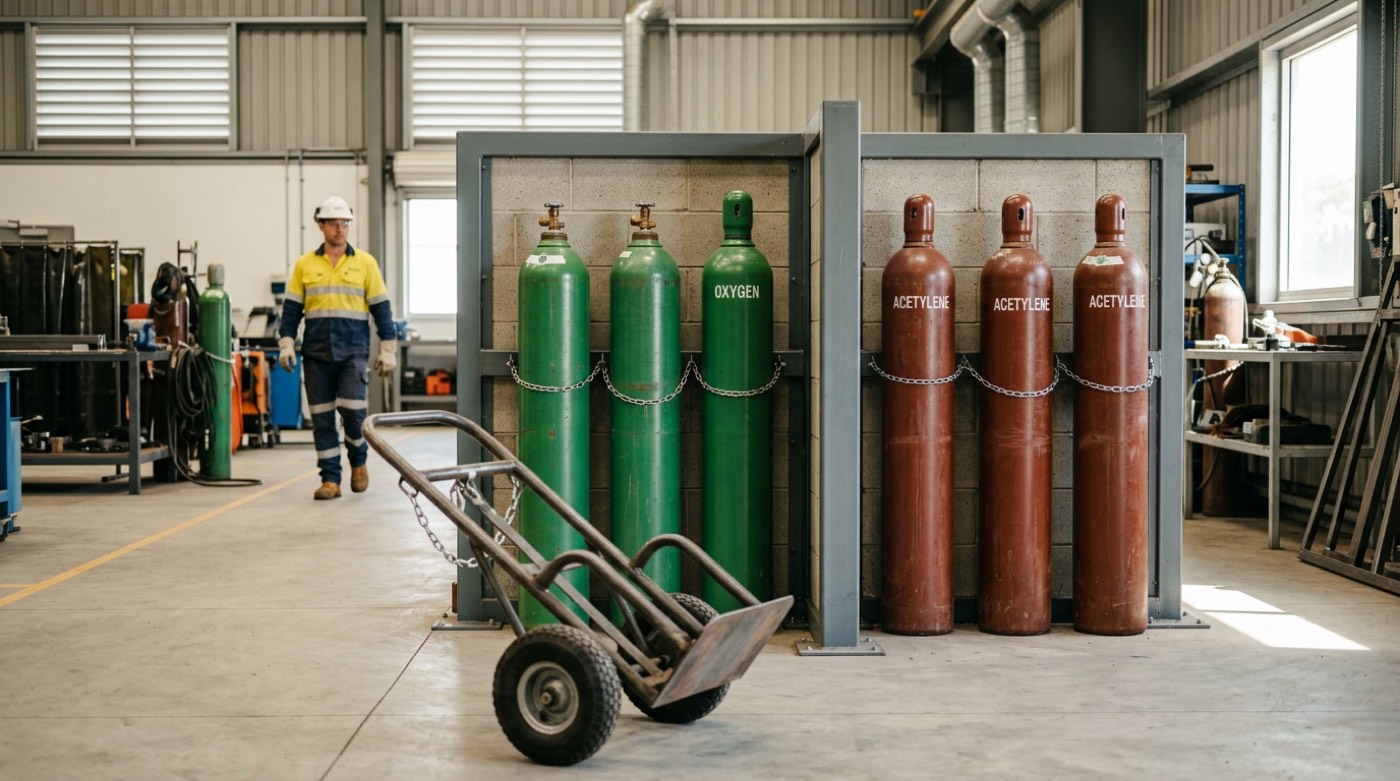
The load-bearing rule is OSHA 1910.253(b)(4)(iii): "Oxygen cylinders in storage shall be separated from fuel-gas cylinders or combustible materials (especially oil or grease), a minimum distance of 20 feet (6.1 m) or by a noncombustible barrier at least 5 feet (1.5 m) high having a fire-resistance rating of at least one-half hour." Storage areas should be dry, well-ventilated, and built of noncombustible materials, and oxygen must be kept away from oil and grease — a combination that can ignite violently.
Acetylene's pressure limit
Acetylene is unstable above a certain pressure. OSHA 1910.253(a)(2) is explicit: acetylene shall not be generated, piped (except in approved manifolds), or used at a pressure above 15 psig (or 30 psia). Acetylene and other dissolved-gas cylinders must also be stored and used valve-end up to keep the solvent (acetone) from being drawn out with the gas.
Handling: caps, carts, and securing
- Valve-protection caps: "shall always be in place, hand-tight, except when cylinders are in use or connected for use" (1910.253(b)(2)(iv)). Before moving a cylinder, remove regulators and put the cap back on unless it's secured on a proper cart (1910.253(b)(5)(ii)(D)).
- Secure upright: cylinders are chained or strapped upright to prevent tipping, at the workstation and in storage.
- Move with a cart: never lift or drag a cylinder by the valve or cap, and never use it as a roller.
- Inspect before use: OSHA 1910.101(a) requires cylinders be determined safe by visual inspection; the in-plant handling, storage, and use of compressed gases follows CGA Pamphlet P-1, incorporated by reference.
Keep cylinders away from the work
Store and position cylinders clear of the welding and cutting operation itself, away from heat, sparks, and electrical circuits, with fulls and empties separated and empty cylinders marked with valves closed and caps on. The discipline is simple; the failure modes — a toppled cylinder, an oxygen-and-grease fire, an over-pressured acetylene line — are not.