The short answer: OSHA's powered-industrial-truck standard (29 CFR 1910.178) governs forklift design, maintenance, operation, and operator training — including re-evaluation of every operator at least once every three years. But the control that prevents the deadliest incidents isn't in the operator's cab: it's physically separating pedestrian and vehicle routes so the two never have to negotiate the same square of floor.
Why the struck-by risk is so lethal
A loaded forklift can weigh several times a car, with limited visibility past the load and a tendency to tip if maneuvered too fast. When it shares an aisle with walking workers, the energy mismatch means a low-speed contact can be fatal. Forklift-related incidents remain a recurring source of occupational fatalities in BLS data, and a large share involve pedestrians rather than operators. The common thread in the serious ones is a point where a person and a truck were expected to share the same space and rely on attention alone.
What 1910.178 requires of operators
Under 29 CFR 1910.178(l), employers must ensure each operator is competent, demonstrated through training and a hands-on evaluation, before operating a truck. Operators must be re-evaluated at least once every three years, and refresher training is triggered by unsafe operation, an accident or near-miss, a change in workplace conditions, or assignment to a different truck type. The employer must certify that each operator was trained and evaluated. Pre-shift inspection of each truck is required, and any defect takes the truck out of service until repaired. The design and stability requirements OSHA references trace to ANSI/ITSDF B56.1.
Separation is the real control
Operator training is necessary but sits low in the hierarchy — it depends on human attention every single time. The controls that actually remove the struck-by hazard are engineering and layout:
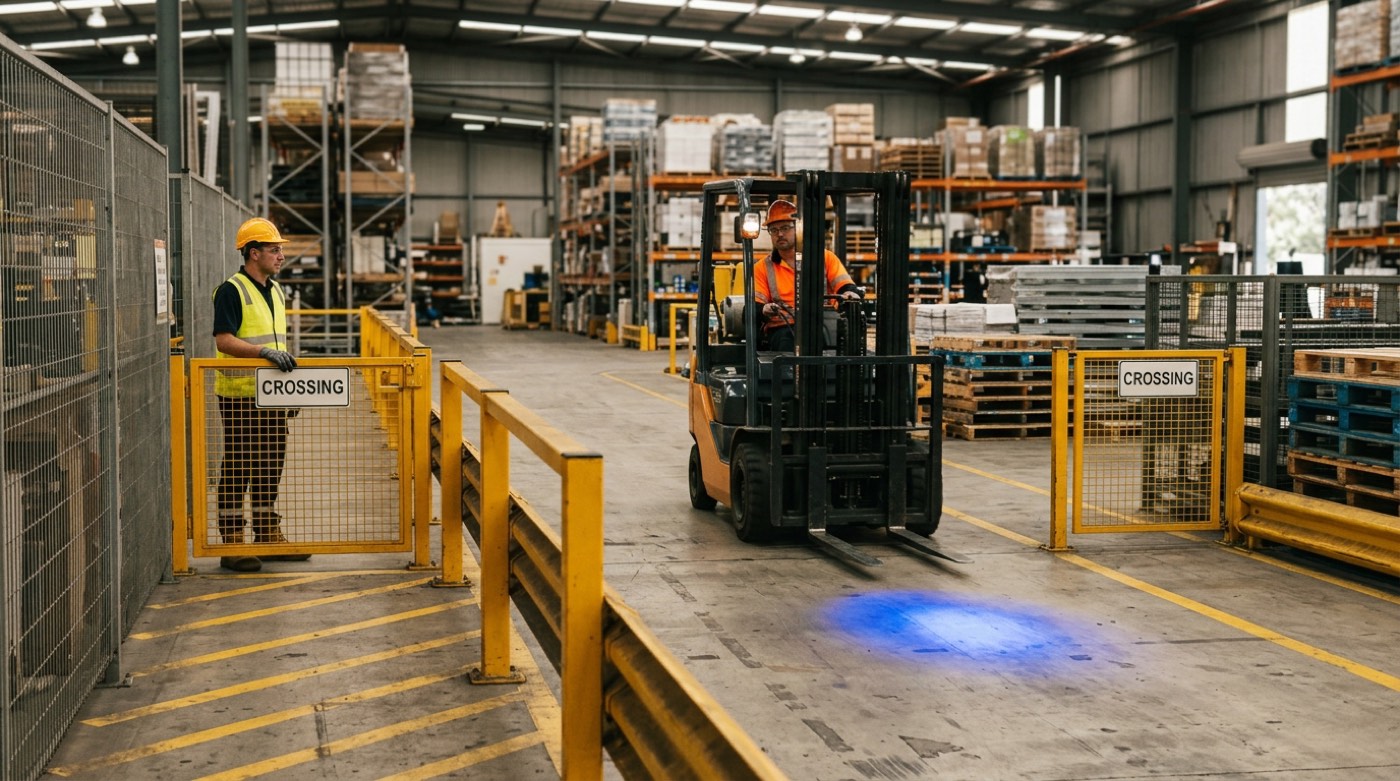
- Separate the routes: Dedicated, physically bounded pedestrian walkways and separate vehicle aisles, with separate doorways where they must cross a wall.
- Protect the conflict points: Guardrails and bollards, gated or signalized crossings, and floor markings that make the boundary unambiguous.
- Add detection where separation can't be complete: Proximity-detection systems, blue spot or red-zone lights that project ahead of the truck, convex mirrors at blind corners, and speed-limiting in mixed zones.
- Set the rules: A right-of-way policy that gives pedestrians priority, speed limits, and horn use at intersections — backed by a traffic-management plan that is reviewed after every layout change.
OSHA does not publish a single numeric separation distance; the expectation, drawn from 1910.178 and the General Duty Clause, is that you engineer the interaction so pedestrians and trucks are not relying on each other's vigilance to avoid contact.