The short answer: OSHA's machine-guarding requirements (29 CFR 1910 Subpart O) require the point of operation and every nip point, rotating part, and flying-chip hazard to be guarded so that no part of the body can enter the danger zone during operation. Presses (1910.217), robots (ANSI/RIA R15.06, adopting ISO 10218), and conveyors (ASME B20.1) each add specific safeguarding rules — and none of them replaces lockout/tagout the moment someone has to reach past the guard.
The general duty to guard
The foundation is 29 CFR 1910.212: one or more methods of machine guarding must protect operators and nearby workers from hazards such as the point of operation, ingoing nip points, rotating parts, and flying chips or sparks. The point of operation must be guarded whenever its operation exposes a worker to injury — and the guard must prevent any part of the body from being in the danger zone during the operating cycle. Guarding methods range from fixed barriers and interlocked gates to presence-sensing devices and two-hand controls; the right one depends on the machine, the task, and a risk assessment.
Presses: energy that closes fast
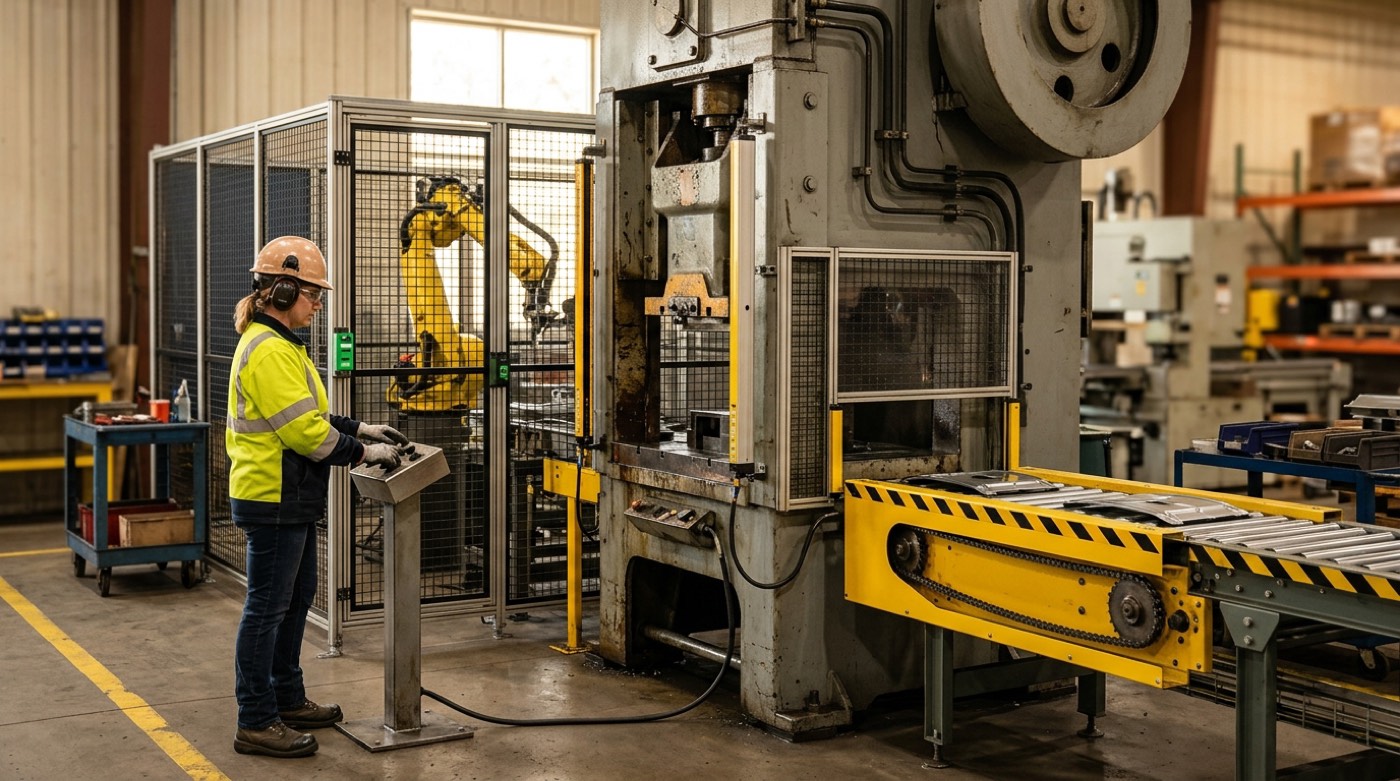
Mechanical power presses fall under 29 CFR 1910.217, which layers additional requirements onto the general duty: point-of-operation safeguarding matched to the stroke, two-hand trips and controls, brake monitoring, and specific provisions for die-setting and setup — the moments when workers are most exposed. Presence-sensing device initiation and light curtains are common engineering safeguards, but they must be selected and positioned so a hand cannot reach the die before the stroke stops.
Robots: safeguard the space, not just the arm
Industrial robots are governed in the U.S. by ANSI/A3 R15.06 (the current 2025 edition, which superseded the long-standing 2012 RIA edition), nationally adopting the international robot-safety standards ISO 10218-1 (the robot) and ISO 10218-2 (the integrated system). The core principle is safeguarding the robot's operating space — perimeter guarding, interlocked access, and presence-sensing that stops motion before a person reaches the arm. Where humans and robots share space, collaborative-operation limits on speed, force, and pressure (defined in ISO/TS 15066) apply. A robot at rest is not a robot that is safe to approach: a NIOSH-authored analysis counted 41 robot-related U.S. worker deaths from 1992–2017, most caused by the robot striking a worker who had entered its space, frequently during maintenance — which is precisely why safeguarding the space and locking out for entry both matter.
Conveyors: the nip point that never sleeps
Conveyors are covered by ASME B20.1 together with OSHA's general guarding duty. The hazards are nip points at pulleys, rollers, and transfer points; entanglement; and being drawn in. Controls include nip-point guarding, emergency-stop pull-cords accessible along the run, and interlocks at access points.
The guard and the lock have to work together
Every one of these safeguards protects a worker during normal operation. The moment maintenance, a jam clear, or a die change requires reaching past the guard, the controlling standard becomes lockout/tagout (1910.147) — isolate and verify zero energy before the barrier comes off. Guarding and energy control are not alternatives; they cover different phases of the same machine's life, and the gap between them is where amputations happen.