The short answer: Same-level falls on contaminated floors are among the most frequently recorded injuries in vehicle manufacturing, and OSHA's walking-working surfaces rule (29 CFR 1910.22) is built around one idea — keep the surface clean and dry so far as practicable, and provide drainage or mats where a wet process makes that impossible. The durable fix is to stop the fluid at its source and drain what remains; slip-resistant footwear and matting are the layers that catch the residual risk, not the program itself.
Why plant floors slip in the first place
Automotive assembly runs on fluids: cutting and coolant fluids at machining stations, hydraulic oil around presses, transmission and brake fluid at fill stations, and washdown water in cleaning bays. Every one of them lowers the friction between a boot and the floor. When that friction — measured as the coefficient of friction — drops below the level a walking worker needs, a slip becomes likely. The result is the "fall on the same level," a category the 2025 Liberty Mutual Workplace Safety Index ranks as the #2 cause of serious disabling workplace injury at about $10.5 billion a year — second only to overexertion.
What OSHA actually requires
OSHA's general requirement for walking-working surfaces, 29 CFR 1910.22, requires employers to keep floors "clean, orderly, and in a sanitary condition" and dry so far as reasonably practicable. Critically, where a wet process is unavoidable, 1910.22(a)(2) requires that drainage be maintained and that "false floors, platforms, mats, or other dry standing places" be provided where practicable. That is the regulatory basis for putting a drainage mat at a washdown station — but notice the order: drainage first, mats where drainage cannot do the whole job.
Measuring slip resistance instead of guessing
"Slip-resistant" is meaningless as a marketing word; it means something only as a measured value. The recognized North American method is ANSI A326.3, which measures the dynamic coefficient of friction (DCOF) of a hard-surface floor in the wet condition using a calibrated tribometer. A326.3 does not set a single number — it sets situation-specific minimums: a wet DCOF of 0.42 for interior floors walked on with water, and a higher 0.55 for floors subject to oils and greases. For an oil- or coolant-contaminated plant floor, 0.55 — not 0.42 — is the applicable target, which is exactly the value a 0.42 "wet-rated" product can quietly fall short of. Two cautions: A326.3 itself warns that a minimum number is close to meaningless if traffic, contaminants, wear, and maintenance are ignored, and the value to specify is the contaminated one — tested with the oil or coolant actually present, not a clean, dry lab figure.
The hierarchy of controls, applied to a spill
- Eliminate / substitute: Fix the leaking fitting, seal the machine, switch to a less-migratory coolant, or enclose the process so fluid never reaches the walkway.
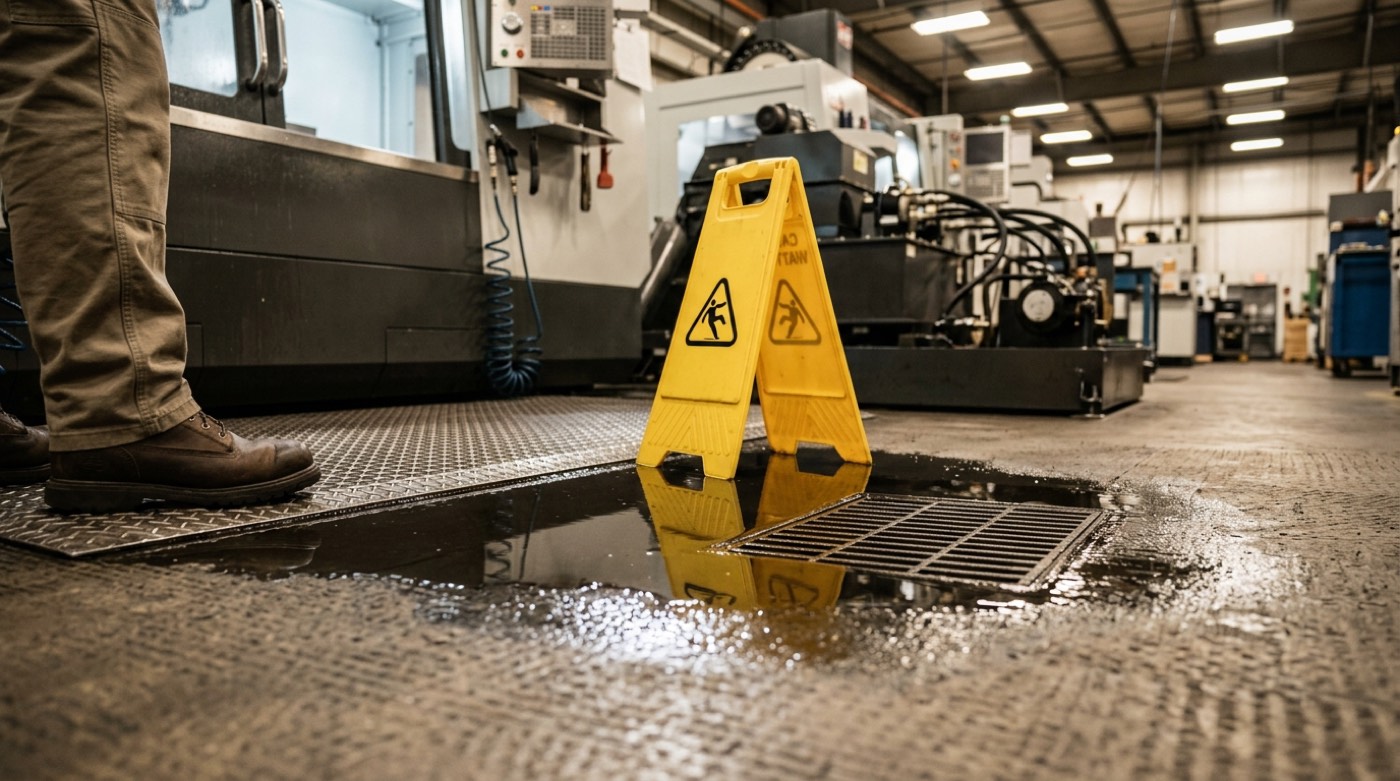
- Engineering controls: Drip trays and bunding under machines; floor drainage and trench grates in wet zones; a floor coating or surface with a documented wet DCOF; adequate lighting so a sheen is visible.
- Administrative controls: A dated, signed cleaning cycle; an immediate spill-response standard with materials staged nearby; wet-floor signage placed the moment a hazard appears and removed only when the floor is dry.
- PPE / surface layers: Slip-resistant footwear issued against the specific contaminant, and drainage or slip-resistant matting where a station stays wet.
Matting and footwear land at the bottom of that list deliberately. They are effective and worth using — but a program that reaches for them first, while leaving the leak unfixed and the cleaning cycle undocumented, is the kind of program that fails an audit and keeps generating claims.
Building a floor program that holds up
Map the floor by contamination: where fluid lands, how far it migrates, and which walkways cross it. Prioritize the wettest, highest-traffic zones. Assign each zone an owner and a cleaning frequency, and record completion — an undated cleaning schedule is not auditable evidence. Investigate every slip and near-miss for the source fluid, and feed that back into leak repair. The floors that stay defensible are the ones where the paperwork proves the surface was managed, not just mopped.