The short answer: There is no federal OSHA ergonomics standard — the 2000 rule was repealed in 2001 — so musculoskeletal-disorder (MSD) hazards are addressed under the General Duty Clause and evaluated with recognized tools: the NIOSH Revised Lifting Equation, RULA/REBA posture scoring, and the ISO 11228 manual-handling series. The highest-leverage control is redesigning the task — height, reach, load, and frequency at the station — not asking workers to "lift with their legs."
What drives MSDs on the line
Assembly work concentrates the classic ergonomic risk factors: force (lifting and pushing parts), repetition (the same motion every cycle for a whole shift), awkward posture (reaching into a body-in-white, overhead work under a vehicle), static loading (holding a tool or a posture), and contact stress. None of these produces a dramatic single-event injury; they accumulate into strains, tendinitis, and low-back disorders over weeks and months. In BLS injury data, MSDs account for a large share of days-away-from-work cases and carry a longer-than-average recovery time.
Screen the risk with the right tool
The NIOSH Revised Lifting Equation (NIOSH Publication 94-110) is the anchor for lifting tasks. It starts from a load constant of 51 lb (23 kg) — the maximum recommended weight under ideal conditions — and multiplies it down by how far the load is from the body (horizontal), its start and end height (vertical), travel distance, trunk twist (asymmetry), lift frequency, and grip quality (coupling). The output is a Recommended Weight Limit, and the Lifting Index — actual weight ÷ RWL. An LI above 1.0 signals increased low-back-injury risk for some workers; a high LI signals risk for most. For static postures and repetitive upper-limb work, RULA and REBA scoring and the ISO 11228-3 method for high-frequency low loads round out the picture. ISO 11228-1 uses a 25 kg reference mass for the general working population under ideal conditions.
Design it out at the station
Ergonomics improves fastest when the control changes the workstation, not the worker:
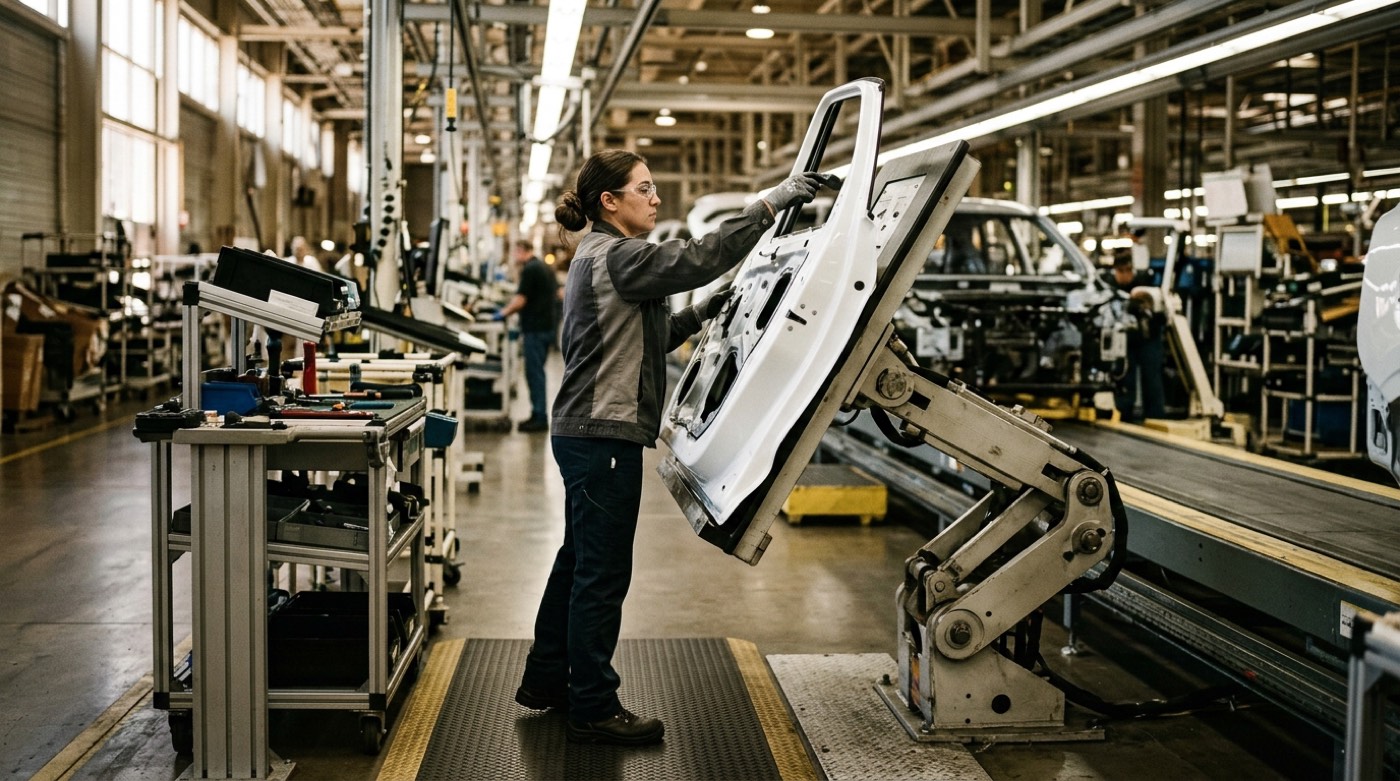
- Engineering controls (first): Set work height and reach to the task and the worker; bring the joint to the operator with tilt tables, lift assists, articulating arms, and positioners; use conveyors and manipulators to remove manual lifts; add sit-stand options so a station is not standing-only by default.
- Administrative controls: Job rotation to vary the muscle groups loaded across a shift; micro-breaks; pacing that leaves recovery time; training workers to recognize and report early symptoms before they become recordable.
- PPE and surface layers: Anti-vibration gloves for powered tools; anti-fatigue matting where a station genuinely must remain standing. Matting eases lower-limb fatigue — it does not fix a station that should have had a sit-stand option, and it is the last layer, not the assessment.
Involve the people doing the work
The most reliable ergonomic wins come from asking operators where the discomfort is. They feel the awkward reach and the too-frequent lift long before it shows up as a claim. Screen new and changed stations before they go live, re-assess after any layout change, and treat early-symptom reporting as a leading indicator worth acting on — not a complaint to manage.