The short answer: Flame-resistant floor matting is a legitimate housekeeping and fire-control layer in a weld cell — but it is one element within NFPA 51B / OSHA hot-work practice, not a code-defined product. There is no dedicated standard for a "flame-resistant welding mat," and none of the borrowed flammability tests simulate direct molten-slag impact. Read fire claims against the actual test a mat passes, and keep the mat as one part of a combustible-control program.
What slag does to an ordinary mat
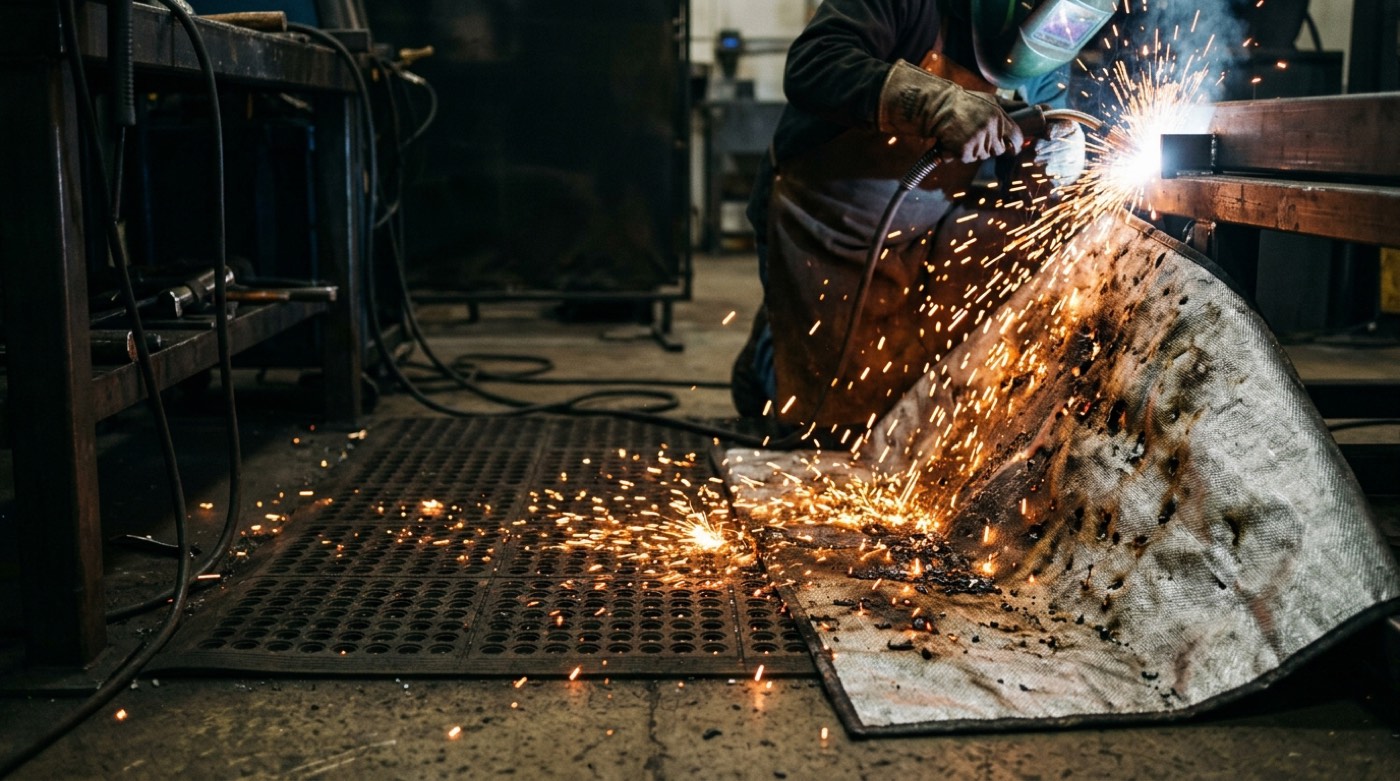
Welding spatter and grinding sparks are droplets of molten metal reaching roughly 1,650 °C (about 3,000 °F). Ordinary EVA-foam, PVC, and rubber anti-fatigue mats are combustible: that spatter melts, pits, ignites, or smoulders through them, and can produce toxic smoke. A comfort mat placed directly in the spatter zone is a fuel source, not a safeguard.
What actually governs floor protection in a weld cell
The real requirement isn't a mat spec — it's the hot-work fire-prevention rule. OSHA 1910.252(a)(2)(v) requires that where welding is done, the floor be swept clean for a 35-foot radius and that combustible floors be kept wet, covered with damp sand, or protected by fire-resistant shields. NFPA 51B carries the same duty to protect or remove combustible floors and coverings. A qualifying non-combustible or flame-resistant mat is one means of providing that "fire-resistant shield" — which is exactly how it should be framed and specified.
There is no "welding mat" standard — so read the test
Because no standard is written for slag-on-mat performance, "flame-resistant" and "self-extinguishing" mat claims lean on flammability tests borrowed from carpets, textiles, and plastics. Know which one a product actually passes:
- ASTM D2859 — the "pill test" behind the federal carpet flammability rule (16 CFR 1630); a self-extinguishing/limited-spread test designed for a dropped cigarette, not molten metal.
- ASTM E648 / NFPA 253 — critical radiant flux of floor coverings (Class I ≥ 0.45 W/cm²); a corridor fire-spread metric, not a slag test.
- UL 94 — self-extinguishing ratings for plastics (e.g., V-0); a materials test.
- EN 13501-1 — the European reaction-to-fire classification (matting often marketed at Bfl-s1); the clearest formal class the mat market cites.
None of these simulates a droplet of 1,650 °C slag landing on the mat. That gap is worth stating plainly: a mat can be genuinely "self-extinguishing per UL 94" and still degrade under direct spatter. For the spatter zone itself, the recognized protectors are leather, fiberglass, or silicone-coated fiberglass welding pads and blankets.
Use FR matting as one housekeeping control
Place flame-resistant matting where it protects a combustible floor as part of the hot-work setup, keep the immediate spatter zone covered with a rated welding pad, and remember the surrounding controls that do the heavy lifting: clear the 35-foot radius, sweep the floor, post the fire watch. The mat is a layer in that system — a useful one — not the thing that makes the cell fire-safe.