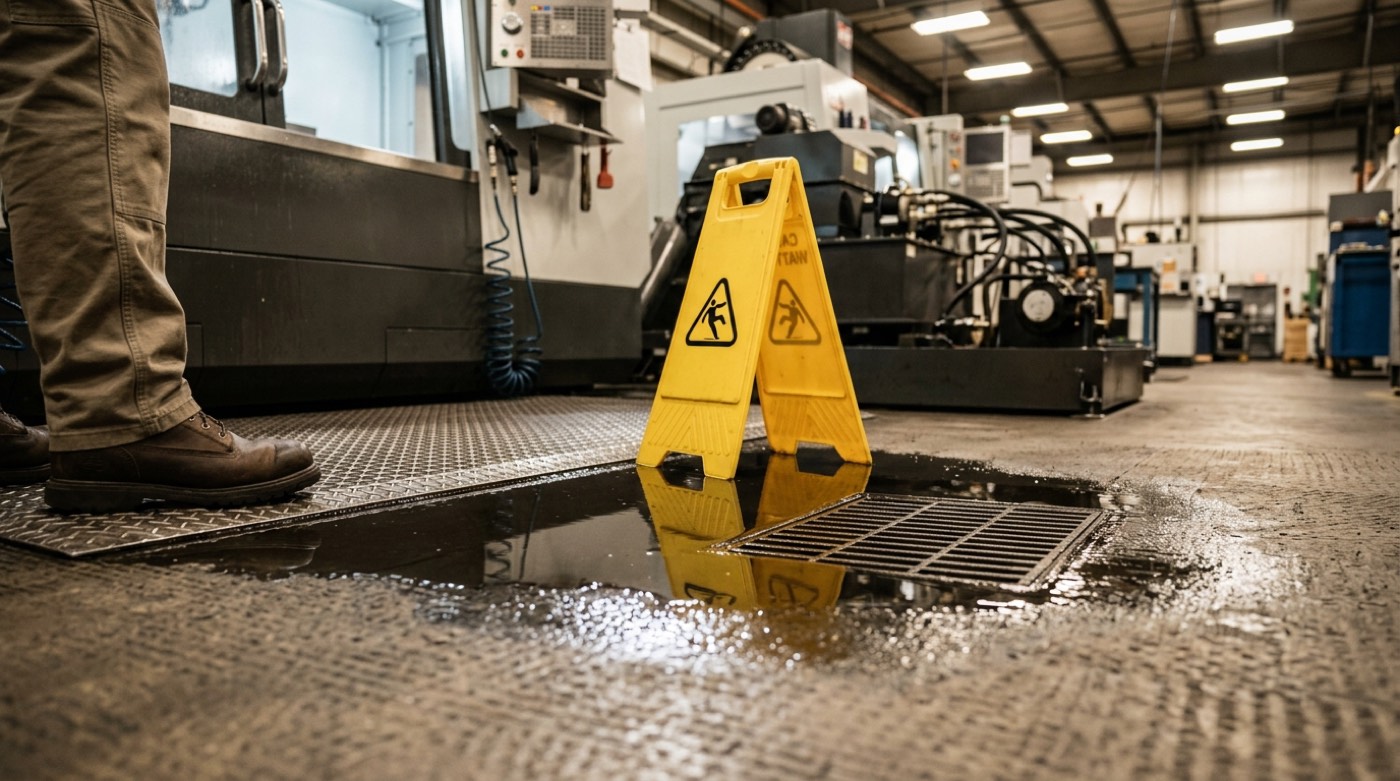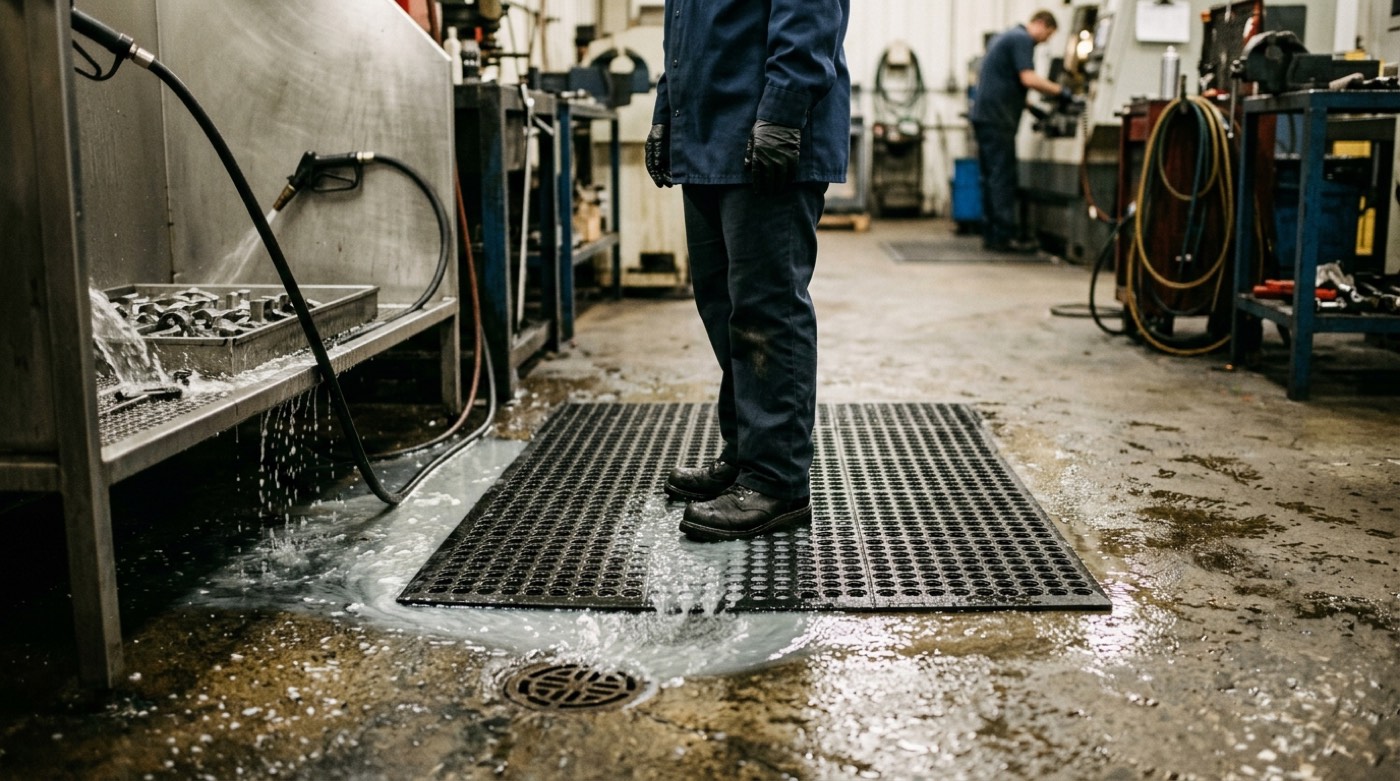
The short answer: Slip-resistant and drainage matting is a legitimate, useful control for oil, coolant, and washdown areas — but it is one control among several, sitting below drainage and spill capture in the hierarchy. OSHA references mats in 1910.22(a)(2) specifically as something provided "where practicable" alongside maintained drainage. Choose a mat by a measured wet DCOF (ANSI A326.3) in the actual contaminant, and specify an oil-resistant compound — standard rubber degrades in oil and coolant.
Where matting genuinely helps
At a fixed wet station — a coolant-fed machining cell, a parts-wash bay, a fluid-fill station — an open-grid drainage mat lets contaminated liquid fall below the standing surface so the worker's boots stay on a comparatively dry, textured tread. That is a real reduction in slip risk at exactly the spot where the floor cannot be kept dry. Matting also gives a defined, visible walking zone through a wet area, which helps with both traction and wayfinding.
Why matting is a layer, not the fix
The reason to be disciplined about this is credibility and results. OSHA's walking-working surfaces rule (29 CFR 1910.22(a)(2)) requires that where wet processes are used, drainage is maintained and dry standing places such as mats are provided where practicable. The order is deliberate: fix and contain the fluid, drain the floor, and let matting handle the residual. A washdown bay that relies on a mat while the floor pools and the leak keeps running has inverted the hierarchy — and the mat becomes a tripping edge floating on a hazard, not a control.
Specify slip resistance as a number
"Slip-resistant" means nothing until it is measured. The recognized method is ANSI A326.3, which measures the dynamic coefficient of friction in the wet condition. It sets 0.42 for surfaces walked on with water — but 0.55 for surfaces subject to oils and greases, which is the category a machining or washdown mat actually lives in. For a plant mat, insist on:
- A wet DCOF value from a recognized test — and, where possible, tested with the contaminant you actually have (oil or coolant), not just water.
- An oil/grease-resistant compound. Nitrile-based mats resist oil; natural rubber swells, hardens, and loses traction in it. A mat's slip resistance is only meaningful over the life it survives in the contaminant.
- Beveled, high-visibility edges so the mat itself doesn't become a trip hazard, and a size/anchoring that keeps it flat under traffic and cart wheels.
Maintain the mat like part of the floor
A drainage mat clogged with swarf and congealed coolant stops draining and starts holding the very fluid it was meant to shed. Put mats on the cleaning cycle: lift, clean beneath, clear the grid, and inspect for curling edges and worn tread. A mat is a control only while it is maintained — treat it as infrastructure, not a consumable you forget once it is down.