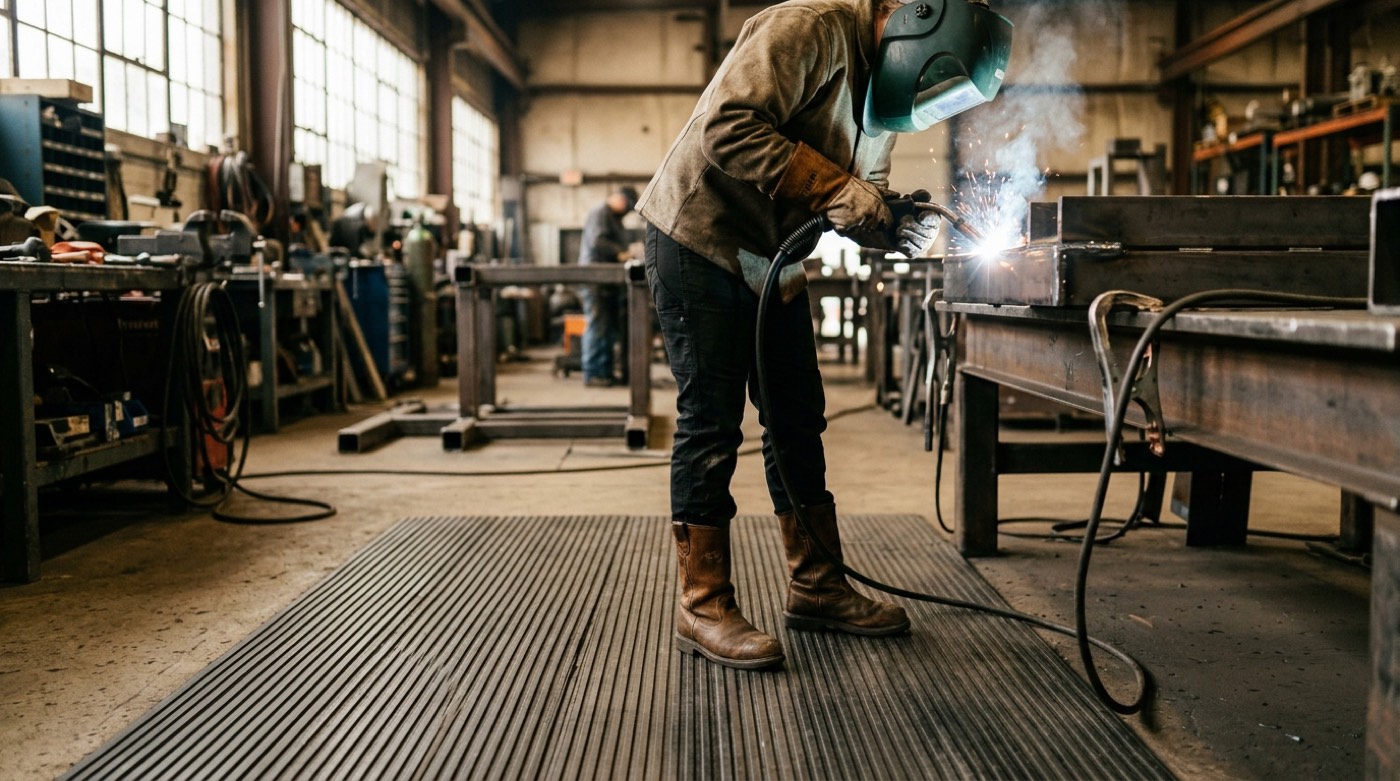
The short answer: Arc welding puts the operator in a live circuit at an open-circuit voltage typically around 20–100 V — low, until damp skin, perspiration, or contact with grounded steel drops body resistance and makes it dangerous. Insulating matting to ASTM D178 (with class-voltage ratings codified in OSHA 1910.137) is one barrier that insulates the welder from the work and ground. It sits alongside voltage-reduction design, insulated holders, and dry gloves — not ahead of them.
Why arc welding is a shock hazard
Every arc-welding circuit runs a voltage between the electrode and the work, and the welder can become part of that circuit. AWS Z49.1 is explicit that water or perspiration creates environments with increased risk of electric shock, and that cramped, kneeling, or prone positions against conductive surfaces raise the danger — because sweat and large-area contact lower the body's resistance so that even modest voltages can drive a harmful current. Open-circuit (no-load) voltage on conventional supplies runs roughly 20–100 V, commonly capped near 80 V; plasma cutting can reach much higher DC voltages.
The class-voltage system for insulating matting
Rubber insulating matting is specified by ASTM D178, and its class-to-voltage scheme is codified in OSHA 1910.137 (electrical protective equipment). The maximum-use voltages are:
- Class 00: 500 V | Class 0: 1,000 V
- Class 1: 7,500 V | Class 2: 17,000 V
- Class 3: 26,500 V | Class 4: 36,000 V
The international equivalent is IEC 61111, which uses the same maximum-use classes. ASTM D178 also distinguishes Type I from Type II (ozone-resistant) matting. For typical arc-welding voltages a Class 0 mat is well within range — but the point of the rating is that the mat is a tested dielectric barrier, not just a rubber mat, and it must be kept intact and periodically inspected and dielectrically tested, because damage voids the rating.
The mat is one control, not the primary one
AWS Z49.1 organizes shock prevention as a hierarchy, and insulating matting sits well down it:
- Design / engineering first: in higher-risk (wet, confined) conditions, voltage-reducing devices cut the no-load voltage to a safe level — Z49.1 references reducing it to roughly ≤ 38 V AC or ≤ 50 V DC.
- Equipment integrity: fully insulated electrode holders, intact cables and connections, and correct grounding of the work.
- Dry personal insulation: dry gloves and clothing, and — as CCOHS puts it — an insulating mat under the operator when working on steel or other conductive material, especially against large-area contact when sitting or prone.
An insulating mat is a supplementary barrier that catches what the higher controls miss. It does not replace a voltage-reduction device, an insulated holder, or the discipline of keeping gloves and clothing dry — and it is a different product from an ESD (static-dissipative) mat, which is designed to conduct, not insulate.