The short answer: OSHA's Control of Hazardous Energy standard (29 CFR 1910.147) requires that machines be isolated, locked, tagged, and verified at zero energy before anyone services them where unexpected start-up could cause injury. The automotive flashpoint is the minor-servicing exception — it exempts routine, repetitive tasks integral to production only if effective alternative protection is provided. Stretch it past that and a changeover becomes an amputation.
What the standard controls
29 CFR 1910.147 applies to servicing and maintenance where the unexpected energization, start-up, or release of stored energy could injure a worker. It covers all hazardous energy — electrical, mechanical, hydraulic, pneumatic, thermal, and gravitational — not just electrical. The program requirements are specific: written, machine-specific energy-control procedures; authorized-employee training; and periodic inspection of each procedure at least annually. OSHA estimates that compliance prevents roughly 120 fatalities and 50,000 injuries a year — and 1910.147 remains one of its most-cited standards, ranked #4 in FY2025, which is a fair measure of how often the basics get skipped.
The six-step sequence, applied to a changeover
- Notify affected employees the line is coming down for the change.
- Identify every energy source — drive motors, hydraulic accumulators, pneumatic clamps, servo axes, gravity-loaded tooling, and stored spring energy in dies.
- Shut down using the normal stopping procedure.
- Isolate each source at its energy-isolating device — a disconnect, valve, or block. Note that a push-button, selector switch, or control-circuit device is not an energy-isolating device under 1910.147(b).
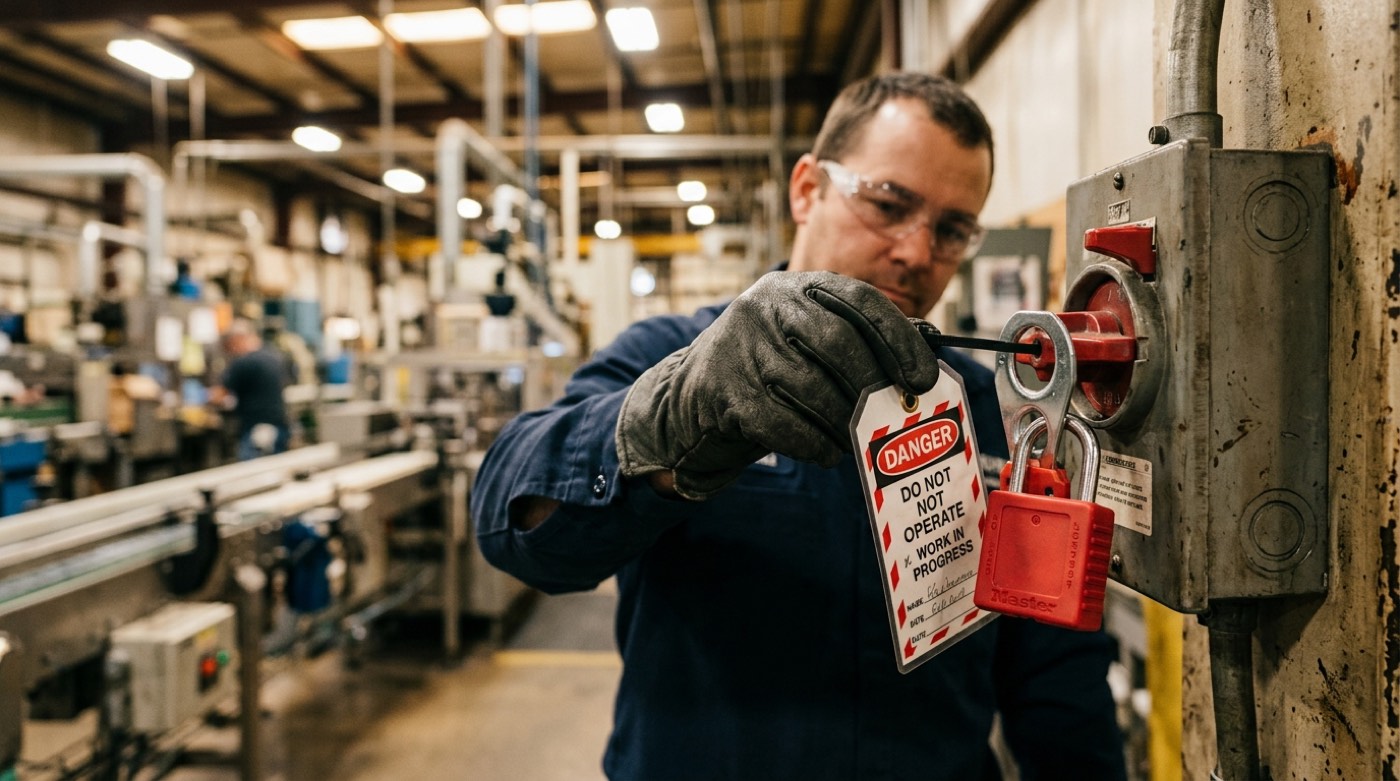
- Lock and tag each isolating device. On a multi-trade changeover, group lockout requires every authorized employee to affix a personal lock.
- Verify zero energy — try to start, bleed lines, block suspended tooling, discharge stored energy — before any hands go in.
Where the minor-servicing exception ends
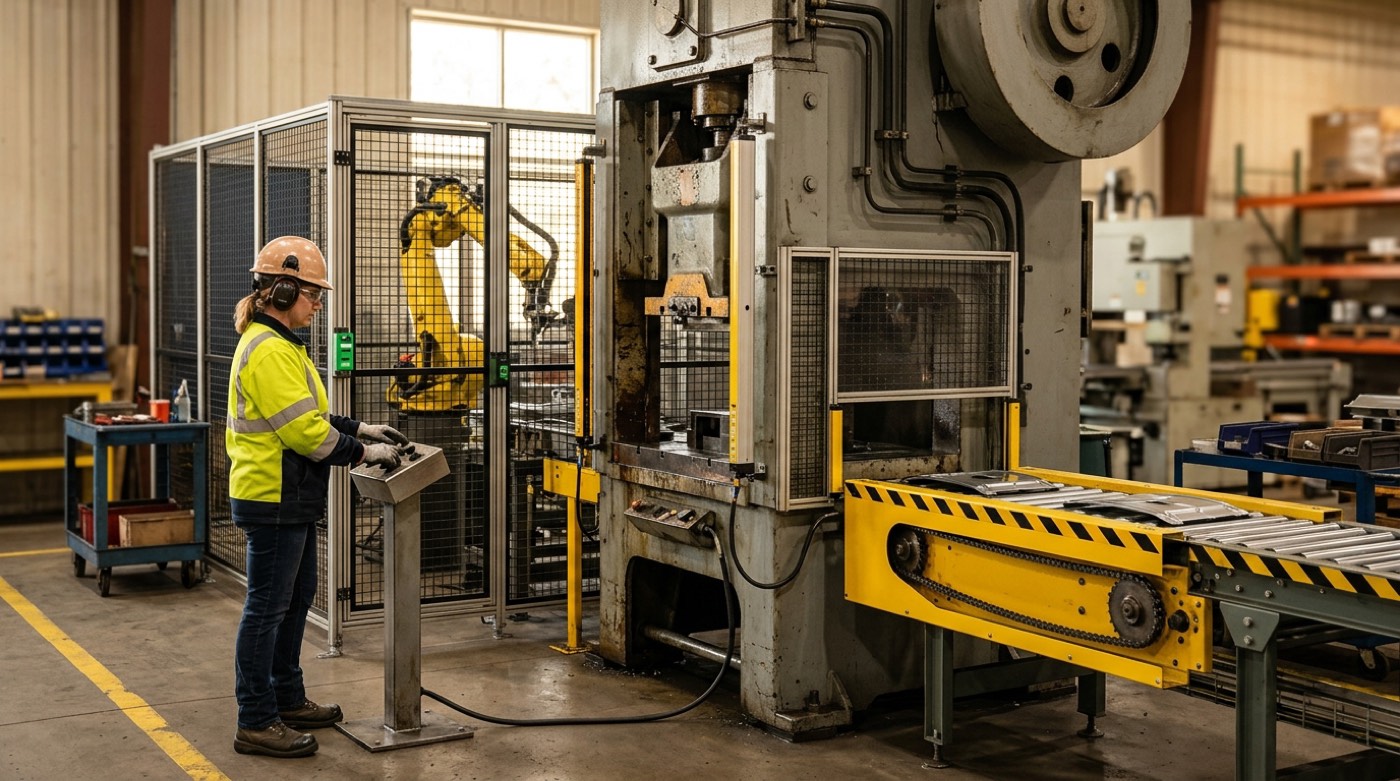
The exception at 1910.147(a)(2)(ii) exempts minor tool changes and adjustments during normal production — but only when the task is routine, repetitive, and integral to production, and is performed with alternative measures that provide effective protection (light curtains, interlocks, control-reliable safeguarding). This is the exact test an automotive changeover has to pass. A quick die adjustment behind a fixed guard with a control-reliable interlock may qualify; reaching into an unguarded press or robot cell to clear a jam does not. When the alternative protection isn't demonstrably effective, the exception does not apply — and full lockout is required.
Alternative methods, done properly
ANSI/ASSP Z244.1 formalizes risk-assessment-based "alternative methods" for tasks where full lockout is genuinely infeasible for a production task. It is a legitimate path — but it is a documented, risk-assessed engineering solution, not an excuse to skip isolation. Most changeover incidents trace back to a task that was treated as "minor" without the effective protection the exception actually requires.