The short answer: Welding fume from stainless and high-chrome steel carries hexavalent chromium — a regulated lung carcinogen with an OSHA permissible exposure limit of 5 µg/m³ (action level 2.5 µg/m³) — and manganese, a neurotoxin. The control hierarchy is clear: source-capture ventilation first, position the head out of the plume, and use respiratory protection under OSHA 1910.134 for the exposure that remains. In 2017 IARC classified welding fume as a Group 1 human carcinogen.
What's actually in the plume
Welding vaporizes metal that re-condenses as ultrafine particles small enough to reach deep into the lungs. The specific hazards depend on the base metal and consumable:
- Hexavalent chromium — Cr(VI): generated welding stainless and chrome alloys; a lung carcinogen. OSHA's substance-specific standard 1910.1026 sets a PEL of 5 µg/m³ (8-hour TWA) and an action level of 2.5 µg/m³ that triggers monitoring and medical surveillance. NIOSH's recommended limit is far lower at 0.2 µg/m³, and OSHA estimated roughly 558,000 U.S. workers are exposed to Cr(VI).
- Manganese: chronic overexposure causes "manganism," a Parkinson-like neurological condition. ACGIH lowered its threshold limit value in 2013 to 0.02 mg/m³ respirable (0.1 mg/m³ inhalable) — well below OSHA's older 5 mg/m³ ceiling, a gap worth understanding when you set your own targets.
- Iron oxide and other metal fumes, covered by OSHA's air-contaminant table (iron oxide fume PEL 10 mg/m³).
In 2017 the International Agency for Research on Cancer (IARC) reclassified welding fumes and UV radiation from welding as Group 1 — carcinogenic to humans, which removed any remaining ambiguity about the stakes.
Ventilation before respirators
The controlling principle in both OSHA and the AWS ventilation guidance (AWS F3.2) is to remove the fume before it reaches the welder, not to filter it at the face after the fact:
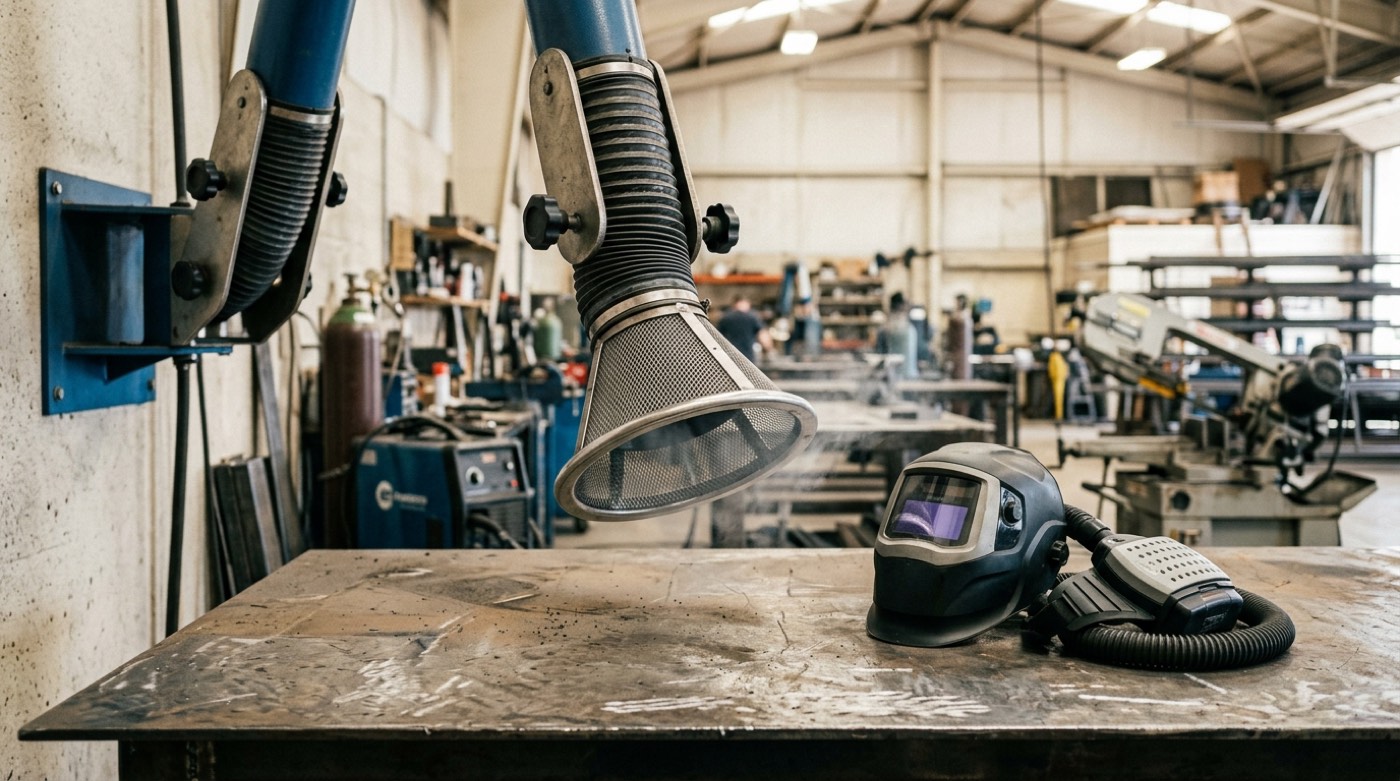
- Source-capture local exhaust ventilation (LEV) — a hood, fume gun, or on-torch extraction capturing fume at the arc — is the preferred engineering control.
- Substitution — a lower-fume process or consumable — reduces the hazard at the source.
- Position and posture — keeping the head out of the rising plume is a free, immediate reduction.
- General/dilution ventilation is a weaker backstop, and OSHA 1910.252 specifically requires mechanical ventilation for confined spaces and for hazardous coatings and alloys.
Respiratory protection covers the remainder
Where LEV can't get exposures below the limit, respirators are required — but as the last layer, governed by OSHA 1910.134. That standard requires a written respiratory-protection program with nine elements: respirator selection, medical evaluation, fit testing, use procedures, cleaning and maintenance, breathing-air quality for supplied-air, training on hazards, training on use, and program evaluation — all at no cost to the worker. A respirator handed out without that program behind it is not compliance; it's a false sense of security.